

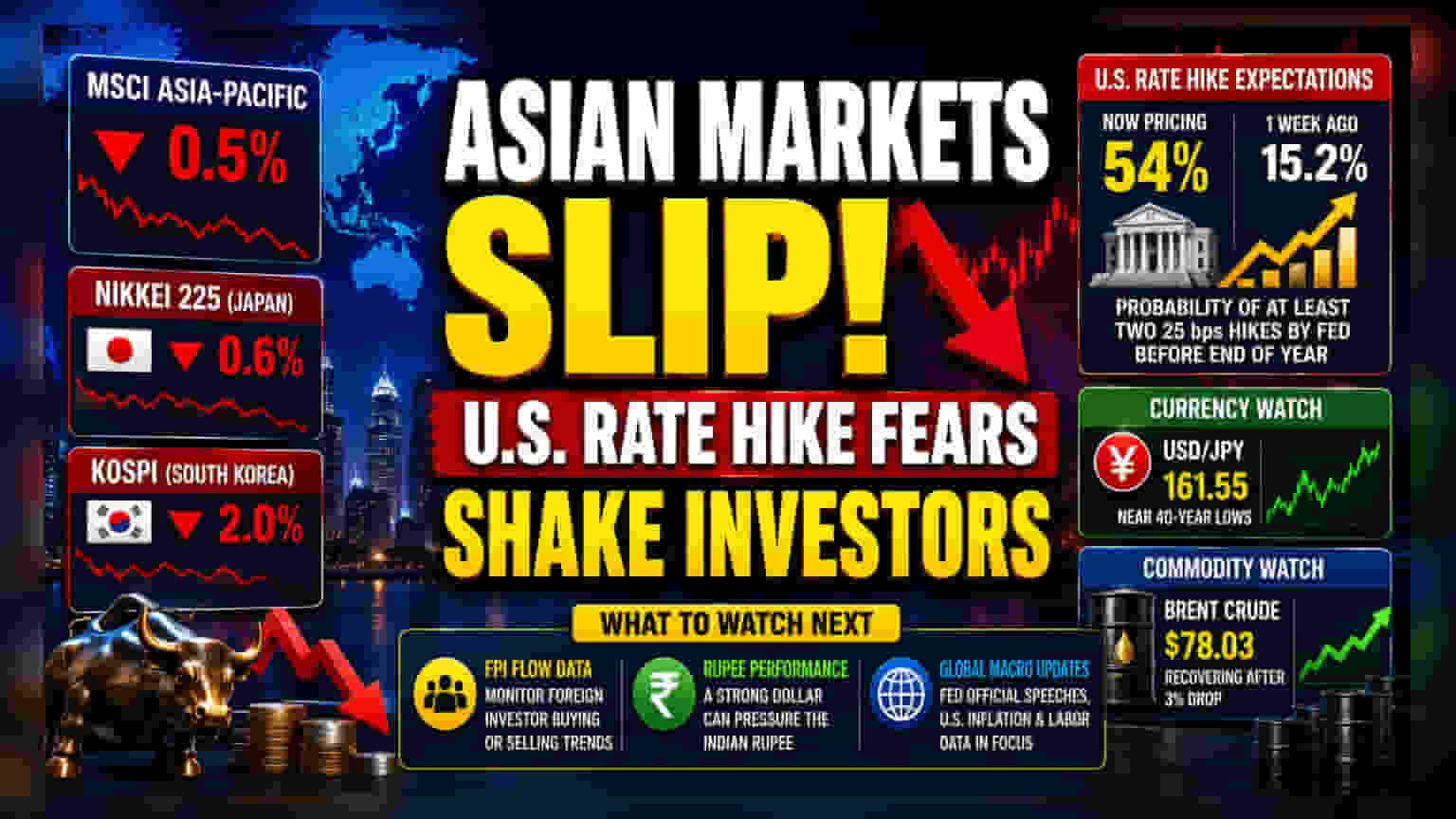
Asian stock markets declined on Tuesday after traders sharply increased the probability of upcoming US Federal Reserve interest rate hikes to 54%. The shift in global monetary expectations has pressured regional currencies and equity indices. Indian investors may watch for potential volatility in foreign institutional flows and the rupee's performance against the US dollar amid this global macro shift.
What Happened
Asian stock markets faced selling pressure on Tuesday as investors reacted to a significant shift in expectations for U.S. monetary policy. The MSCI Asia-Pacific index fell by 0.5% following news that traders are now pricing in a 54% probability of at least two 25-basis-point interest rate hikes by the Federal Reserve before the end of the year. This is a marked increase from the 15.2% probability seen just one week ago. In Japan, the Nikkei 225 index declined 0.6%, while South Korean shares fell 2%, reflecting the broader caution across the region.
Why This Matters For Indian Investors
For Indian investors, shifts in U.S. interest rate policy are significant because they influence global liquidity and foreign portfolio investment (FPI) flows. When the U.S. Federal Reserve signals a 'higher-for-longer' interest rate stance, U.S. Treasury yields typically rise, making dollar-denominated assets more attractive to global investors.
This can lead to a reversal in capital flows, where foreign investors may reduce their exposure to emerging markets like India to shift funds into safer, higher-yielding U.S. assets. Additionally, a stronger U.S. dollar often puts pressure on the Indian rupee, which can increase the cost of imports—particularly oil—and potentially lead to imported inflation. Investors typically watch these macro trends because they can dictate the short-term sentiment for Nifty and Sensex indices, regardless of domestic company performance.
The Currency And Commodity Picture
Currency markets are also feeling the heat. The Japanese yen, a key indicator of risk sentiment in Asia, traded at 161.55 against the U.S. dollar, hovering near 40-year lows. Significant weakness in the yen often signals broader uncertainty in Asian forex markets, which can indirectly weigh on the Indian rupee as investors seek the safety of the greenback.
Meanwhile, oil prices showed a recovery, with Brent crude rising to $78.03 per barrel. While higher oil prices are generally a headwind for the Indian economy—given India's heavy reliance on energy imports—the current recovery follows a sharp 3% drop, suggesting continued volatility in energy markets.
What To Watch Next
Investors may monitor a few key developments in the coming sessions:
- Foreign Institutional Flow Data: Watch for net buying or selling trends by foreign investors in the Indian equity market, which often react quickly to changes in U.S. rate expectations.
- Rupee Performance: A sustained rise in the dollar index could pressure the rupee, which is a factor that often influences RBI monetary policy and corporate input costs.
- Global Macro Updates: Any upcoming commentary from Federal Reserve officials or new U.S. labor and inflation data will remain the primary drivers of these market expectations.