 Whalesbook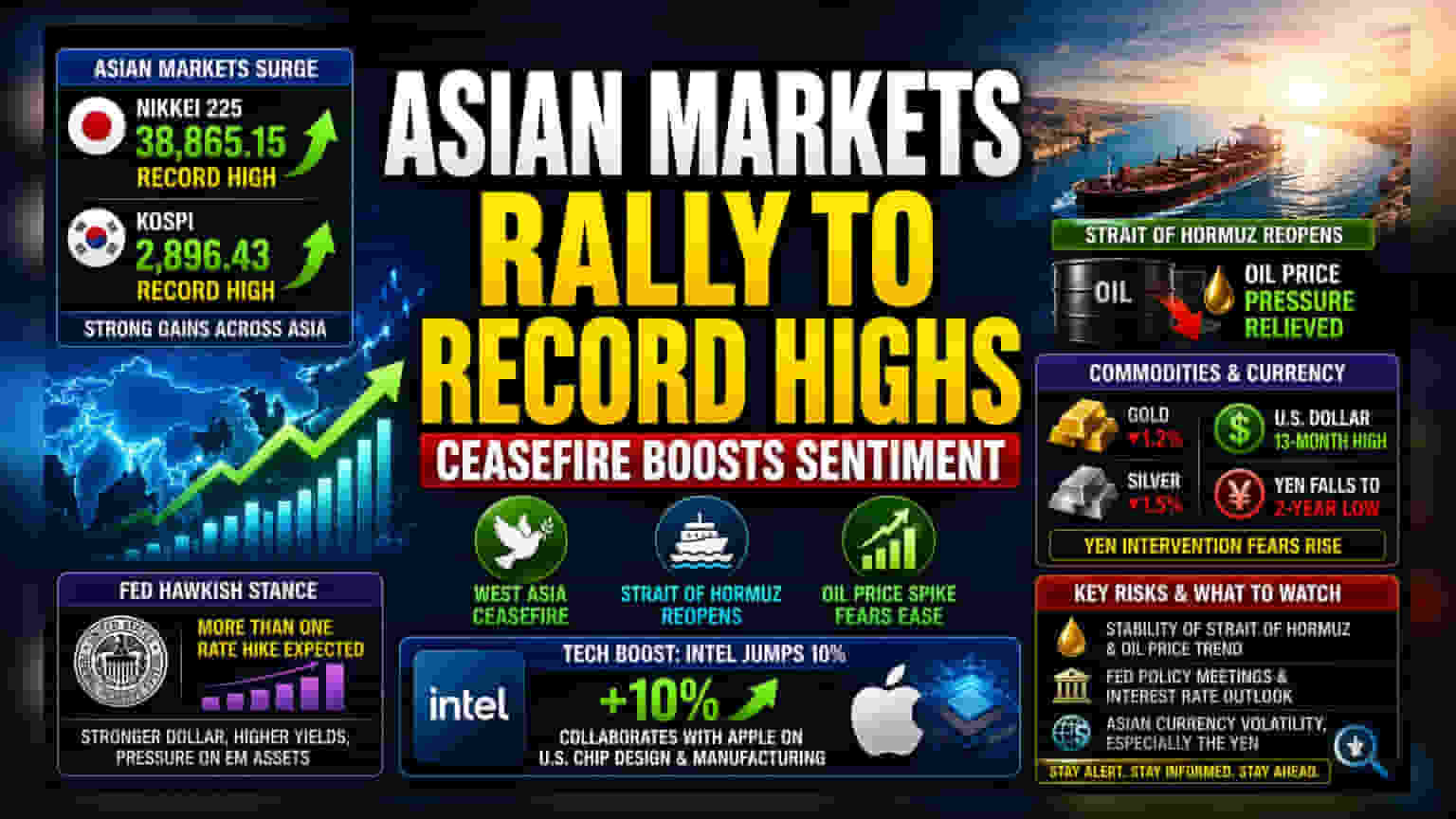
Asian stock markets soared to record levels following a truce in West Asia that reopened the Strait of Hormuz, easing global oil price concerns. While regional indices like the Nikkei and KOSPI climbed, global investors remain focused on a strong U.S. dollar and the Federal Reserve’s signals on potential interest rate hikes. This mix of geopolitical relief and looming rate pressure is shifting global market dynamics.
What Happened
Asian equity markets experienced a major boost on Friday, with key indices including Japan’s Nikkei and South Korea’s KOSPI hitting record highs. The optimism was primarily driven by a newly announced ceasefire in West Asia. This agreement led to the lifting of the U.S. blockade on Iran and the official reopening of the Strait of Hormuz, a vital route for international oil transport. The resolution of this geopolitical friction has helped lower expectations for oil price spikes, providing immediate relief to global markets.
Why This Matters For Investors
The market reaction is currently driven by two competing forces. On the positive side, the reopening of the Strait of Hormuz has reduced immediate supply chain and energy price anxieties. This is a relief for energy-importing economies across Asia. However, investors are also balancing this relief against a stronger U.S. dollar. The U.S. Federal Reserve has recently signaled a tougher stance on interest rates, with expectations of more than one rate hike within the year. A stronger dollar often puts pressure on emerging market currencies and can increase borrowing costs globally.
Impact on Commodities and Currencies
As the U.S. dollar climbed to a 13-month peak, other assets faced downward pressure. Gold and silver prices declined, as investors typically move away from these non-yielding assets when the dollar and interest rate expectations rise. Meanwhile, the Japanese yen fell to a two-year low, leading to market speculation that Japanese authorities might intervene to support the currency’s value and stabilize the local market. The yield curve, which shows the difference between short-term and long-term interest rates, flattened as short-term yields rose, reflecting investor anticipation of the Federal Reserve’s future moves.
Technology and Corporate News
Beyond the macroeconomic shifts, the tech sector saw significant movement. Intel’s stock rose by 10% following an announcement that it would collaborate with Apple on new chip design and manufacturing in the United States. For investors, this marks a notable development in the semiconductor space, highlighting potential shifts in manufacturing partnerships and domestic tech production capabilities.
Risks and Market Uncertainties
While the market sentiment is currently positive due to the truce, there are lingering questions. Analysts have pointed out that despite the reopening of the Strait of Hormuz, there is uncertainty regarding Iran’s future control over the region. There are concerns that the implementation of 'maritime service' fees could still affect the cost and freedom of international shipping. Furthermore, the Federal Reserve’s hawkish stance remains a significant risk factor; if interest rates rise faster than expected, it could temper the recent gains in equity markets by making capital more expensive.
What Investors Should Track
Going forward, investors may want to monitor several key indicators. First, the stability of the Strait of Hormuz remains a critical watch point for oil prices. Second, the U.S. Federal Reserve’s upcoming policy meetings and commentary will be vital for understanding the path of interest rates and the dollar. Finally, currency volatility in Asia, particularly the yen, will be important for those tracking emerging market risk and the overall strength of the U.S. dollar.

