

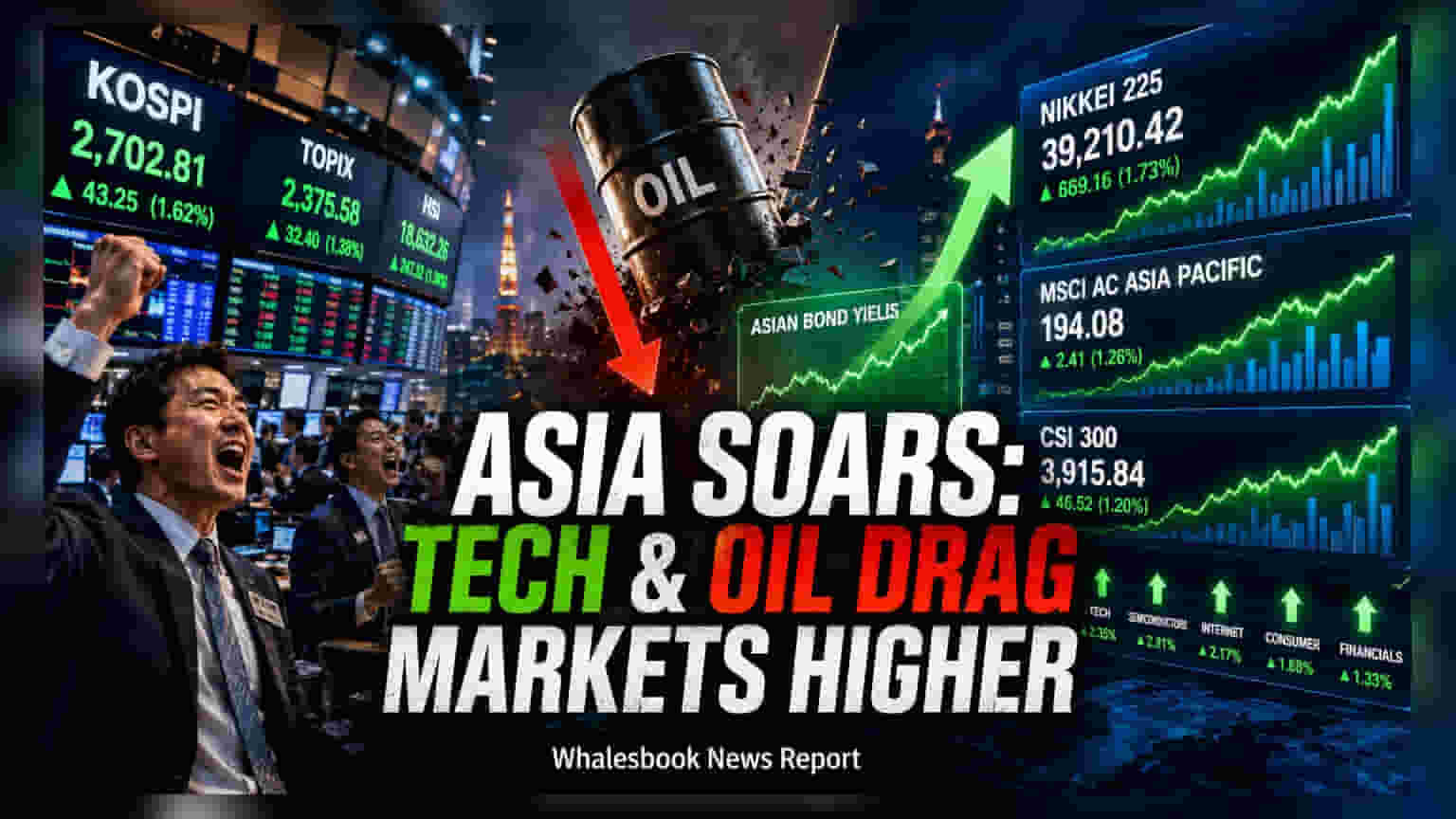
Asian markets rose on Wednesday, with the MSCI Asia-Pacific index gaining 1.9% on improved investor sentiment and lower oil prices. While regional indices saw broad growth, shares of tech giants AMD and SpaceX fell sharply after reports highlighted high costs and profit-taking. Investors are now balancing optimism over AI growth against the financial strain of large-scale infrastructure investments.
Asian stock markets showed strong growth on Wednesday, August 5, 2026, as investors reacted positively to record-breaking performances on Wall Street. The broader MSCI Asia-Pacific index rose by 1.9%, with specific strength seen in major regional markets. Japan's Nikkei index climbed 3.0%, and South Korea's Kospi jumped 4.2%. This upward trend was largely driven by a combination of strong earnings reports from the technology sector and a cooling in global inflation fears.
The market mood was further helped by a decline in energy prices. Brent crude oil prices softened to around $79 a barrel, supported by reports of potential progress in mediation efforts regarding the Strait of Hormuz. This retreat from recent peaks reduced pressure on inflation, leading to a rally in government bonds. The yield on the 10-year Treasury, a key benchmark for borrowing costs, eased to 4.6187%. This drop in yields has helped lower expectations for further interest rate hikes by the Federal Reserve, providing a more stable environment for equity investors.
Despite the general rally, some technology stocks faced a difficult session as investors reacted to company earnings. Advanced Micro Devices (AMD) saw its share price drop by approximately 9% in after-hours trading. This decline occurred even though the company reported earnings that were better than market forecasts. For many investors, this appears to be a case of 'selling the news,' where traders take profits immediately after a positive earnings release rather than holding for further gains. This reaction suggests that market participants are becoming more cautious about the high valuations of tech stocks.
SpaceX shares also experienced a setback, falling 7.5% following its latest earnings update. A significant factor behind this move was investor concern over the company's capital spending. The group reported high costs related to its AI infrastructure, totaling $18.4 billion. For investors, this level of spending creates uncertainty about cash flow, as high compute power costs can squeeze profit margins. While the company continues to expand its AI and satellite communication business, the market is signaling that it will prioritize evidence of financial efficiency alongside revenue growth.
Looking ahead, market participants will monitor whether the decline in oil prices is sustained, as this will play a key role in central bank policy decisions. Investors will also continue to watch how technology companies balance the need for massive investment in AI infrastructure with the requirement to protect profit margins and free cash flow. Geopolitical developments in the Strait of Hormuz remain an important factor for energy stability, which could influence market volatility in the coming days.