 Whalesbook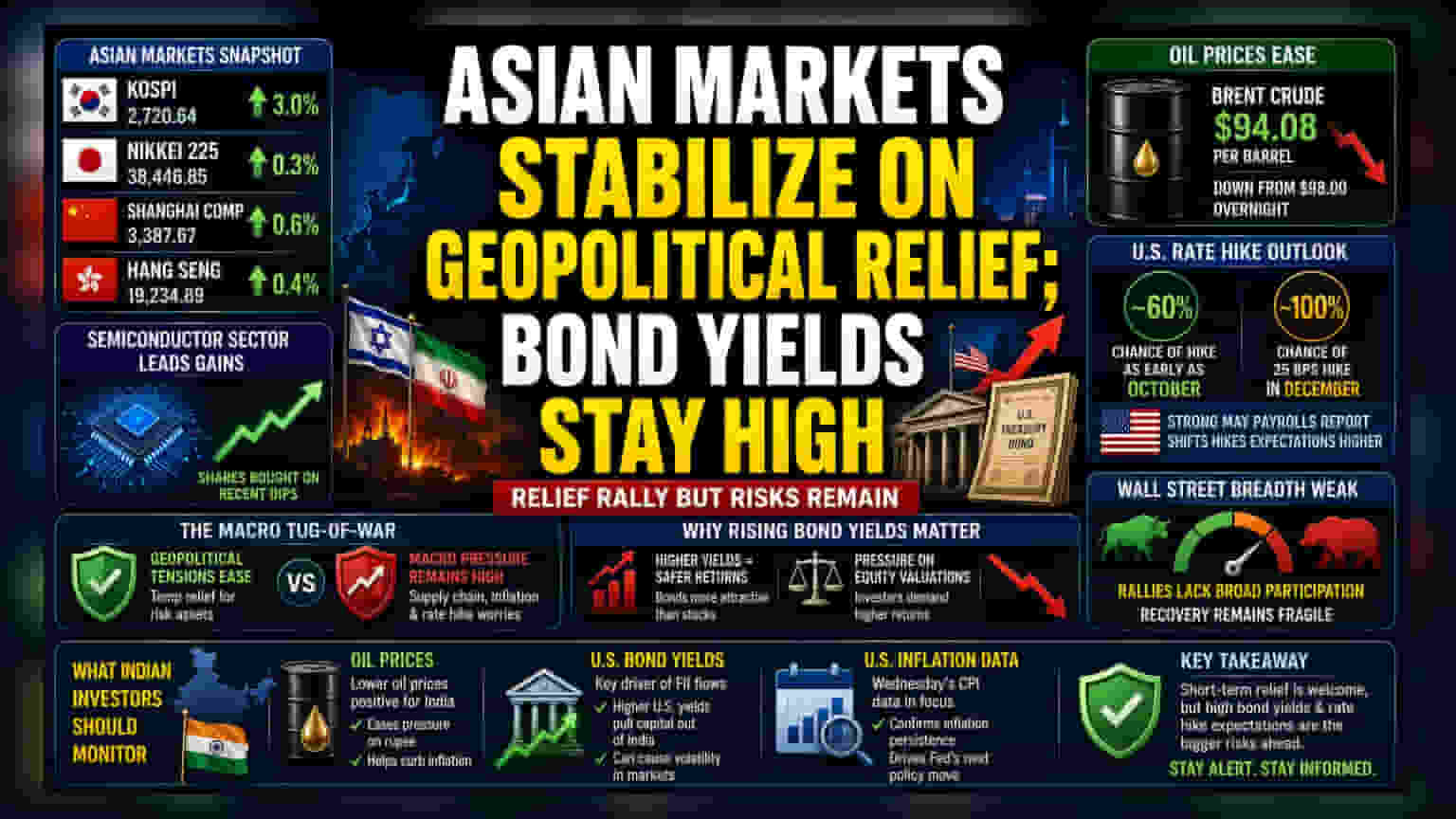


What Happened
Asian stock markets attempted to stabilize on Tuesday, June 9, as geopolitical tensions between Israel and Iran showed signs of de-escalating. This news provided temporary relief to investors, with Brent crude prices retreating to $94.08 a barrel after touching $98.00 overnight. In response, investors showed some appetite for risk, particularly in the semiconductor sector, where shares were bought following recent price dips. Regional indices showed varied performance, with South Korea’s KOSPI rising 3.0% and Japan’s Nikkei 225 gaining 0.3%.
The Macro Tug-of-War
While the easing of geopolitical conflict offered a reprieve, the broader market outlook remains cautious. Global investors are facing a tug-of-war between short-term geopolitical relief and long-term macroeconomic pressure. Although oil prices eased, concerns about supply chain disruptions, particularly regarding shipping routes through the Strait of Hormuz, continue to keep traders on edge. Furthermore, trading patterns on Wall Street showed that even when major indices rose, the number of stocks participating in the rally was limited, suggesting that the current recovery is fragile and not broad-based.
Why Rising Bond Yields Matter
For investors, the most significant risk right now is not the conflict, but the bond market. Yields on government bonds remain high, driven by concerns over sticky inflation and the potential for more interest rate hikes by global central banks. When bond yields are high, they become a more attractive and safer alternative to stocks. This puts pressure on equity valuations, as investors demand higher returns to justify the risk of holding shares. If bond yields continue to climb, it could dampen the appeal of riskier assets across global markets, including emerging markets.
The US Rate Hike Outlook
Market expectations regarding US interest rates have shifted significantly following a strong May payrolls report. Investors are now factoring in a higher probability of further rate hikes by the Federal Reserve, with the market pricing in a roughly 60% chance of an increase as early as October and a near-certainty of a 25 basis point hike in December. This change in outlook is a key reason for the current market uncertainty. Investors are now anxiously awaiting Wednesday's US consumer price data, which is expected to confirm that inflation remains a persistent challenge, largely due to energy costs.
What Indian Investors Should Monitor
Indian investors should closely watch how these global cues filter down to the local market. First, oil prices are a major monitorable. As India is a net importer of crude oil, a decline in prices is generally positive, as it helps ease pressure on the rupee and domestic inflation. Second, the movement in US bond yields is a critical indicator for Foreign Institutional Investor (FII) flows. When US yields are high, capital often moves out of emerging markets like India and back into US assets, which can cause volatility in domestic stock prices. Finally, keeping an eye on the upcoming US inflation data is essential, as it will likely determine the Federal Reserve's next policy moves and, by extension, the direction of global market sentiment.