 Whalesbook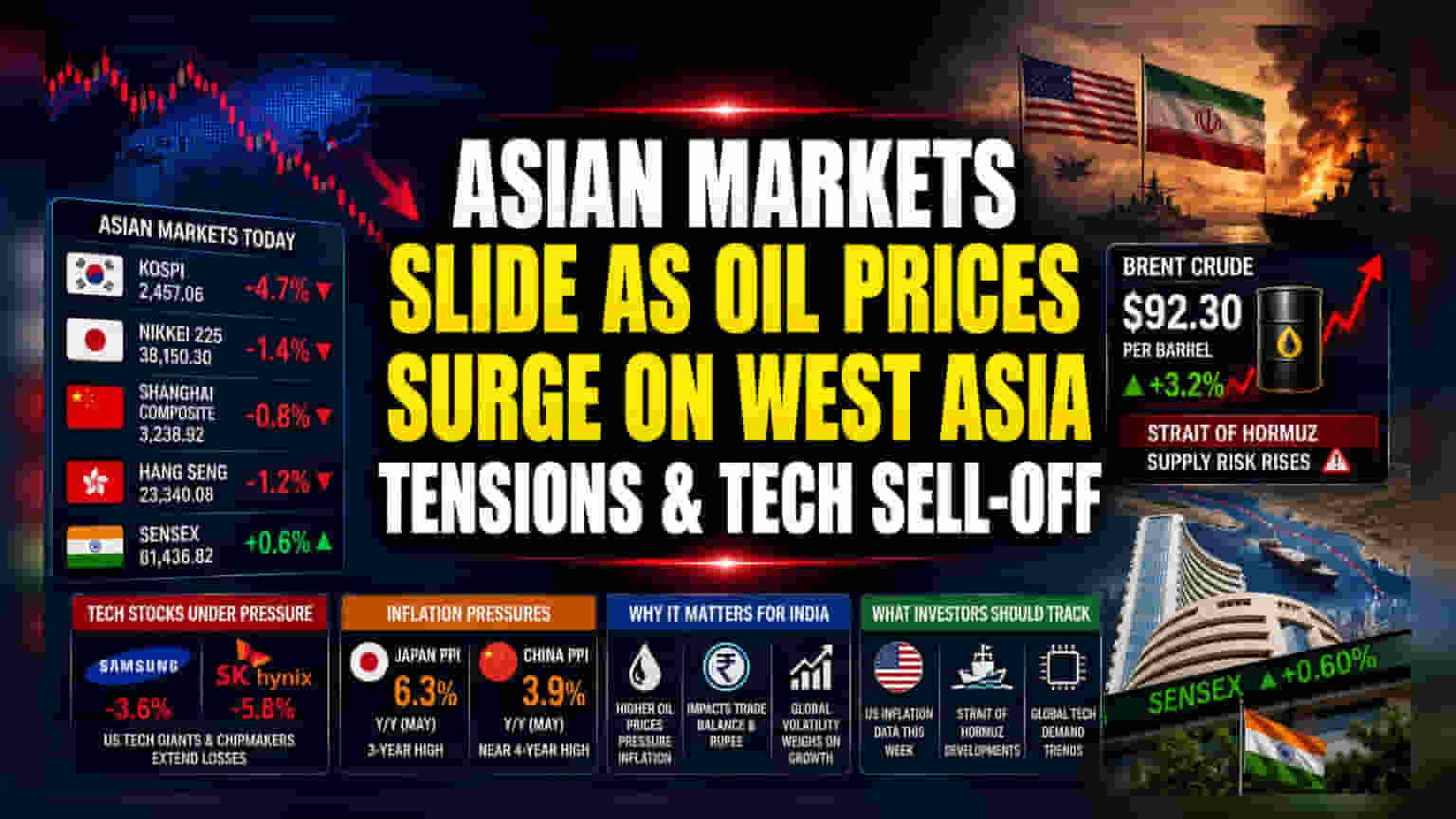


Asian stock markets declined on Wednesday as a global tech sell-off and rising oil prices—driven by US-Iran geopolitical tensions—hurt investor sentiment. While indices like the Kospi and Nikkei saw notable drops, India’s Sensex bucked the trend with a gain of 0.6%. Investors are now watching global energy prices and upcoming US inflation data for future market cues.
What Happened
Asian stock markets faced selling pressure on Wednesday, largely driven by a sharp decline in technology shares and rising geopolitical tensions in West Asia. Following a broader tech sell-off on Wall Street, major regional indices, including South Korea’s Kospi and Japan’s Nikkei 225, saw significant losses. Tensions escalated after US military actions in the region led to a vow of retaliation from Iran, causing an immediate spike in energy prices. Brent crude, the global benchmark, rose to $92.30 per barrel, heightening concerns about supply chain stability through the critical Strait of Hormuz.
Why This Matters For Indian Investors
For Indian investors, the rise in global oil prices is a key development to watch. As India is a major importer of crude oil, sustained high prices can put pressure on the country's trade balance and potentially influence domestic inflation. While the Sensex managed a 0.6% gain today, showing some resilience against the regional downturn, the broader global sentiment remains fragile. Persistent geopolitical conflict in West Asia could lead to prolonged volatility in energy markets, which often acts as a headwind for the Indian economy and currency.
Tech Sector Sensitivity
The technology sector remains under close watch globally. Major Asian firms such as Samsung Electronics and SK Hynix reported significant declines in their share prices, tracking the negative sentiment seen in US tech giants and chipmakers like Micron and AMD. This global sell-off in AI-related and hardware stocks can influence sentiment toward Indian IT companies, even if the domestic business fundamentals remain different. Investors often track these global peers to gauge shifts in demand and capital allocation within the tech space.
Regional Market Divergence
The performance across Asian markets was mixed on Wednesday. While the Kospi dropped 4.7% and the Nikkei 225 fell 1.4%, other regions showed varying levels of impact. Japan’s producer price index, a measure of wholesale inflation, climbed 6.3% year-on-year in May, hitting a three-year high. Similarly, China reported a 3.9% rise in producer prices, nearing a four-year peak. These inflationary pressures, combined with the geopolitical uncertainty, are forcing investors to reconsider their positions in riskier assets.
What Investors Should Track Next
Looking ahead, the most critical monitorable for investors is the upcoming US inflation data, which is expected later this week. This report will be essential in helping the market understand the trajectory of interest rates and global economic health. Additionally, investors may continue to track the situation in the Strait of Hormuz, as any further disruption to oil flow could cause additional price volatility. While the Sensex has shown strength, the interplay between energy costs, global tech demand, and inflationary pressures will likely dictate the market mood in the coming sessions.