 Whalesbook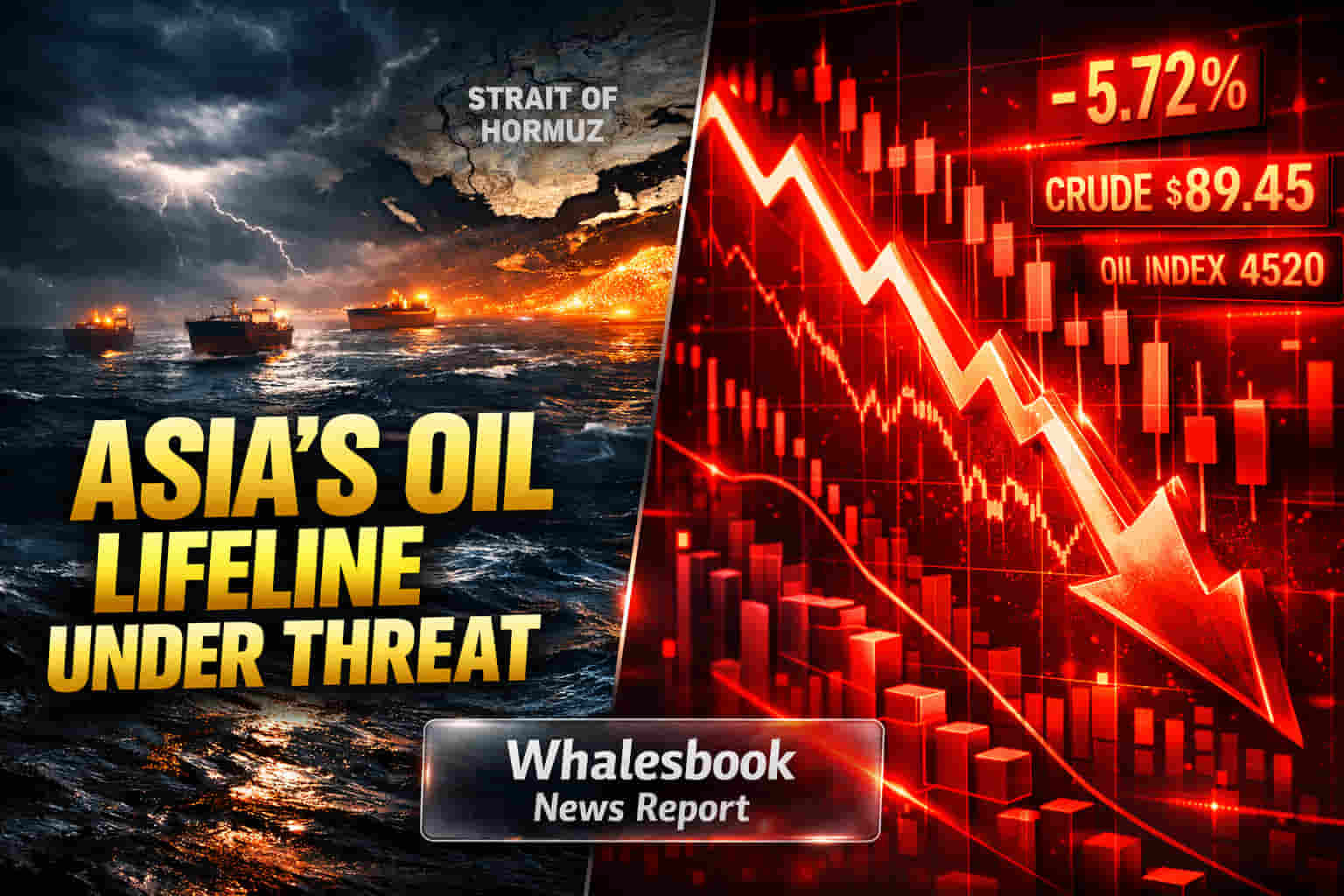
### The Core Catalyst: Geopolitical Shockwaves Grip Global Markets
Escalating conflict in the Middle East has sent shockwaves through global financial markets, driving oil prices to multi-month highs and sending Asian equities into a downturn. Brent crude futures jumped significantly, trading above $77 per barrel on Monday, March 2, 2026, a stark increase from Friday's closing price of approximately $72.87 per barrel. This price surge follows coordinated strikes by the United States and Israel on Iran, and retaliatory actions including missile barrages across the region. The reported death of Iran's Supreme Leader Ayatollah Ali Khamenei has further intensified geopolitical risk premia across asset classes.
Markets responded with a decisive risk-off sentiment. Asian stock markets broadly declined, with Japan's Nikkei 225 falling by as much as 2.4% and Hong Kong's Hang Seng Index seeing losses of over 1.7%. Conversely, traditional safe-haven assets saw significant gains. Gold prices rose by as much as 2.8%, reaching $5,397 per ounce, while the US dollar strengthened against major Asian currencies, reflecting heightened investor caution. Reports of attacks on vessels in the Strait of Hormuz and surrounding waters have amplified concerns over supply chain integrity.
### The Analytical Deep Dive: Asia's Precarious Energy Dependence
Asia's advanced economies are particularly vulnerable to the immediate economic fallout from Middle East instability. The region's high-income economies, including Japan, South Korea, Taiwan, Singapore, and Hong Kong, import over 80% of their energy needs [cite: Original Source]. Moody's Analytics highlights that Asia is disproportionately exposed as it absorbs the lion's share of Middle East oil and gas exports, with roughly a third of global seaborne crude oil and approximately 20% of liquefied natural gas shipments passing through the critical Strait of Hormuz. In 2024, an estimated 84% of oil and 83% of LNG moving through the Strait were destined for Asian markets, with China, India, Japan, and South Korea being the primary recipients.
This reliance creates a direct inflationary channel. Higher energy and food prices are anticipated to fuel consumer and producer inflation across the region. Such a scenario could compel central banks, many of whom were anticipating or already engaged in rate cut cycles, to pause or even reverse course. For instance, the Bank of Japan is expected to maintain its policy rate in March, though future actions remain under scrutiny amidst global volatility. The Bank of Korea, facing a weaker won, is also expected to hold rates steady. The Eurozone, while having reduced its reliance on Middle Eastern LNG in favor of US imports since the Ukraine conflict, remains sensitive to energy price spikes, potentially complicating the European Central Bank's already stable policy path. The United States, as a net energy exporter, is comparatively less exposed but not immune to inflationary pressures.
Historical precedent illustrates the immediate impact of such disruptions. During past oil price shocks, such as the 2021-2022 energy crisis, energy costs significantly drove inflation in Europe, Asia, and the US. The Strait of Hormuz's strategic importance cannot be overstated; it is a vital chokepoint for approximately 20% of global oil consumption, and even temporary disruptions lead to increased shipping costs, insurance premiums, and price volatility. Moreover, disruptions in other key trade corridors like the Red Sea compound these supply chain risks [cite: Original Source].
### ⚠️ THE FORENSIC BEAR CASE: Structural Weaknesses and Renewed Debt Pressures
The current geopolitical crisis exacerbates pre-existing structural vulnerabilities for many Asian economies. Advanced economies face a direct hit to import bills, potentially widening trade deficits. For emerging Asian economies, the risk of renewed external debt challenges is significant. The inflationary pressures stemming from rising energy and food prices, similar to those seen following Russia's invasion of Ukraine, could reignite sovereign debt concerns in countries like Sri Lanka, Bangladesh, and Pakistan [cite: Original Source].
While OPEC+ nations have agreed to a modest production increase of 206,000 barrels per day for April, this is widely viewed as insufficient to offset a full-scale disruption, especially given logistical challenges in transporting product out of conflict zones. The industry is currently grappling with a slowdown in shipping activity via the Strait of Hormuz due to insurability issues rather than an outright blockade, leading several major tanker owners and oil majors to suspend shipments. The conflict, coupled with the reported death of Iran's Supreme Leader, escalates the risk of prolonged instability. US President Donald Trump has indicated that military operations could continue for several more weeks, further embedding a geopolitical risk premium into oil prices. The potential for wider regional conflict also remains a significant overhang, particularly for countries hosting US military forces [cite: Original Source].
### The Future Outlook: Navigating Uncertainty and Inflationary Headwinds
Global inflation forecasts for 2026, which generally anticipated a moderation to around 2.8%, now face significant upward revision due to the Middle East conflict. The immediate outlook for oil prices points to continued volatility, with analysts predicting Brent crude could trade between $90 and $115 per barrel, or even higher in severe escalation scenarios. This elevated energy cost environment poses a substantial challenge for global economic recovery, potentially dampening demand and creating a tightrope walk for central banks balancing inflation control with growth support. The sustained rise in geopolitical risk premia suggests that markets will remain sensitive to any further developments in the region, impacting currency valuations and investment flows across Asia and beyond.