 Whalesbook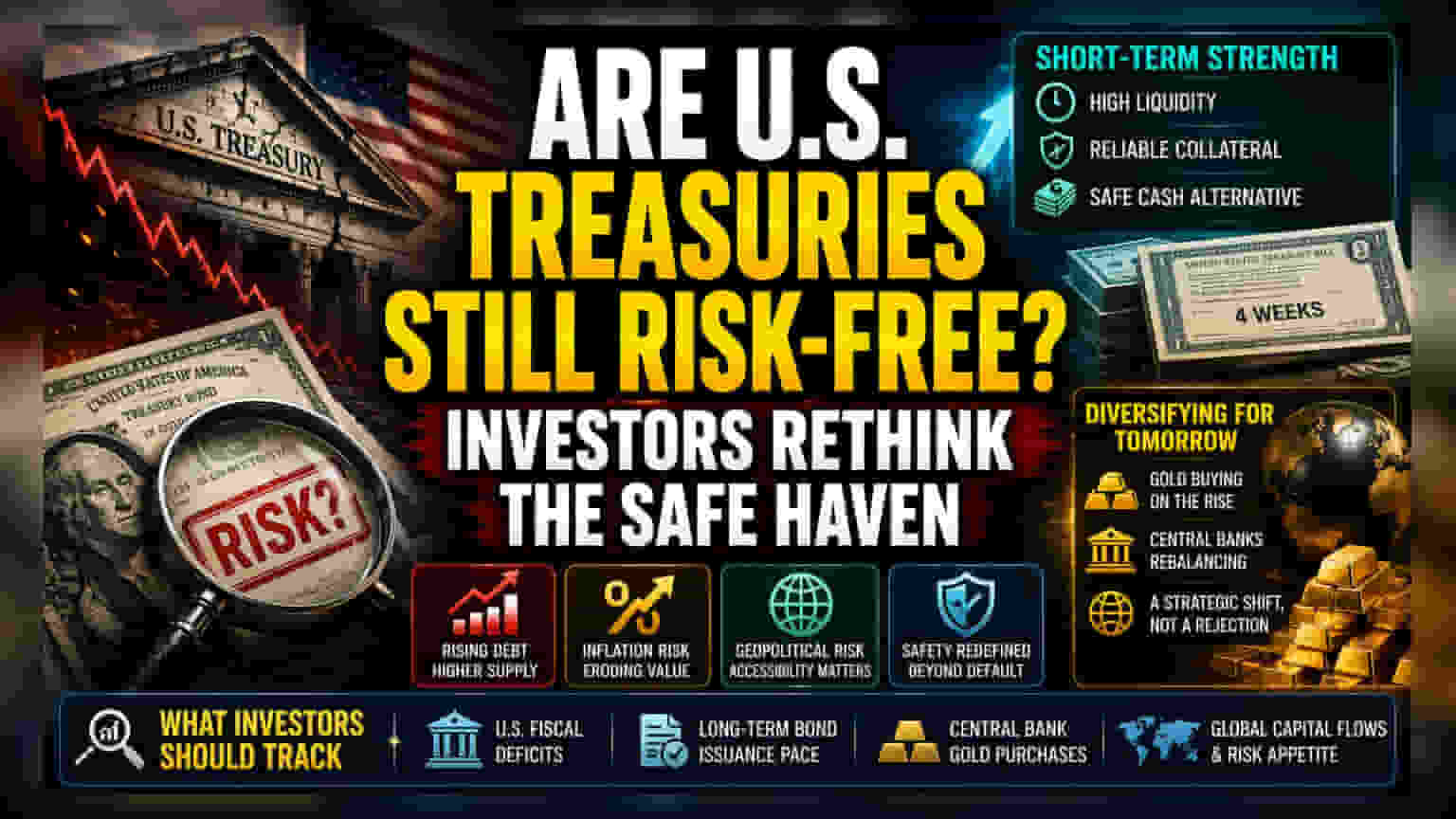


The traditional status of US Treasury bonds as the world's safest investment is being questioned. While short-term bills remain popular, long-term bonds face pressure from high debt and inflation concerns. Global central banks, including India, are increasingly looking at gold to manage reserve risks. This shift highlights a change in how the market defines 'safety' in a volatile global economy.
What Happened
Global financial markets are currently re-examining the long-held belief that US Treasury bonds are entirely risk-free. For decades, these assets were the gold standard for safety, used by central banks, institutions, and investors worldwide as a benchmark. Recent developments—including rising fiscal deficits, persistent inflation, and geopolitical changes—have forced investors to reconsider whether these bonds truly offer the same level of security they did in the past.
The Changing Definition of Safety
Financial experts are now breaking down the concept of a "risk-free" asset into different functions. It is no longer just about the risk of default, which remains low for the US government. Instead, investors are looking at other critical factors: the ability of an asset to store value against inflation, its role as collateral in financial markets, and, crucially, its accessibility during times of geopolitical tension. This analysis shows that while an asset might be creditworthy, it may not necessarily be safe in all conditions.
The Pressure on Long-Term Bonds
Why are long-term US Treasury bonds facing scrutiny? The core issue is the increasing supply of debt. As the US government issues more bonds to cover fiscal deficits, the balance between supply and demand has shifted. Investors are finding that the premium—or the extra return they receive—for holding these long-dated bonds is not always sufficient to cover the risks of inflation and future uncertainty. While the US dollar remains a dominant global currency, the appeal of holding long-term US debt as a simple, risk-free store of value has diminished compared to previous years.
The Resilience of Short-Term Instruments
Unlike their long-term counterparts, short-term Treasury bills continue to see strong demand. Investors and financial institutions treat these more like cash. They serve a specific purpose: providing immediate liquidity, acting as reliable collateral for financial transactions, and offering a safe parking spot for capital. Because they are short-lived, they are less sensitive to long-term inflation or massive swings in interest rates, keeping their status as a preferred "safe" instrument for day-to-day financial operations.
The Shift Toward Gold and Diversification
Geopolitical developments have added a new layer of risk: accessibility. Recent global events and sanctions have demonstrated that even the most creditworthy assets can be difficult to access during diplomatic conflicts. This reality has encouraged central banks, including the Reserve Bank of India, to diversify their reserves. Adding gold to national reserves is one way to ensure that a portion of wealth remains accessible and resilient, independent of the US-centric financial system. This does not signal a rejection of the dollar, but rather a strategic rebalancing to ensure long-term stability.
What Investors Should Monitor
This shift does not mean the current global financial system is collapsing, but it does mean investors need to be more nuanced in their approach to safety. For those tracking global trends, the key monitorables include US fiscal deficit data, the issuance pace of long-term Treasury bonds, and the gold-buying activities of global central banks. Understanding these dynamics helps in assessing the broader risk appetite in the market and how global capital flows might change in the future.