 Whalesbook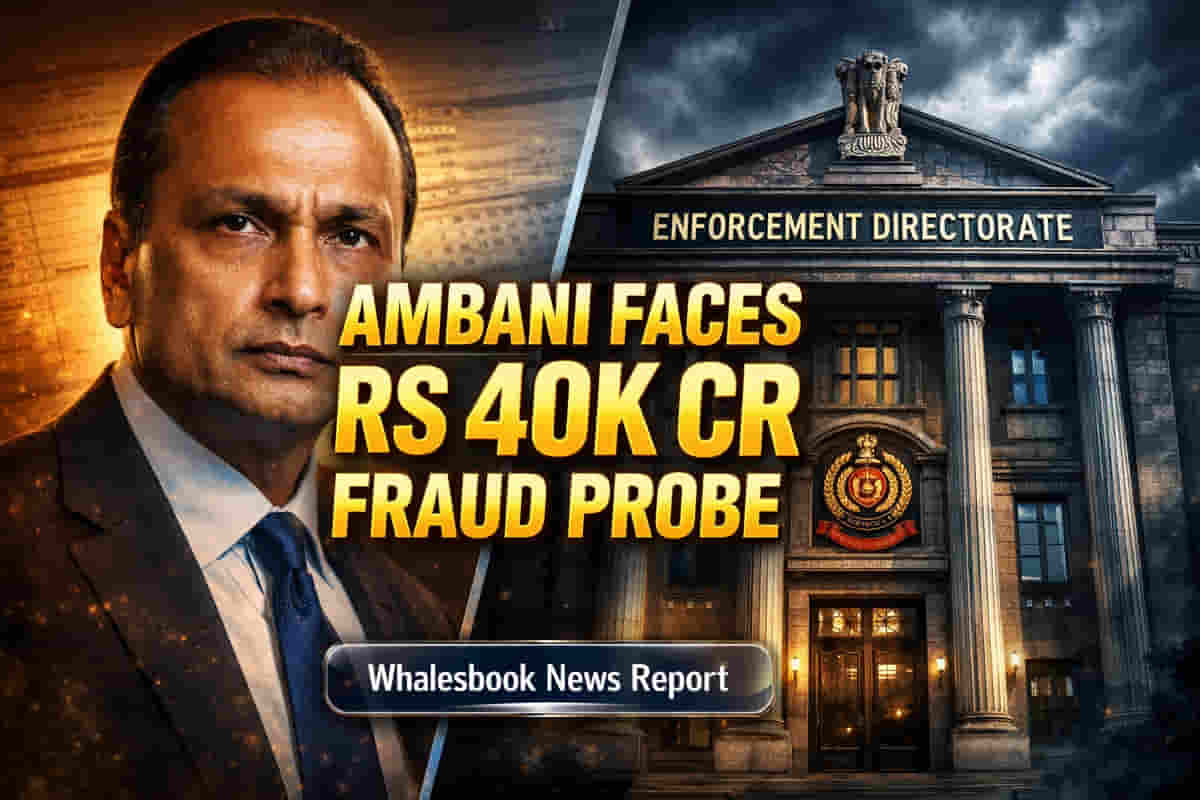
**### Escalating Regulatory Storm
Anil Ambani presented himself before India's Enforcement Directorate (ED) for the second time on Thursday, February 26, 2026, intensifying a probe into alleged money laundering linked to a monumental bank fraud case. The investigation centers on claims of over ₹40,000 crore in loan defaults by his group company, Reliance Communications (RCOM) [16]. This marks a significant escalation in regulatory scrutiny for the Reliance Group chairman. The ED is meticulously recording his statement under the Prevention of Money Laundering Act (PMLA) [16], following directions from the Supreme Court to form a Special Investigation Team (SIT) to expedite inquiries into the sprawling financial irregularities [27].
Mounting Asset Seizures
The ED's aggressive stance is underscored by the provisional attachment of Anil Ambani's Mumbai residence, 'Abode', valued at ₹3,716.83 crore, on Wednesday, February 25, 2026 [3, 14, 20, 31]. This latest action brings the total value of seized assets in connection with the RCOM fraud case to approximately ₹15,700 crore [3, 14, 20, 31]. Previous attachments, including ₹1,120 crore in December 2025 and another ₹1,885 crore in January 2026, had already amassed significant holdings [18, 25]. The agency alleges that assets were aggregated into a family trust, 'RiseE Trust,' to shield them from personal liabilities and lender banks whose loans became non-performing assets (NPAs) [3, 20, 22].
The Financial Fallout: RCOM and RPOWER
The relentless legal and financial pressures are manifesting in the performance of Reliance Group entities. Reliance Communications (RCOM) is in a dire financial state, with a market capitalization hovering around ₹257 crore and heavily negative P/E ratios, signaling substantial ongoing losses [4, 6, 8, 11, 12, 17, 26]. The company is already undergoing corporate insolvency resolution proceedings [5]. Simultaneously, Reliance Power (RPOWER) faces scrutiny over its valuation. Trading at a P/E ratio of approximately 37.4x [9], RPOWER is considered expensive compared to the Indian Renewable Energy industry average of 24.1x and its direct peers at 17.3x [21]. Despite this premium valuation, the company has struggled with poor sales growth, negative return on equity, and a low interest coverage ratio [1]. Its revenue saw a 4% decrease in FY 2024-2025, with a significant 243% drop in profit after tax [23]. Notably, Reliance Power and Reliance Infrastructure have publicly stated they are separate entities with no business or financial ties to RCOM, seeking to distance themselves from the ongoing investigations [5].
The Bear Case: Structural Weaknesses and Contagion
The current situation paints a grim picture for entities associated with Anil Ambani's business empire. The sheer scale of the alleged ₹40,000 crore bank fraud and the cumulative ₹15,700 crore in attached assets suggest deep-seated financial mismanagement and potential systemic risk. The State Bank of India has declared RCOM and Anil Ambani as 'fraud' under RBI guidelines, a serious classification with significant implications [5]. The ED's assertion of wealth preservation tactics via private trusts, aimed at shielding assets from distressed public banks, highlights a pattern of alleged financial maneuvering [3, 20, 22]. While Reliance Power boasts a large asset base and capacity under development, its current financial metrics—expensive valuation, negative ROE, and weak growth—coupled with the overhang of broader group litigation, present considerable risks for investors. The historical context of multiple previous asset attachments and the ongoing insolvency of RCOM create a narrative of persistent financial distress rather than recovery.
Future Outlook
Anil Ambani's continued engagement with the ED, combined with the significant asset seizures, indicates that regulatory pressure on the Reliance Group is unlikely to abate soon. The market will remain fixated on the progression of these cases, the ED's findings, and any potential impact on the financial health and operational capabilities of other group companies. Investor confidence will likely remain subdued until a clear resolution is achieved, potentially requiring substantial financial restructuring and a demonstrable return to robust financial health across the relevant entities.