

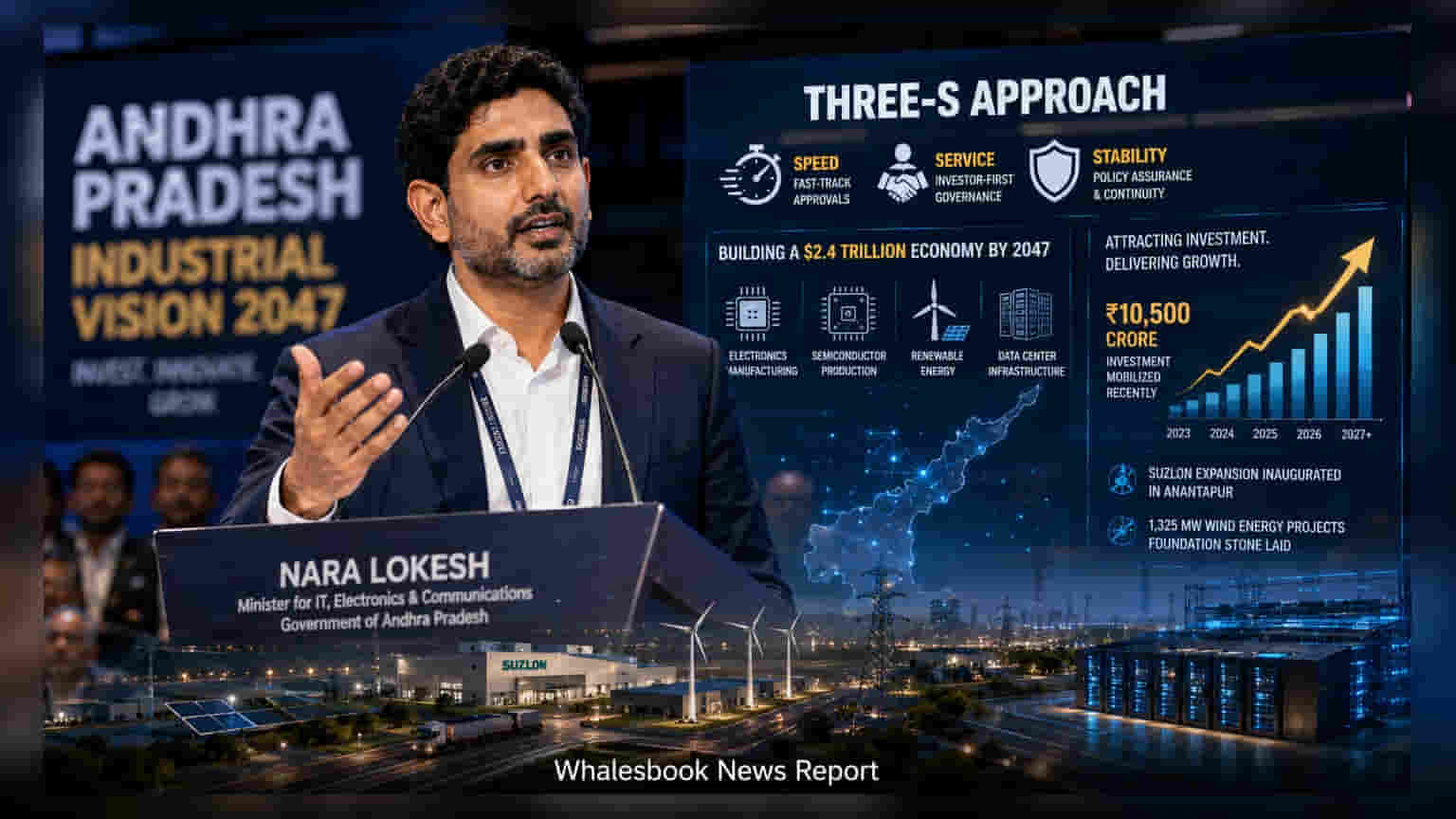
Andhra Pradesh Minister Nara Lokesh is implementing a 'Three-S' strategy—speed, service, and stability—to attract industrial capital. The state is focusing on transforming memorandums into actual grounded projects, with a long-term goal of reaching a $2.4 trillion economy by 2047. Investors are monitoring how this governance model manages large-scale industrialization alongside environmental and community requirements.
Andhra Pradesh is actively working to reshape its industrial environment through a strategy centered on three core pillars: speed, service, and stability. Minister for IT, Electronics and Communications, Nara Lokesh, is leading this initiative to attract both domestic and international capital. The objective is to move beyond the traditional practice of signing memorandums of understanding by ensuring that projects are actually grounded and operational.
Putting Strategy into Practice
The impact of this focused approach is becoming visible through recent industrial activities. For instance, the state recently saw the inauguration of Suzlon Energy’s expanded blade manufacturing facility in Anantapur, alongside the foundation stone for wind energy projects totaling 1,325 MW. These developments represent a combined investment of ₹10,500 crore. By prioritizing this type of project execution, the government aims to establish a track record that builds confidence among corporate planners who often face delays in setting up operations.
Building for a $2.4 Trillion Economy
To achieve its ambitious goal of becoming a $2.4 trillion economy by 2047, the state government is targeting specific high-growth sectors. The administration is prioritizing electronics manufacturing, semiconductor production, renewable energy, and data center infrastructure. A significant part of this plan involves allocating 6.5 GW of power capacity for data centers in Visakhapatnam, which is intended to draw massive digital infrastructure investments. The 'Three-S' model is designed to facilitate these projects by streamlining government approvals and providing consistent policy support, effectively reducing the time it takes for businesses to go from the planning stage to production.
Risks and Future Monitorables
While the push for rapid industrialization is clear, investors and stakeholders often watch for the challenges associated with large-scale development. One key area of focus is the execution risk inherent in mega-projects, which require complex infrastructure and logistics. Additionally, as the state encourages power-intensive sectors like data centers, managing environmental impacts—such as water usage and energy distribution—will be a critical factor for long-term sustainability.
Policy continuity remains another essential aspect for long-term investors. Because infrastructure projects often span several years, the ability of the state to maintain a stable and predictable policy environment will determine if these industrial targets can be met. For those tracking the state's progress, the key monitorables will be the actual commissioning rate of these announced projects, the transparency of the approval process, and how the government balances rapid industrial expansion with the socio-economic needs of local communities.