 Whalesbook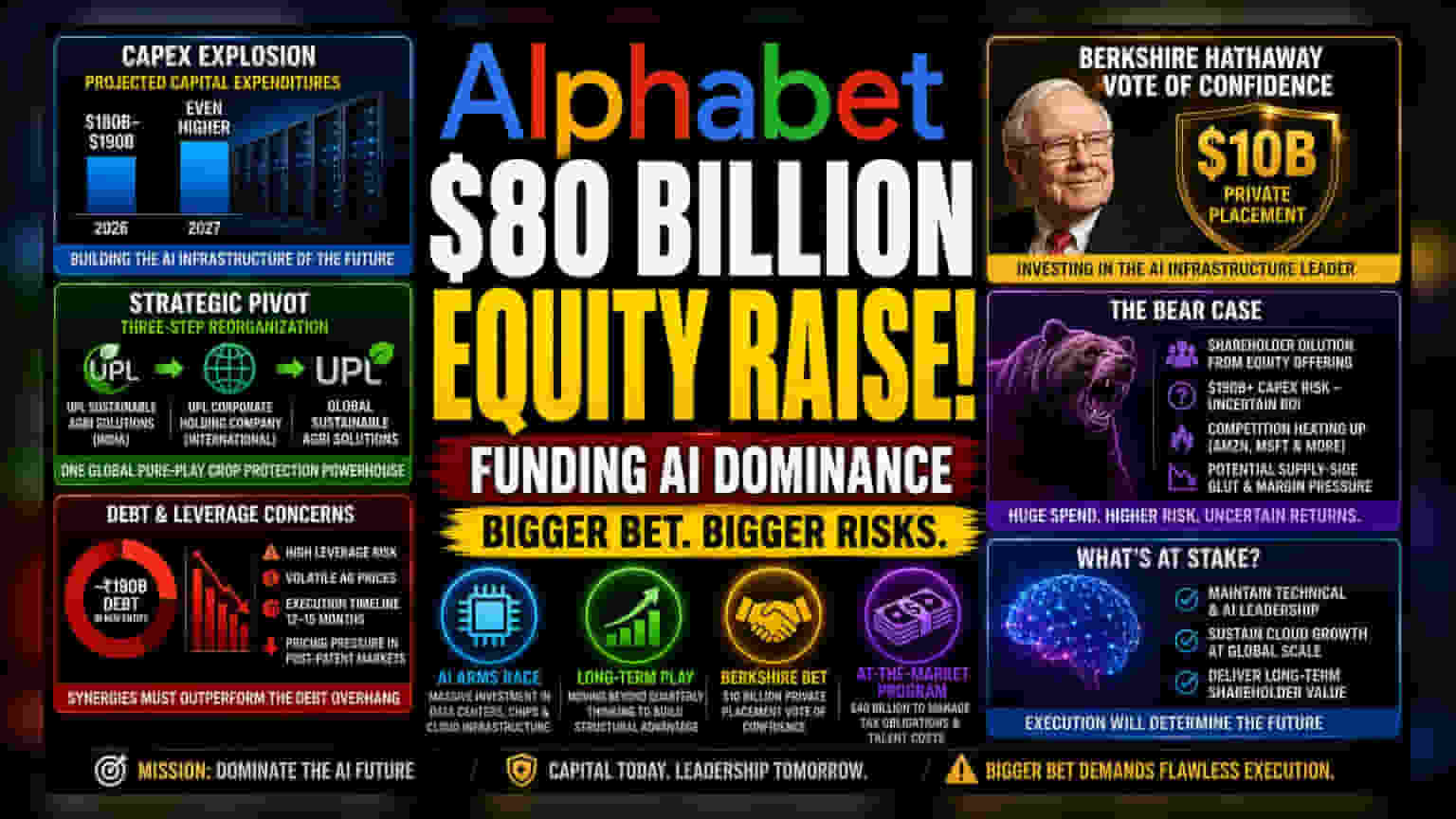


The Capital Expenditure Inflection Point
Alphabet’s decision to pursue an $80 billion equity capital raise marks a fundamental shift in how the world’s largest technology companies finance the AI arms race. Historically reliant on massive internal cash generation and debt markets, Alphabet is now signaling that the scale of current AI infrastructure requirements—ranging from data center construction to the acquisition of advanced semiconductors—exceeds even the most robust organic cash flows. With capital expenditures projected to reach $180 billion to $190 billion in 2026 and expected to climb further in 2027, the company is preemptively strengthening its balance sheet to maintain technical dominance.
Strategic Paranoia and the Funding Gap
This pivot arrives as veteran financiers, including Uday Kotak, increasingly warn of a "Structural Change" era. Kotak’s recent discourse at the CII Annual Business Summit emphasized that companies must move beyond the short-termism of quarterly earnings and treasury management. The scale of Alphabet’s spending has become a benchmark for global relevance, with the company’s AI infrastructure requirements now eclipsing the total market capitalization of many major national stock exchanges. For Indian corporations, this serves as a potent reminder that the window to build deep, competitive domestic AI pools is narrowing, and the reliance on foreign capital could prove risky in a fragmented global economy.
The Berkshire Hathaway Validation
Warren Buffett’s Berkshire Hathaway, through a $10 billion private placement, has provided a critical stamp of approval for this fundraising strategy. By purchasing shares at a slight discount to market rates, Berkshire is positioning itself to benefit from Alphabet’s transition into an infrastructure-heavy behemoth. This investment suggests that despite the skepticism surrounding AI returns on investment, the core compute and cloud layers remain the most attractive long-term bets in the sector.
The Forensic Bear Case
Despite the enthusiasm, structural risks remain. The equity offering introduces immediate dilution for current shareholders, a sharp reversal for a company that has long prioritized share buybacks. Furthermore, the sheer scale of the $190 billion capex forecast raises questions about the long-term utility and profitability of these assets. Should the demand for AI services fail to outpace the surge in computing capacity, the company risks significant margin compression. Competitors such as Microsoft and Amazon are also aggressively scaling, creating a supply-side glut that could commoditize the very cloud services Alphabet is betting its future on. Finally, the use of a $40 billion at-the-market program to address tax obligations, while standard, underscores the high ongoing cost of retaining talent in a hyper-competitive AI landscape.