

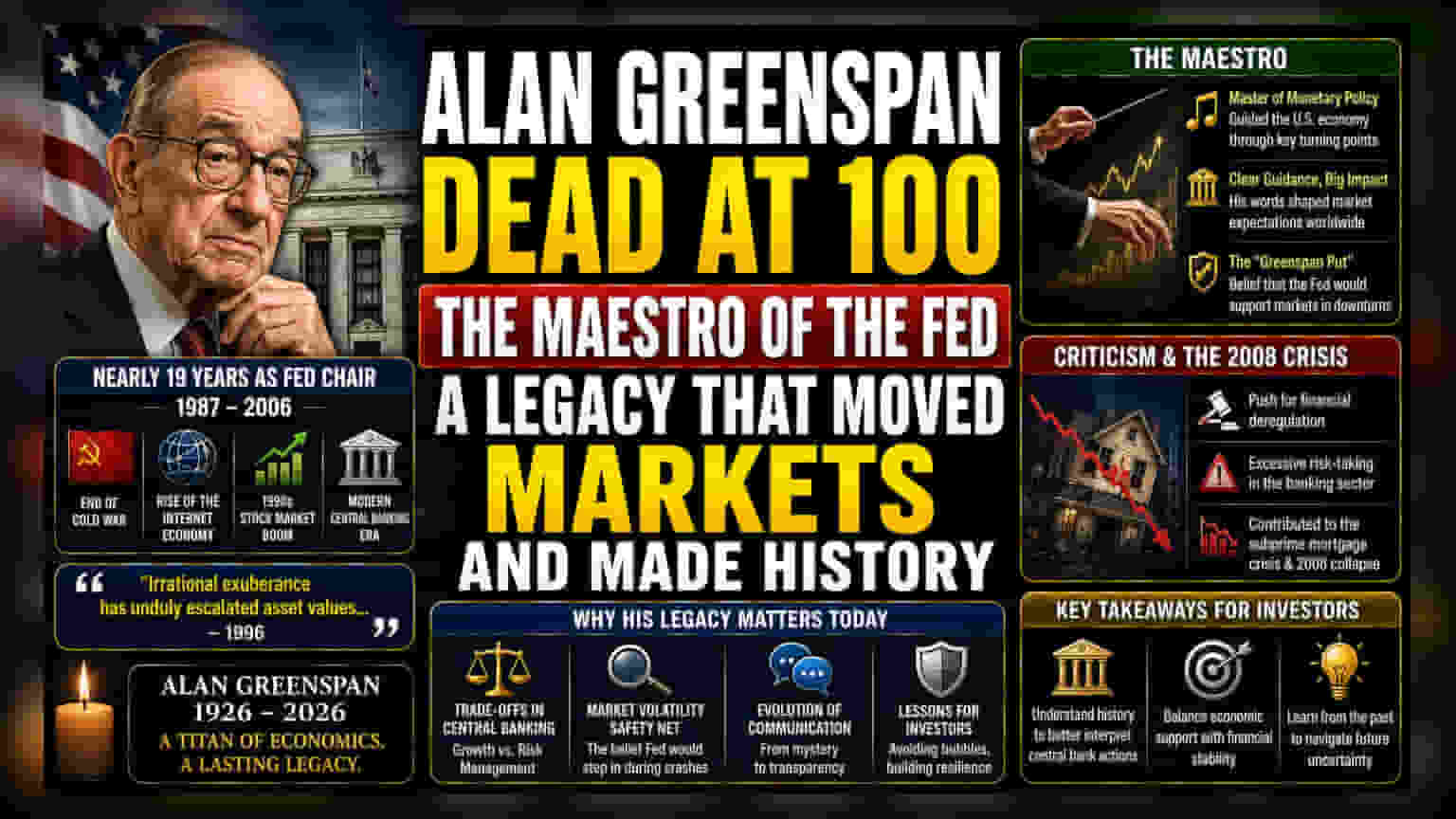
Alan Greenspan, who led the U.S. Federal Reserve for nearly two decades, has died at 100. His monetary policies influenced global economic cycles, leaving a legacy defined by both market-stabilizing interventions and debates over financial deregulation that preceded the 2008 crisis.
What Happened
Alan Greenspan, the economist who served as the Chair of the U.S. Federal Reserve for nearly 19 years, has died at the age of 100. His tenure, which spanned from 1987 to 2006, made him one of the most influential figures in modern economic history. During his time at the helm, the U.S. economy navigated major events, including the end of the Cold War, the rise of the internet economy, and the stock market boom of the 1990s.
The Legacy of 'The Maestro'
Greenspan was often called 'the maestro' for his perceived ability to manage economic growth and inflation. His approach to monetary policy defined how central banks worldwide operated for years. He became famous for using clear but often complex language to guide market expectations. One of his most enduring legacies is the concept known as the 'Greenspan Put.' This term was coined to describe the belief that the Federal Reserve would step in with supportive interest rate policies or liquidity if the stock market suffered a significant decline, effectively creating a safety net for investors.
Famous Phrases and Market Shifts
Investors and market participants frequently cite his 1996 remark about 'irrational exuberance.' He used this term to describe the stock market's rapid rise during the dot-com era, questioning whether asset prices were becoming detached from economic reality. His ability to move markets with a single comment remains a textbook example of how central bank leadership can impact investor sentiment and asset pricing on a global scale.
Financial Criticism and The 2008 Crisis
While highly respected for managing periods of growth, Greenspan's legacy also includes significant criticism. After he stepped down in 2006, the U.S. economy faced the devastating subprime mortgage crisis in 2008. Many critics and economists have pointed to his push for financial deregulation as a contributing factor. They argued that his policies, which favored limited oversight, allowed excessive risk-taking within the banking sector, eventually leading to the financial collapse. This debate remains a central part of his history, highlighting the risks of light-touch regulation.
Why His Era Matters to Modern Investors
For today’s market participants, Greenspan’s legacy serves as a reminder of the trade-offs in central banking. His era was marked by a preference for managing market volatility, which some argue set the stage for later financial instability. In contrast, modern central banks often emphasize transparency and clearer communication to avoid the 'mystery' that sometimes defined Greenspan’s approach. Understanding this historical context helps investors better interpret how central banks balance the need for economic support against the risk of creating future market bubbles or financial fragility.