

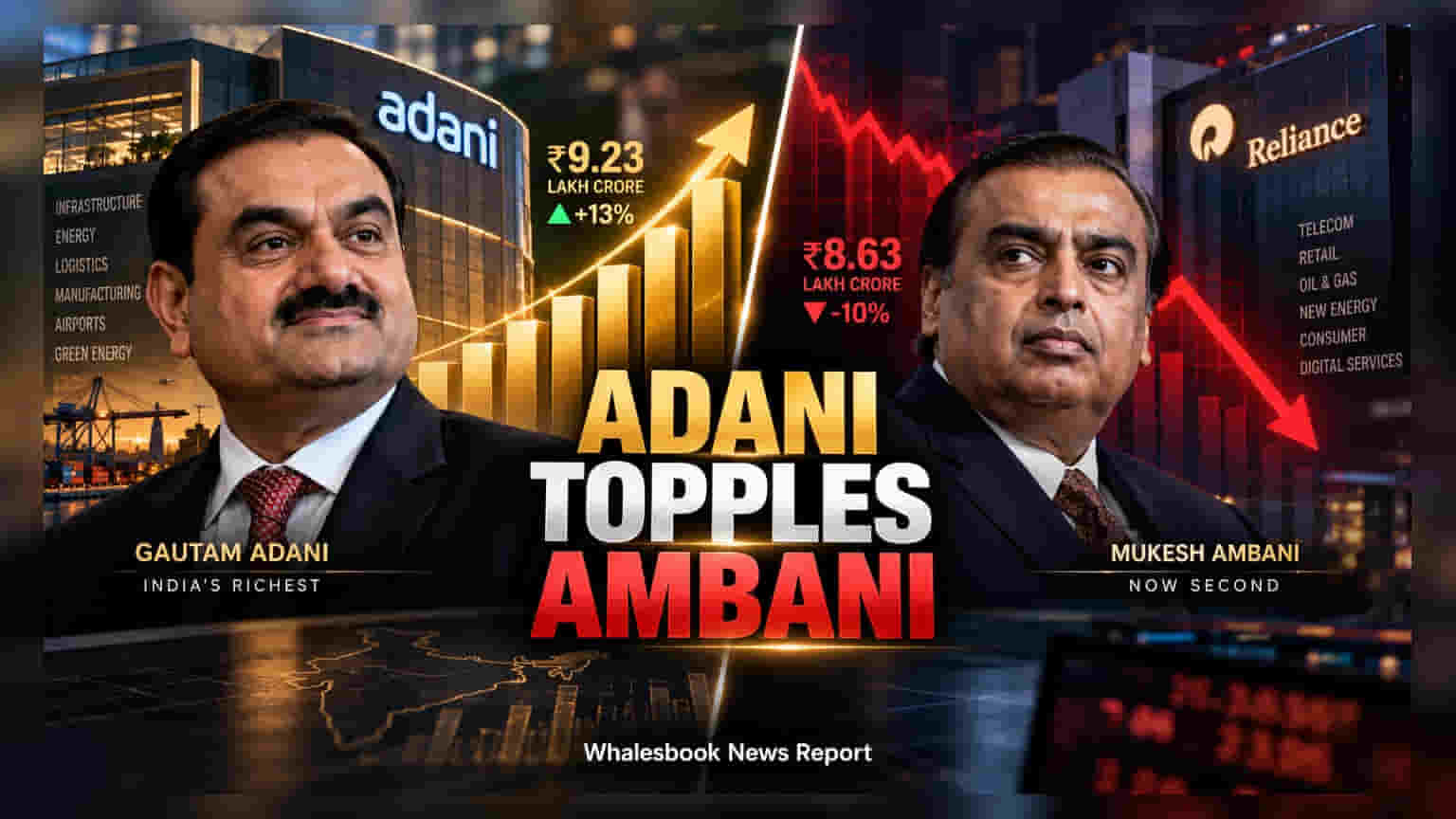
Gautam Adani and family have topped the M3M Hurun India Rich List 2026, with a net worth of ₹9.23 lakh crore, as Mukesh Ambani’s family wealth fell by 10%. Despite a 4-6% decline in benchmark indices like the Nifty and Sensex, the collective wealth of the 1,810 individuals tracked grew by 13%, driven by strong gains in AI, defense, and aerospace sectors.
The M3M Hurun India Rich List 2026 reveals a significant realignment at the top of India’s economic hierarchy. Gautam Adani and his family have secured the top position with a net worth of ₹9.23 lakh crore, representing a 13% increase over the previous year. This transition displaces Mukesh Ambani, whose family wealth declined by 10% to ₹8.63 lakh crore, marking a notable shift in the ranking of India’s wealthiest citizens.
Market Trends and Wealth Concentration
This change occurs against a backdrop of volatility in broader equity markets. During the observation period, the Nifty 50 and Sensex recorded declines of 4% and 6% respectively. Despite this market pressure, the cumulative wealth of the 1,810 individuals tracked by the report grew by 13% to ₹187 lakh crore. This figure is equivalent to nearly half of India’s annual GDP, illustrating both the concentration of wealth at the top and how asset valuations for the wealthiest individuals can decouple from the performance of the broader market indices.
Sectoral Rotation Toward New Technology
The list highlights that traditional conglomerates are seeing increased competition from emerging technology and high-growth sectors. LN Mittal has surged into third place with a 93% increase in wealth, primarily fueled by rising steel prices. Meanwhile, the technology sector is demonstrating rapid diversification. The report identifies 19 new entrants with businesses linked to Artificial Intelligence, commanding a combined net worth of ₹3.07 lakh crore. The debut of Nagendra Nagaraja of QpiAi further highlights the growing prominence of quantum computing within this group.
Aerospace and Defense sectors have also emerged as significant contributors to this cycle’s growth. These fields accounted for 23 new entrants who added ₹85,200 crore to the total valuation. This trend suggests that while traditional energy and telecommunications sectors remain powerful, capital and entrepreneurial focus are increasingly rotating toward sectors where government policy and global demand for new capabilities are driving expansion.
Changing Demographic Profile
The data also points to significant changes in the demographic makeup of India’s wealthiest individuals. Approximately 70% of the 1,810 people featured are categorized as self-made. Women’s representation continues to rise, with 131 women making the list compared to 100 in the previous year, led by Roshni Nadar Malhotra with a net worth of ₹2.79 lakh crore. Youth also played a role in the year’s wealth expansion, with 28-year-olds Tanay Kothari and Sahaj Garg debuting as the youngest AI founder entrants. Additionally, Aditya Kumar Halwasiya of Cupid recorded the fastest growth, multiplying his wealth eightfold over the last cycle. These shifts underscore a more dynamic landscape where new entrants can rapidly scale through high-growth technology and niche industries, though investors should note that these wealth figures are based on estimates and fluctuate with market conditions.