

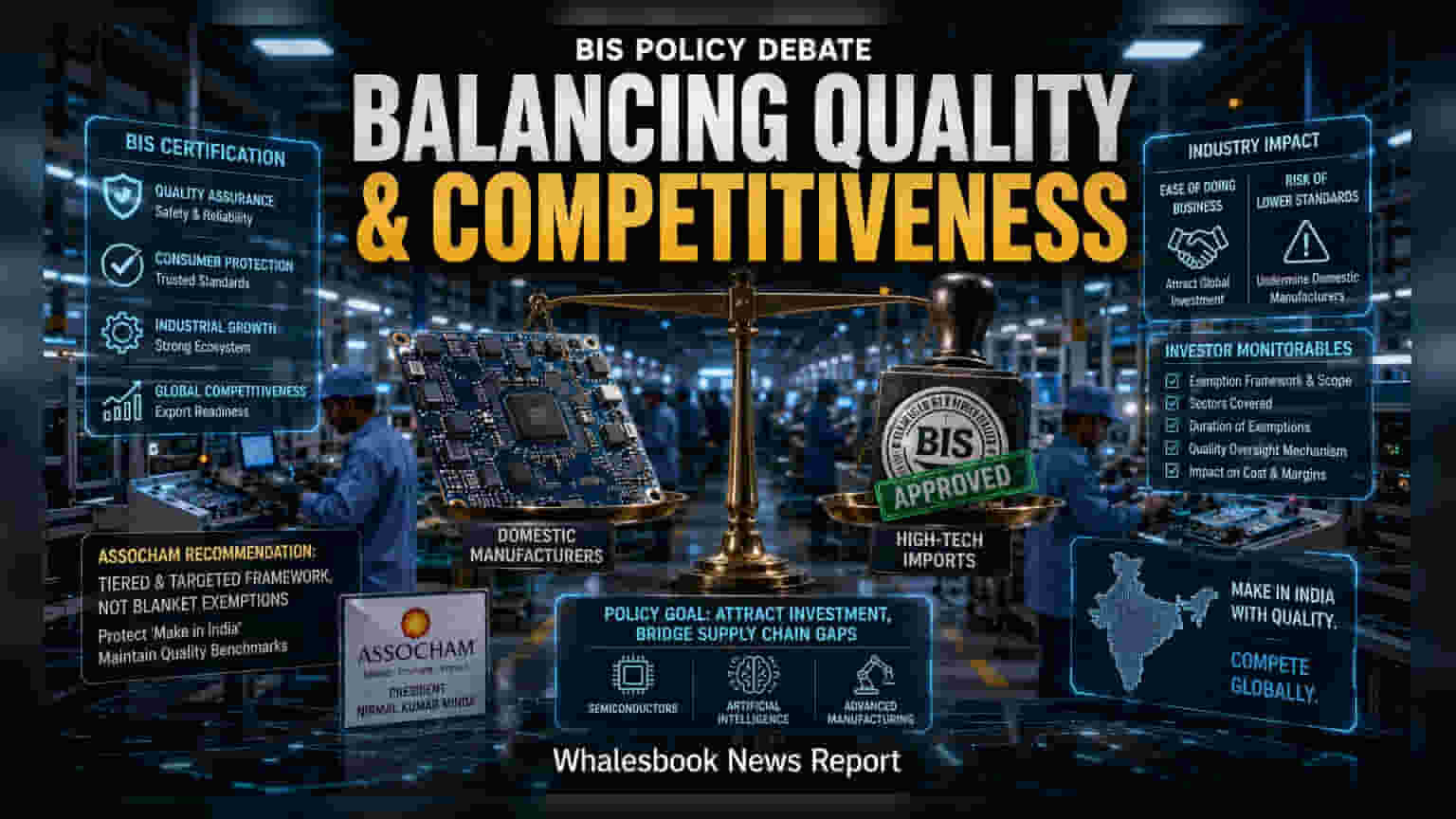
ASSOCHAM President Nirmal Kumar Minda has urged the government to avoid blanket exemptions for Bureau of Indian Standards (BIS) certification on high-tech imports. While the government aims to attract investment in sectors like semiconductors and AI, the industry body warns that unchecked relaxation could harm domestic manufacturing. Investors in the manufacturing and electronics sectors should track the final framework for potential impacts on domestic competition.
The Bureau of Indian Standards (BIS) certification process has become a key focal point for industrial policy in India. The government, led by Commerce and Industry Minister Piyush Goyal, is currently evaluating a new framework to provide exemptions or eased norms for high-tech imports, particularly in the semiconductor and Artificial Intelligence sectors. The objective is to attract global manufacturing investment and bridge critical supply chain gaps that currently hinder rapid production scaling.
However, the Associated Chambers of Commerce and Industry of India (ASSOCHAM), led by President Nirmal Kumar Minda, has cautioned that broad, blanket exemptions could be counterproductive. The chamber argues that while the intent to improve the ease of doing business is clear, any move that significantly lowers quality benchmarks may inadvertently place domestic manufacturers at a severe competitive disadvantage. According to the industry body, the influx of unvetted or lower-quality imports could undermine the long-term goals of the ‘Make in India’ initiative, which prioritizes building a high-quality, indigenous manufacturing base.
Balancing Investment and Domestic Competitiveness
The core of the policy debate lies in finding a balance between incentivizing high-tech firms to set up shop in India and protecting the local ecosystem. ASSOCHAM has proposed that rather than offering blanket relaxations, the government should adopt a ‘tiered’ or ‘targeted’ verification framework. This suggested approach would focus on specific high-tech niches where compliance burdens are currently excessive, without eroding the mandatory quality standards that have been established for the broader manufacturing sector.
For investors, this policy shift represents a crucial monitorable for the technology and manufacturing sectors. The implementation of any new exemption framework could alter the competitive landscape for companies that rely on domestic manufacturing versus those that depend heavily on component imports. If norms are relaxed significantly, domestic players may face intensified price competition from imported products that previously had to meet stricter, cost-heavy compliance standards.
Investors should keep a close watch on future notifications from the Ministry of Commerce regarding the final structure of these exemptions. The specific sectors covered, the duration of such exemptions, and the mechanism for quality oversight will determine the long-term impact on domestic profit margins and market share. Monitoring government statements and subsequent Gazette notifications will be essential to understanding how these changes will affect the cost structure and competitive positioning of Indian manufacturing companies in the coming quarters.