

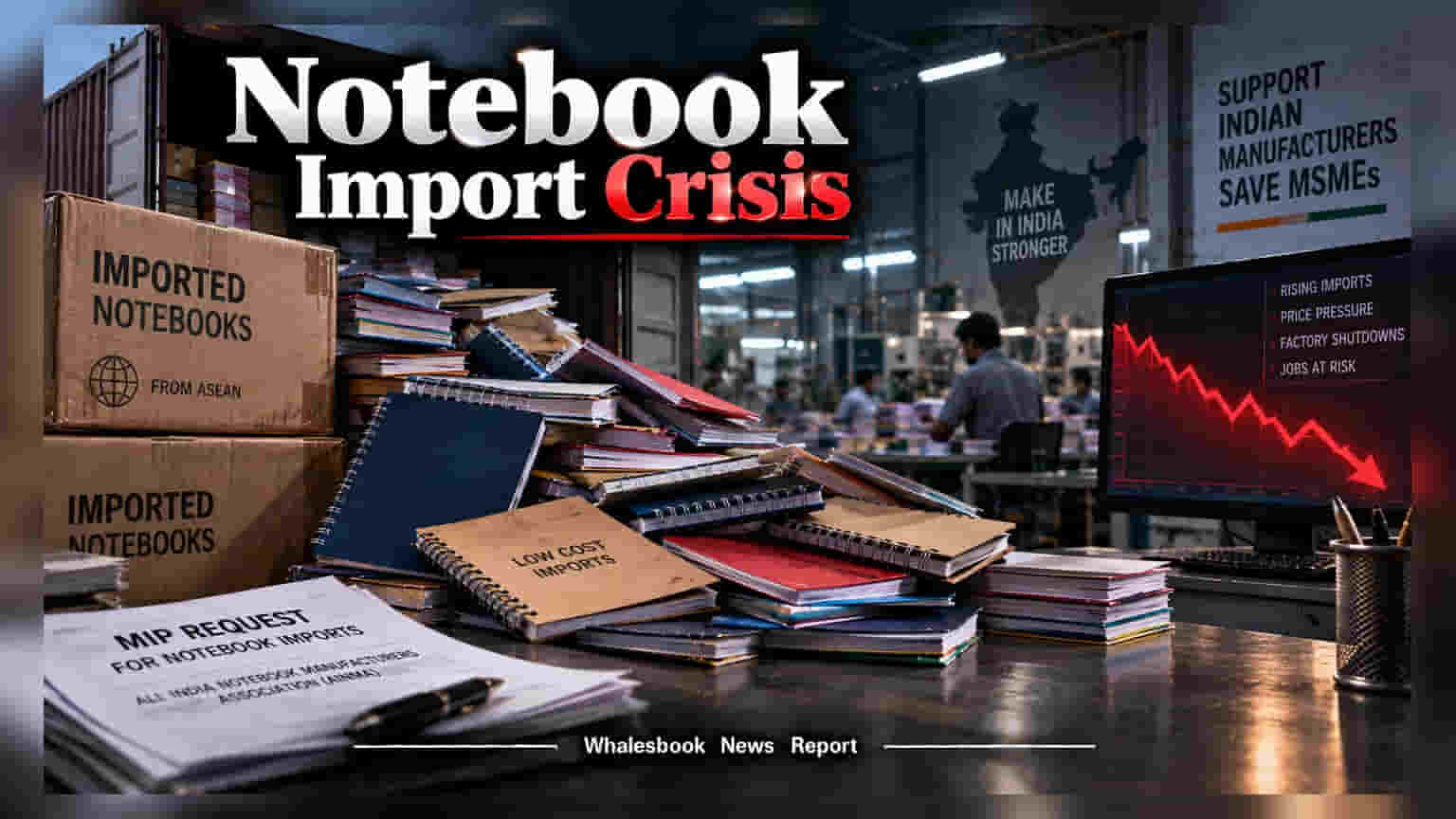
The All India Notebook Manufacturers Association has urged the Commerce Ministry to set a minimum price on imported notebooks. The sector reports a fivefold increase in imports in the first half of 2026, driven by zero-duty trade agreements. Local makers warn that current tax policies threaten the survival of over 1,500 small-scale units.
The All India Notebook Manufacturers Association (AINMA) has formally requested the Union Commerce Ministry to implement a Minimum Import Price (MIP) on notebook shipments. The association argues that current trade conditions are allowing cheap imports to flood the domestic market, putting local manufacturers at a severe disadvantage.
Data indicates that the pressure on local producers is mounting rapidly. In the first half of 2026, India imported notebooks worth ₹22.36 crore, a sharp fivefold increase compared to the ₹3.65 crore recorded during the same period in 2025. This surge is largely attributed to the India-ASEAN Free Trade Agreement signed in 2010, which allows notebooks to enter India with nil customs duty.
Domestic manufacturers are highlighting a structural tax disadvantage, often described as an inverted duty structure. While local producers face costs for raw materials that are subject to various taxes, they struggle to compete against finished products that enter the country tax-free. Furthermore, manufacturers point out that domestic tax regulations regarding the Goods and Services Tax (GST) have created an environment where they cannot effectively claim input tax credits on finished notebooks, further eroding their price competitiveness.
This environment is creating significant stress for the stationery and paper industry. The association warns that if the government does not intervene to create a price floor, the cumulative effect of these predatory import prices could lead to the closure of over 1,500 micro, small, and medium enterprises (MSMEs) across India. These units form the backbone of the domestic manufacturing sector and rely on local demand to sustain operations.
The ministry is now expected to evaluate the petition to determine whether adjustments are needed to balance free trade commitments with the protection of domestic manufacturing. For investors and industry observers, the key monitorable remains how the government approaches this trade policy conflict. Future updates will likely focus on whether the commerce ministry agrees to set a floor price, which would directly impact the pricing power and market share of local notebook producers relative to cheaper imports.