 Whalesbook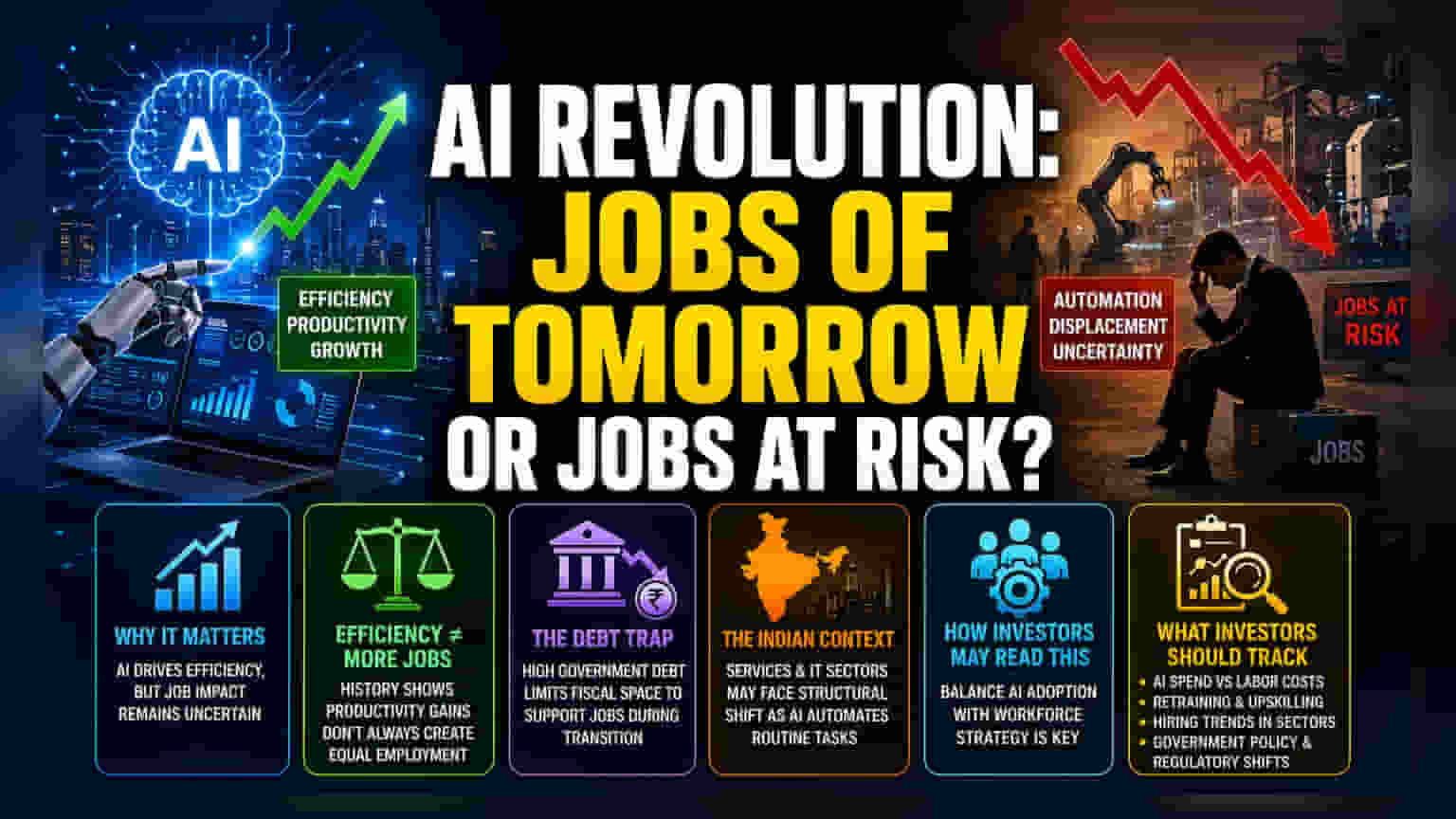


As AI adoption accelerates, economists are warning about a potential gap between productivity gains and job stability. With global debt limiting government intervention, the shift toward automation presents new challenges for economies, especially those with large labor forces like India. Investors should look beyond short-term profit growth and consider how companies manage their workforce strategies amid this technological transition.
What Happened
Artificial Intelligence (AI) is rapidly becoming a core part of business strategy, driving significant gains in productivity and efficiency. However, a growing debate among economists centers on a critical question: will these efficiency gains create new jobs, or will they lead to significant displacement of human labor? While technology companies often promote AI as a tool that enhances human capability, experts are increasingly concerned about the pace of change and the lack of robust policy frameworks from governments to manage the potential social and economic impact of widespread automation.
Why Efficiency Doesn't Always Mean Jobs
Proponents of rapid AI adoption often point to economic theories like the Jevons Paradox. This theory suggests that as technology makes the use of a resource more efficient, the cost of that resource drops, which in turn increases overall demand and creates more jobs. Another common argument draws on the work of economist Joseph Schumpeter, who viewed technological disruption as a necessary, beneficial part of capitalism. However, historical data does not always support the idea that every productivity boom leads to equal employment growth. Past IT revolutions showed that while capital efficiency improved, it did not always translate into lasting job creation in the same sectors.
The Debt Trap
In the past, governments could often use public spending to support employment during times of economic transition. Today, however, many nations face high levels of debt. The International Monetary Fund and other financial institutions have flagged that the fiscal space—or the ability for governments to spend without causing financial instability—is shrinking globally. Because of this, traditional methods of creating jobs through government spending are becoming harder to sustain. This creates a risk where governments may find it difficult to support workers displaced by automation, potentially leading to social and economic pressure.
The Indian Context
For investors in India, this topic is particularly relevant. The Indian economy, especially its large services and IT sector, relies on its demographic advantage—a large, young, and working-age population. If AI automation begins to replace repetitive coding, data management, or business process tasks, the sector may face a structural shift. India has historically benefited from global demand for labor-intensive services. A move toward capital-intensive, AI-driven models could change the business dynamics for major Indian companies, requiring them to rethink how they hire and train staff to remain competitive.
How Investors May Read This
Investors are now looking closer at how companies balance AI adoption with workforce management. A company that uses AI purely to cut headcount to boost margins in the short term may face different risks than one that uses AI to help employees become more productive. The shift could impact long-term margins, employee retention costs, and the overall business model.
What Investors Should Track
Investors should monitor company commentary regarding workforce strategy, not just profit numbers. Key indicators to track include how much a company is spending on AI compared to its labor costs, and whether management is investing in retraining employees. Furthermore, keeping an eye on sector-wide changes in hiring patterns—especially in IT and business services—will be important. Finally, tracking government policy developments regarding automation and labor rights may provide insight into potential future regulatory costs or shifts in the business environment.