

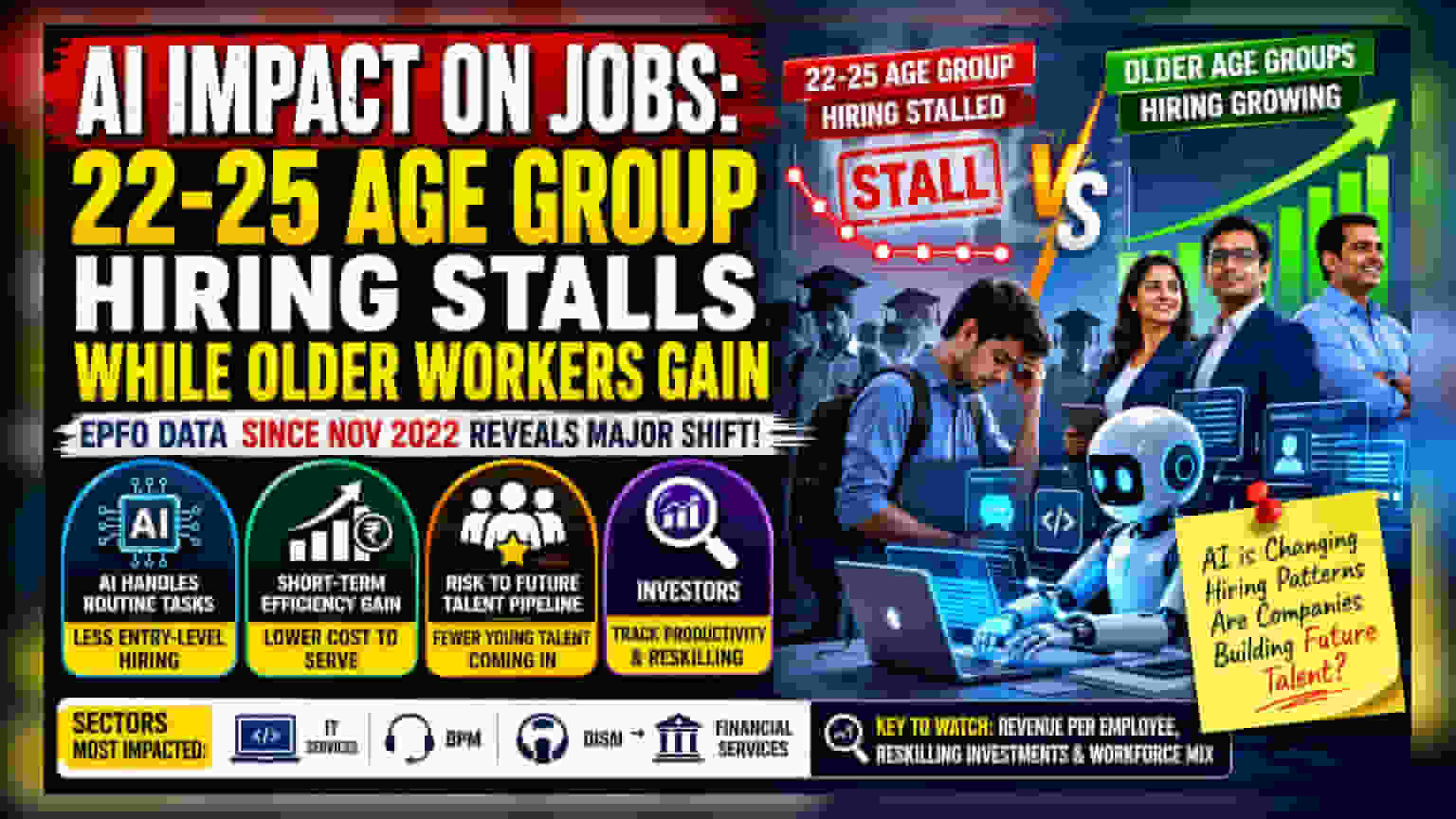
Analysis of EPFO payroll data reveals that hiring for workers aged 22-25 has remained flat since late 2022, while hiring for experienced staff continues to rise. This shift, occurring alongside the rise of artificial intelligence tools, suggests companies are prioritizing automation over mass entry-level hiring. For investors, this creates a trade-off between short-term cost efficiency and long-term talent development.
What Happened
Recent data from the Employees' Provident Fund Organisation (EPFO) indicates a meaningful shift in the Indian job market. Since November 2022—the period when generative AI tools began seeing widespread adoption—formal hiring for the 22-25 age group has effectively stalled. While the overall number of formal jobs continues to grow, this specific younger cohort is seeing little to no new hiring.
In contrast, workers in older age brackets have seen consistent growth in payroll additions. This trend suggests that while businesses are still expanding their workforce, they are increasingly favoring experienced personnel over fresh graduates. The data points to a situation where AI is likely replacing or augmenting routine tasks that were previously handled by entry-level employees, rather than causing a broad displacement of all jobs.
Efficiency Gains vs. Long-Term Risks
For corporate India, particularly in service-heavy sectors, this hiring shift has a direct financial impact. Entry-level hiring typically involves substantial costs related to recruitment, onboarding, and training. By using AI to handle repetitive tasks, companies can potentially lower their 'cost-to-serve' and improve operating margins in the short term.
However, there is an inherent risk. The entry-level workforce is the traditional pipeline for future managers and technical experts. If companies reduce fresh hiring to save on costs, they may face a talent shortage in the mid-to-long term. Investors often monitor whether a company can maintain its operational efficiency without compromising its ability to build the leadership pipeline required for future growth.
Which Sectors Face The Biggest Shift
Sectors that rely heavily on large-scale recruitment of fresh graduates are the most exposed to this trend. The IT services, Business Process Management (BPM), and financial services sectors have historically been the largest employers of early-career workers. These industries are also the most aggressive in adopting AI to automate coding, data entry, and customer support roles.
As these sectors lean more into AI, the need for a high volume of entry-level staff may permanently decrease. Investors may want to look closer at how these companies manage their workforce mix. A company that successfully retrains existing staff to work alongside AI, rather than simply stopping fresh recruitment, may be better positioned to navigate this transition.
What Investors Should Track Next
While the EPFO data provides a useful signal, it is limited to formal employment and does not capture the informal or gig economy. Investors should look beyond just the payroll numbers. Key areas to monitor include the management commentary on 'revenue per employee' metrics, as this will show if the AI-driven hiring slowdown is actually resulting in better productivity and higher profitability.
Additionally, companies’ capital spending on employee reskilling programs will be important. A firm that is investing in training its workforce to use AI effectively may face less disruption than one that relies purely on hiring freezes. Finally, track whether the stagnation in the 22-25 age cohort continues or if companies adjust their hiring strategies to balance short-term cost savings with the need for long-term skill development.