

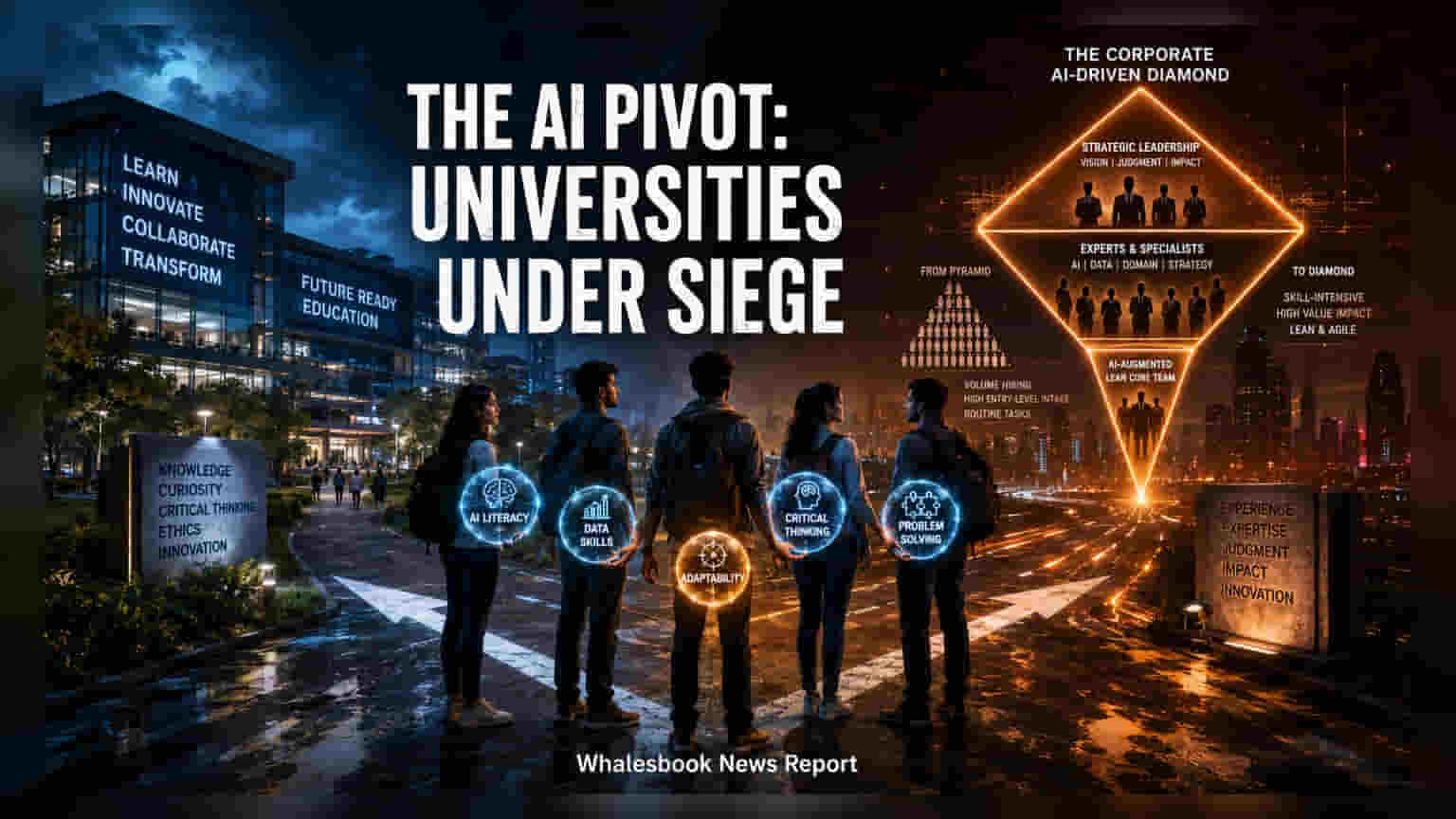
Artificial intelligence is changing India's labor market, with companies shifting from mass hiring of fresh graduates to demanding highly specialized talent. This structural change—from a traditional hiring pyramid to a diamond-shaped model—is forcing Indian universities to move beyond rigid degree production. Investors and observers are now focused on how educational institutions will adapt their curricula to bridge this widening skill gap.
The corporate hiring landscape in India is undergoing a structural change as artificial intelligence automates routine entry-level tasks. For decades, companies relied on a pyramid-shaped hiring model, where a large base of fresh graduates performed administrative or entry-level duties. However, AI is flattening this structure into a diamond shape. This new model favors a smaller intake of entry-level staff, while increasing the demand for experienced, high-level talent capable of managing AI-driven workflows.
The Shift in Corporate Requirements
For businesses, this transition represents a focus on efficiency and high-level output. While companies may reduce entry-level payroll costs, they are reallocating funds toward specialized talent who can synthesize data, navigate ambiguity, and solve complex problems. This shift in the job market directly impacts the economic value of a standard degree. If universities continue to produce graduates with only foundational theoretical knowledge rather than practical AI and critical-thinking skills, the risk of graduate employability falling becomes a material concern for the broader economy.
Challenges for Higher Education
Indian higher education institutions are currently struggling to keep pace with these market realities. Many colleges remain focused on quantitative metrics, such as enrollment numbers and volume of degrees issued. This approach, where the measure of success becomes the target itself, often distracts from the actual quality of learning. To remain relevant, institutions are under pressure to transform from rigid degree factories into agile environments that foster interdisciplinary learning, combining subjects like engineering with ethics, economics, and data science.
Regulatory and Implementation Hurdles
While government frameworks like the National Education Policy 2020 and initiatives such as the IndiaAI Mission aim to bridge the skill gap, implementation has been inconsistent. Regulatory bodies, including the University Grants Commission and the All India Council for Technical Education, face the challenge of transitioning from compliance-focused gatekeepers to facilitators of academic innovation. Institutional territorialism often blocks the cross-disciplinary programs needed to prepare students for a changing workplace.
Risks and Future Monitorables
The most significant risk in this transition is the digital divide. There is a potential for growing inequality in access to AI-related resources, with top-tier institutes having better access than state or private colleges. This disparity could create a bifurcated labor market where only a fraction of graduates are industry-ready. Investors and policy observers should track how quickly universities integrate skill-based learning, the adoption rate of AI in curriculum updates, and whether corporate hiring patterns continue to favor niche skill sets over volume hiring. The ability of the education sector to pivot will determine the long-term productivity and growth of India’s human capital.