 Whalesbook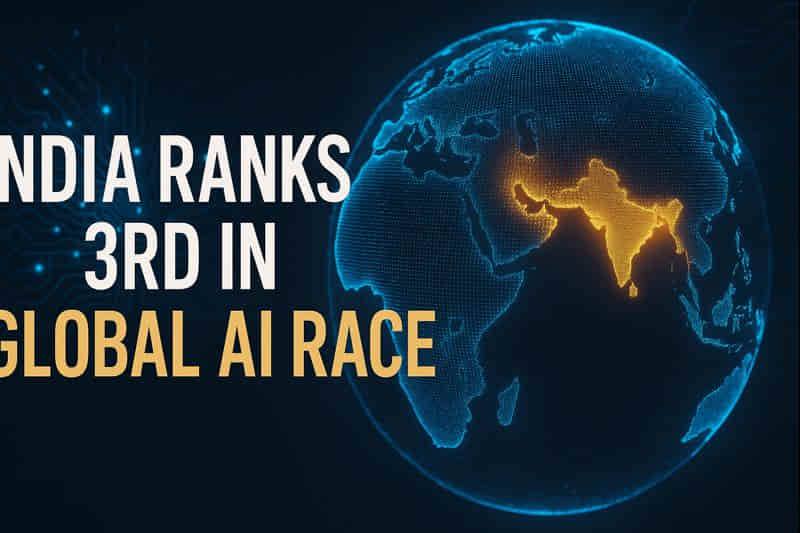
India Surges to Third in Global AI Vibrancy Ranking
Stanford University's latest 'Global AI Vibrancy Tool' report for 2025 has placed India in an impressive third position worldwide in artificial intelligence preparedness. This significant achievement, based on data up to 2024, sees India trailing only the United States and China in the rapidly evolving AI landscape. The ranking underscores India's accelerated efforts and growing capabilities in harnessing AI technologies across various sectors.
The Core Issue
India has made a remarkable leap, climbing from seventh place in the previous year to secure the third spot in the 2024 Global Vibrancy Index. This advancement highlights the nation's strategic focus and increasing investment in artificial intelligence. The index is a comprehensive assessment framework, evaluating countries across seven critical pillars: research and development, responsible AI, economy, talent, policy and governance, public opinion, and infrastructure.
Global Leaders
The United States continues to dominate the index, holding the first position with a substantial weighted score of 78.6. The report notes that the US leads in many AI aspects, particularly in producing cutting-edge AI models, attracting significant private investment, and possessing vast compute capacity. Major AI models released in 2024, such as Gemini 2.0 Pro, o1, and Llama 3.1, were developed by U.S.-based technology giants like Google, OpenAI, and Meta. China ranks second with a score of 36.95, demonstrating exceptional strength in research and development, where it leads globally in AI publications, citations, and patent grants. Chinese model launches like Deepseek have also gained attention.
India's Strengths
India's performance in the Global AI Vibrancy Index is bolstered by strong scores in its Innovation Index assessment and economic competitiveness. Achieving a total score of 21.59, India has outranked established tech players like South Korea, which scored 17.24, and the United Kingdom, with 16.64. The report acknowledges that both India and the United Kingdom have recently revitalized major initiatives aimed at strengthening their positions within the global AI ecosystem.
Methodology and Future Outlook
The Stanford 'Global AI Vibrancy Tool' analyzes data through 2024, covering 36 countries directly and extending indicator-level data to 67 countries. This broad scope provides a robust view of global AI preparedness. India's upward trajectory signals a promising future in AI development, potentially attracting more international collaboration and investment. The findings emphasize the fierce global competition and the strategic importance of AI for national economic growth and technological advancement.
Impact
India's elevated AI ranking is expected to significantly boost its global standing in technology and innovation. This could translate into increased foreign direct investment in the country's AI sector, fostering job creation in high-skilled areas and enhancing overall economic competitiveness. It positions India as a key hub for AI research, development, and application, which is crucial for future technological leadership.
Impact rating: 8/10
Difficult Terms Explained
- AI Vibrancy: A comprehensive measure of a country's strength, progress, and readiness in the field of artificial intelligence, considering various contributing factors.
- Global AI Vibrancy Tool: A research framework developed by Stanford University to assess and rank countries based on their AI capabilities and preparedness.
- Responsible AI: The practice of designing, developing, and deploying artificial intelligence systems in an ethical, safe, fair, and transparent manner that benefits society.
- Innovation Index: A metric that evaluates a nation's capacity for generating novel ideas, technologies, and processes, crucial for technological advancement.
- Economic Competitiveness: A country's ability to achieve sustained economic growth and prosperity by effectively leveraging its resources and technological advancements in the global marketplace.
- AI publications, citations, and patent grants: Key indicators of scientific output, influence, and protection of intellectual property within the field of artificial intelligence.
- Compute capacity: The total processing power available for complex computational tasks, essential for training and running advanced AI models.
- Gemini 2.0 Pro, o1, Llama 3.1: Examples of sophisticated artificial intelligence models developed by leading global technology companies.
- Deepseek: A notable artificial intelligence model developed in China, contributing to its AI research output.