

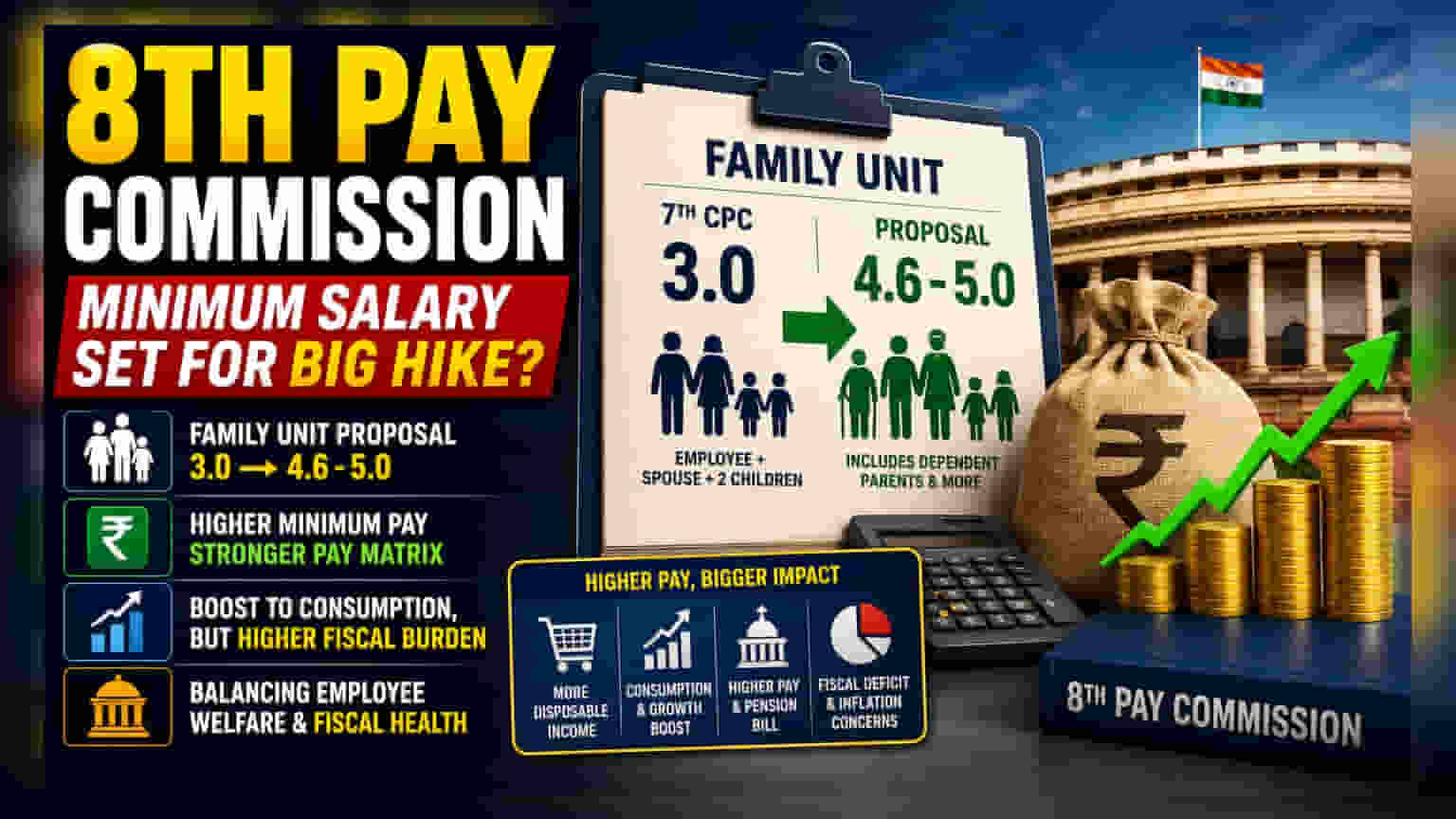
Discussions surrounding the potential 8th Pay Commission are gaining momentum, with employee groups proposing a revision to the 'family unit' calculation. This change, if adopted, could impact minimum pay structures and fitment factors, potentially leading to higher wage brackets for government employees. Investors are watching for the possible fiscal implications on the national budget.
What Happened
Anticipation regarding the 8th Pay Commission is building as employee unions and government staff organizations advocate for a revision in how minimum pay is calculated. The central point of the discussion involves the 'family unit'—a mathematical factor used by pay commissions to determine the basic cost of living for a household. Under the 7th Central Pay Commission, the family unit was set at 3.0, covering the employee, a spouse, and two children. Employee representatives, including the National Council-Joint Consultative Machinery (NC-JCM), have proposed increasing this unit to between 4.6 and 5.0. They argue this better accounts for modern household realities, such as supporting dependent parents.
Why This Matters For The Economy
For investors and the broader market, the structure of pay commissions carries significant weight. A change in the 'family unit' calculation could have a 'cascading effect' on the entire pay matrix. If the minimum basic pay is increased based on a larger family unit, it typically leads to an upward adjustment in the fitment factor. This revision influences the salaries of all government employees, not just those at the entry level. While higher disposable income among government staff can boost consumption and benefit sectors like consumer goods and automobiles, a large wage hike also increases the government's total salary and pension bill, which puts pressure on the national budget and fiscal deficit.
The Math Behind The Salary Debate
To understand the scale of the potential impact, one can look at the 7th Pay Commission’s data as a baseline. The 7th CPC utilized a 3.0 family unit to arrive at a minimum basic pay of ₹18,000. Reports analyzing these proposals suggest that if the unit count were adjusted to 4.6 or higher, the minimum salary figure could rise significantly. A higher minimum wage serves as the foundation for the entire pay structure. Consequently, any percentage increase at the base level tends to ripple through all pay scales, affecting allowances, pensions, and retirement benefits across the civil service.
Balancing Growth And Fiscal Health
Investors are often concerned with the government's fiscal discipline. A substantial increase in the wage bill often necessitates higher government spending, which may limit the resources available for infrastructure or other capital projects. Furthermore, economists monitor such wage revisions for their potential inflationary impact. If a large segment of the population sees a sharp increase in income, demand for goods and services may rise, which can influence headline inflation figures. The government typically balances these demands for higher pay with the need to maintain a sustainable fiscal deficit target, which is closely tracked by credit rating agencies and international investors.
What Investors Should Track
Investors should look for official announcements from the government regarding the formal establishment and terms of reference for the 8th Pay Commission. It is important to distinguish between union demands and official policy decisions. Future monitorables include the government’s stance on the timing of implementation, the accepted fitment factor, and how the projected expenditure is planned within the annual budget. These details will provide clarity on the potential impact on government finances and the overall economy.