 Whalesbook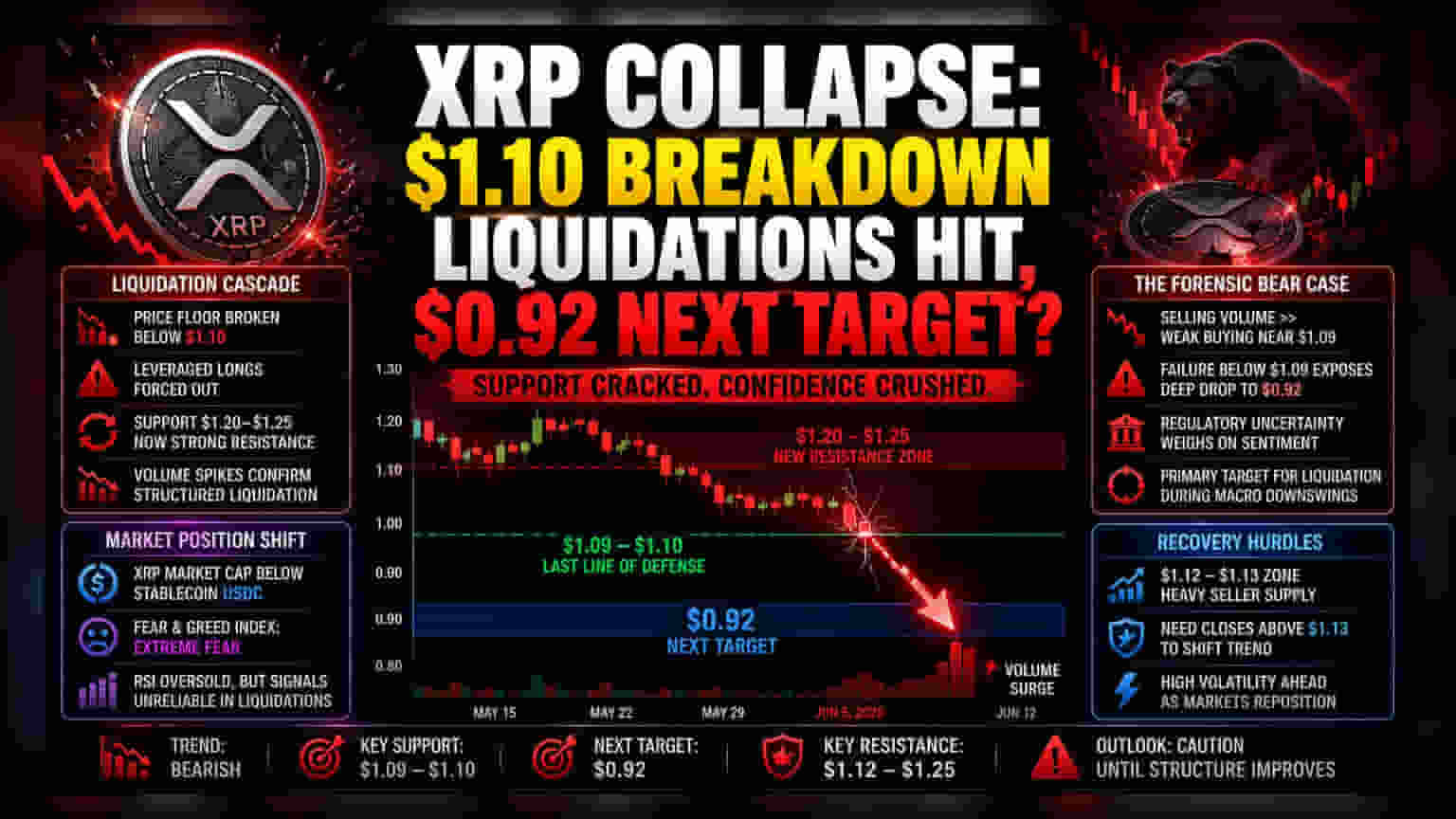


The Liquidation Cascade
The recent erosion of the $1.10 price floor signals a transition from organic profit-taking to a structured liquidation cycle. Unlike standard market retracements, the velocity of the selloff—evidenced by anomalous volume spikes—suggests that leveraged long positions were systematically purged. This forced exit has effectively converted former support zones between $1.20 and $1.25 into formidable resistance, creating a ceiling that will likely cap near-term recovery efforts.
Structural Divergence and Market Positioning
Beyond price action, the underlying shift in market hierarchy presents a concern for long-term holders. The loss of market capitalization dominance relative to stablecoins like USDC serves as a bellwether for institutional risk aversion. When an asset's market value retreats beneath that of a stablecoin, it frequently indicates a migration of capital toward cash-equivalent positions. Historically, this migration during periods of 'extreme fear' on the Fear and Greed Index tends to precede prolonged consolidation phases. While the Relative Strength Index has flirted with oversold conditions, these indicators remain unreliable in a market dominated by margin calls and forced selling, where technical signals are frequently overwhelmed by liquidity requirements.
The Forensic Bear Case
The current structure suggests a precarious outlook for bulls. The primary risk remains the disparity between selling volume and the lackluster recovery attempts observed near the $1.09 level. In healthy market cycles, a dip to long-term support is met with aggressive absorption; here, the absorption has been anaemic. Furthermore, the reliance on the $1.09-$1.10 zone as a primary defense leaves little margin for error. Should this line fail, the absence of meaningful liquidity pockets until the $0.92 range exposes the asset to significant downside volatility. Additionally, XRP’s regulatory shadow continues to weigh on investor sentiment compared to competitors with clearer institutional frameworks, making it a primary target for liquidation during macro-driven selloffs.
Trajectory and Resistance Hurdles
Stabilization is not merely a function of holding the $1.09 level, but of establishing a sustained recovery in volume. Any attempt to reclaim the $1.12 to $1.13 range will be met with selling pressure from traders trapped at higher entry points. Until the asset can demonstrate an ability to close sessions consistently above these levels, the technical trend remains firmly aligned with the bearish momentum initiated by the latest liquidation wave. Market participants should expect heightened volatility as participants reposition in anticipation of further macroeconomic shifts impacting the broader digital asset sector.