

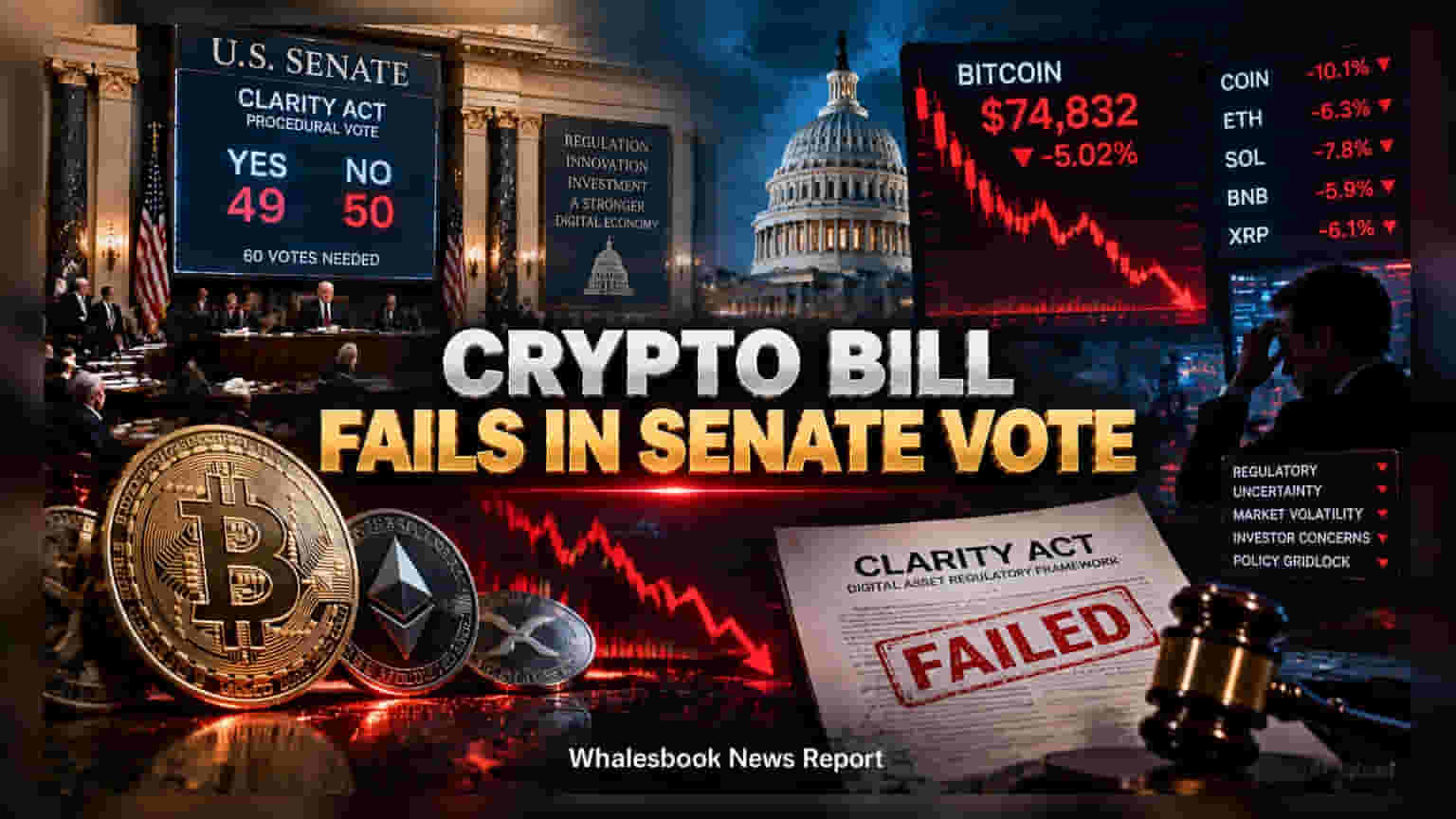
The US Senate failed to advance the 'Clarity Act' on September 15, 2026, in a 49-50 vote, blocking a major crypto regulation framework. The news triggered a market decline, with Bitcoin slipping over 5% and Coinbase shares dropping 10.1% as uncertainty over digital asset rules remains high.
On September 15, 2026, the US Senate blocked the 'Clarity Act,' a proposed law intended to create a comprehensive regulatory framework for cryptocurrencies. The bill failed to advance after a 49-50 procedural vote, falling short of the 60 votes needed to proceed to a full debate.
The failure of this legislation means the cryptocurrency industry will continue to operate under existing regulations enforced by agencies like the US Securities and Exchange Commission (SEC) and the Commodity Futures Trading Commission (CFTC). Many industry players had lobbied for this new law, hoping it would replace the current agency-level oversight which they argue creates inconsistency and legal uncertainty for digital asset businesses.
Financial markets reacted immediately to the setback. Bitcoin, the largest cryptocurrency by market value, declined approximately 5% to trade below $75,000 following the vote. Coinbase Global, a major publicly traded crypto exchange, saw its share price fall by 10.1% on the same day. Investors, who had hoped for a clear federal policy, sold off crypto-linked assets amid fears that the regulatory environment will remain volatile.
The vote saw opposition from all Democratic senators and four Republican senators: Susan Collins, Josh Hawley, Jerry Moran, and Thom Tillis. This outcome suggests that legislative progress on crypto regulation may be stalled as the country approaches the November midterm elections, leaving the industry without a unified federal law governing digital assets.
For investors, the situation highlights the ongoing sensitivity of the crypto sector to political and regulatory developments. Moving forward, the key to monitor will be how existing regulators, such as the SEC and CFTC, manage enforcement and rule-making in the absence of new federal legislation. Market participants will also watch to see if lawmakers attempt to revive similar legislative efforts after the elections, or if the current environment of uncertainty persists.