 Whalesbook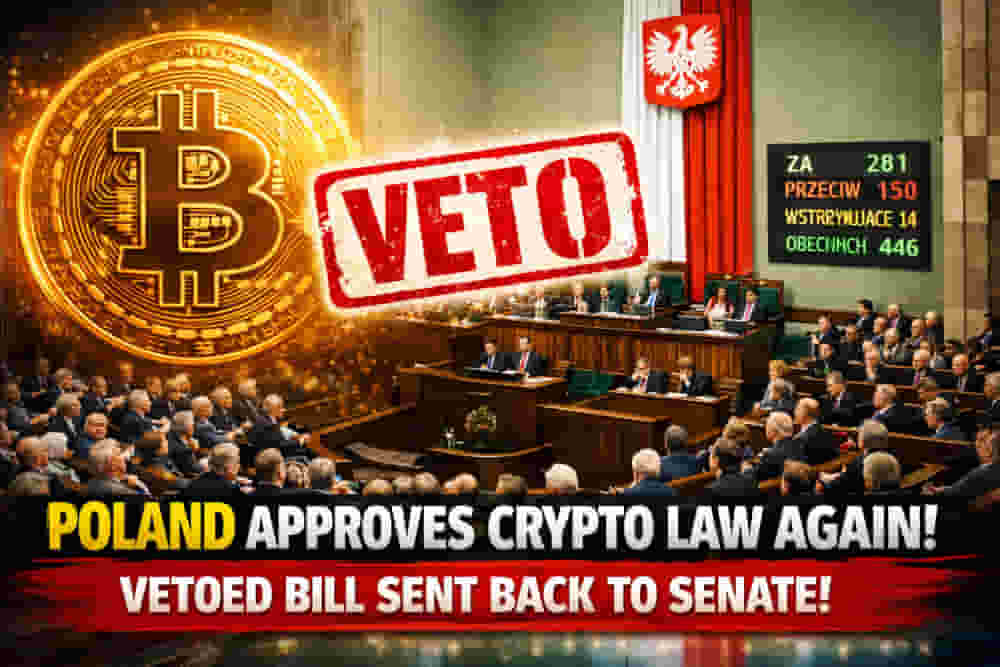
Poland Parliament Re-approves Strict Crypto Bill, Sidestepping Presidential Veto
Poland's lower house of parliament, the Sejm, has once again passed a comprehensive bill designed to regulate the nation's burgeoning cryptocurrency industry. This legislative move occurred despite a previous veto by President Karol Nawrocki, signaling a determined effort by the government to implement stringent oversight on digital assets.
The bill, which secured the support of 241 lawmakers on Thursday, remains unchanged from the version previously struck down by the president. It now proceeds to the Senate, Poland's upper legislative chamber, where it will undergo further debate and scrutiny before potentially returning to the president for final assent or another veto.
Aligning with European Union Standards
The primary objective of the newly passed bill is to ensure that Polish law is in full compliance with the European Union's comprehensive Markets in Crypto-Assets (MiCA) regulation. This framework aims to create a unified regulatory environment for crypto assets across all EU member states, fostering greater market integration and investor protection.
Criticism and Presidential Objections
Despite the alignment goal, the legislation has drawn sharp criticism from President Nawrocki and various stakeholders within Poland's crypto sector. A significant point of contention is the extensive enforcement powers granted to the Polish Financial Supervision Authority (KNF). These powers include the ability to order website blocking and impose substantial fines, potentially amounting to millions of Polish zloty.
President Nawrocki's office had previously cited the law's inherent ambiguity, its potential for overreach, and the considerable compliance costs it imposes on businesses as reasons for its initial veto. Concerns were raised that such broad powers, particularly the swift domain shutdown capabilities, deviate from the regulatory approaches adopted by most other European Union countries and could disproportionately affect smaller crypto firms.
Reintroduction and Future Prospects
Following the presidential veto, Prime Minister Donald Tusk's government has chosen to reintroduce the bill without making any revisions. This decision underscores the administration's commitment to establishing robust national oversight for the crypto market. The bill's extensive nature, spanning over 100 pages, has also been a subject of debate, with critics arguing it is unnecessarily complex compared to simpler implementations seen elsewhere in the region.
As the legislation moves to the Senate, it faces another potential hurdle. The president retains the authority to veto the bill once more if he remains unconvinced by its provisions or if the Senate's deliberations do not lead to satisfactory amendments. The outcome of the Senate's review will be pivotal in determining the future regulatory landscape for cryptocurrencies in Poland.
Impact
This development is significant for Poland's digital asset market, potentially leading to increased operational costs and compliance burdens for crypto businesses. It could also serve as a precedent for other EU nations considering similar regulatory frameworks. For investors, it signals a move towards greater regulatory certainty but may also introduce market apprehension due to the stringent enforcement measures. The impact rating reflects the significant, though primarily national and regional, regulatory implications. Impact Rating: 6/10
Difficult Terms Explained
- Sejm: The lower house of the Polish parliament, responsible for legislation.
- Senate: The upper house of the Polish parliament, which reviews legislation passed by the Sejm.
- MiCA: Markets in Crypto-Assets, a landmark regulation by the European Union aiming to standardize rules for crypto assets across the EU.
- KNF: Komisja Nadzoru Finansowego, the Polish Financial Supervision Authority, the country's financial market regulator.
- Zloty: The official currency of Poland (PLN).
- Veto: The power of a president or head of state to reject a bill passed by the legislature.