 Whalesbook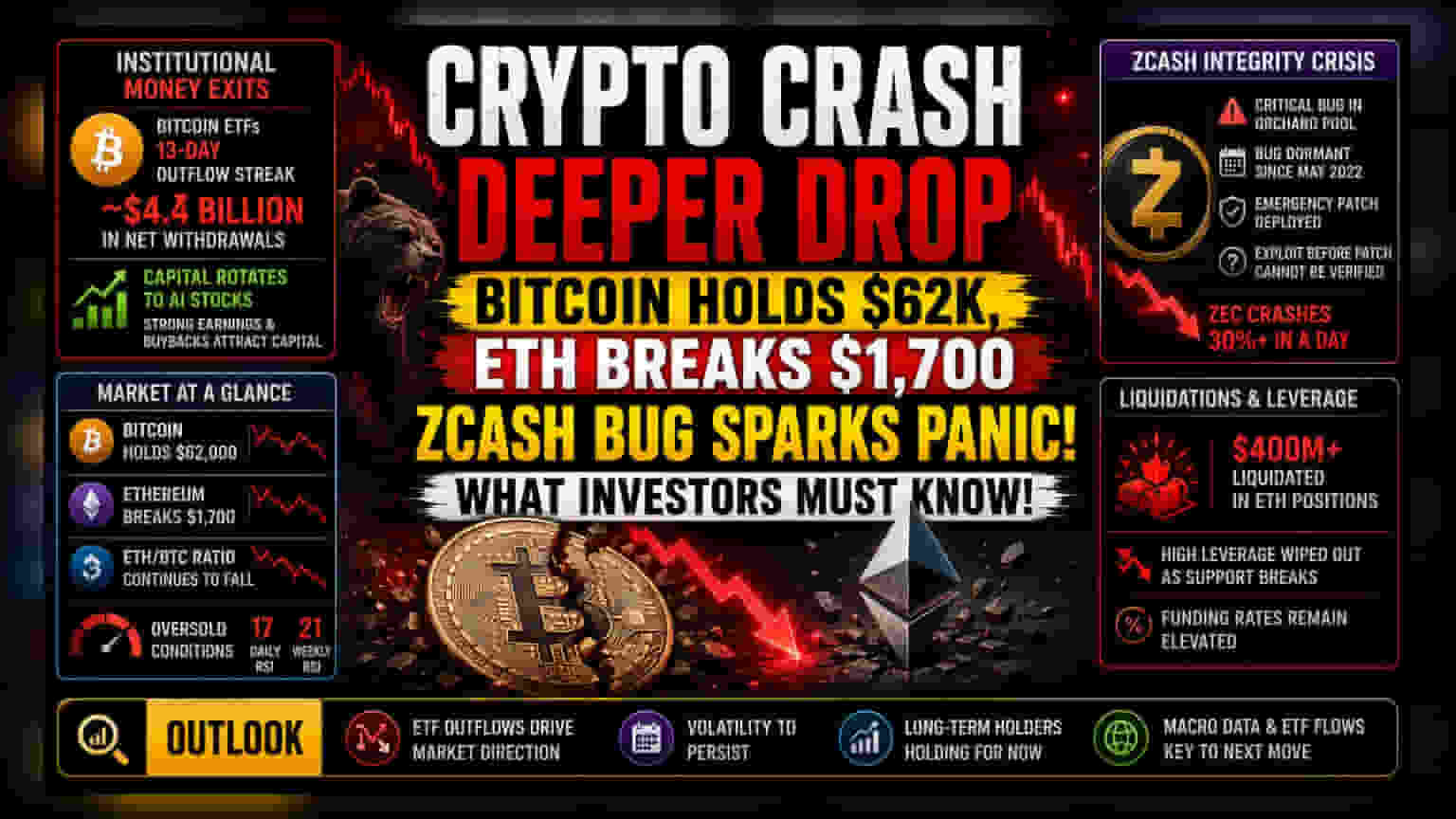


The Capital Rotation Catalyst
The current downturn in digital assets is primarily a function of a structural shift in investor preference. While retail sentiment remains fearful, the primary engine of the sell-off is a consistent bleed in institutional products. Spot Bitcoin ETFs have now endured a record-breaking 13-day outflow streak, resulting in approximately $4.4 billion in net capital withdrawals. This capital is not merely exiting the investment sphere; it is rotating into artificial intelligence-focused equities, which are benefiting from robust earnings growth and aggressive corporate buybacks, leaving digital assets struggling to maintain their liquidity floors.
Valuation and Support Floors
Bitcoin is currently defending the $62,000 level after breaking through multiple psychological support zones. Technical indicators reveal an oversold condition, with daily and weekly Relative Strength Index (RSI) readings suggesting extreme bearish momentum. Ethereum has concurrently broken below $1,700, its lowest valuation since April 2025. The failure to hold this support is exacerbated by over $400 million in forced liquidations within the Ethereum ecosystem, as leveraged long positions are systematically purged from the market. The ETH/BTC ratio continues to face downward pressure, signaling that capital is retreating faster from the broader altcoin sector than from the market leader.
The Zcash Integrity Crisis
The broader market weakness was significantly amplified by the disclosure of a critical soundness bug in Zcash's Orchard privacy pool. This vulnerability, which remained dormant since May 2022, could have theoretically permitted the creation of unlimited, undetectable counterfeit ZEC tokens. While the Zcash development team successfully deployed an emergency fix, the inherent privacy design of the Orchard pool prevents cryptographic verification of whether the bug was exploited prior to the patch. This uncertainty triggered a swift sell-off, with the token losing over 30% of its value in a single day. The event has reignited industry debates regarding the viability of privacy-preserving protocols, with some developers now explicitly cautioning against integrating such complex, opaque systems into broader blockchain consensus layers.
Risk Factors and Outlook
The market outlook remains cautious, with institutional flows serving as the primary leading indicator. Ongoing liquidations in the futures market suggest that volatility will persist until funding rates normalize. While some observers note that long-term holders have not yet capitulated on a scale comparable to 2022, the lack of fresh buy-side demand remains the most significant structural weakness. Future price discovery will likely depend on whether ETF outflows stabilize and if broader macroeconomic data—specifically upcoming inflation and employment reports—encourages a return to risk-on assets.