 Whalesbook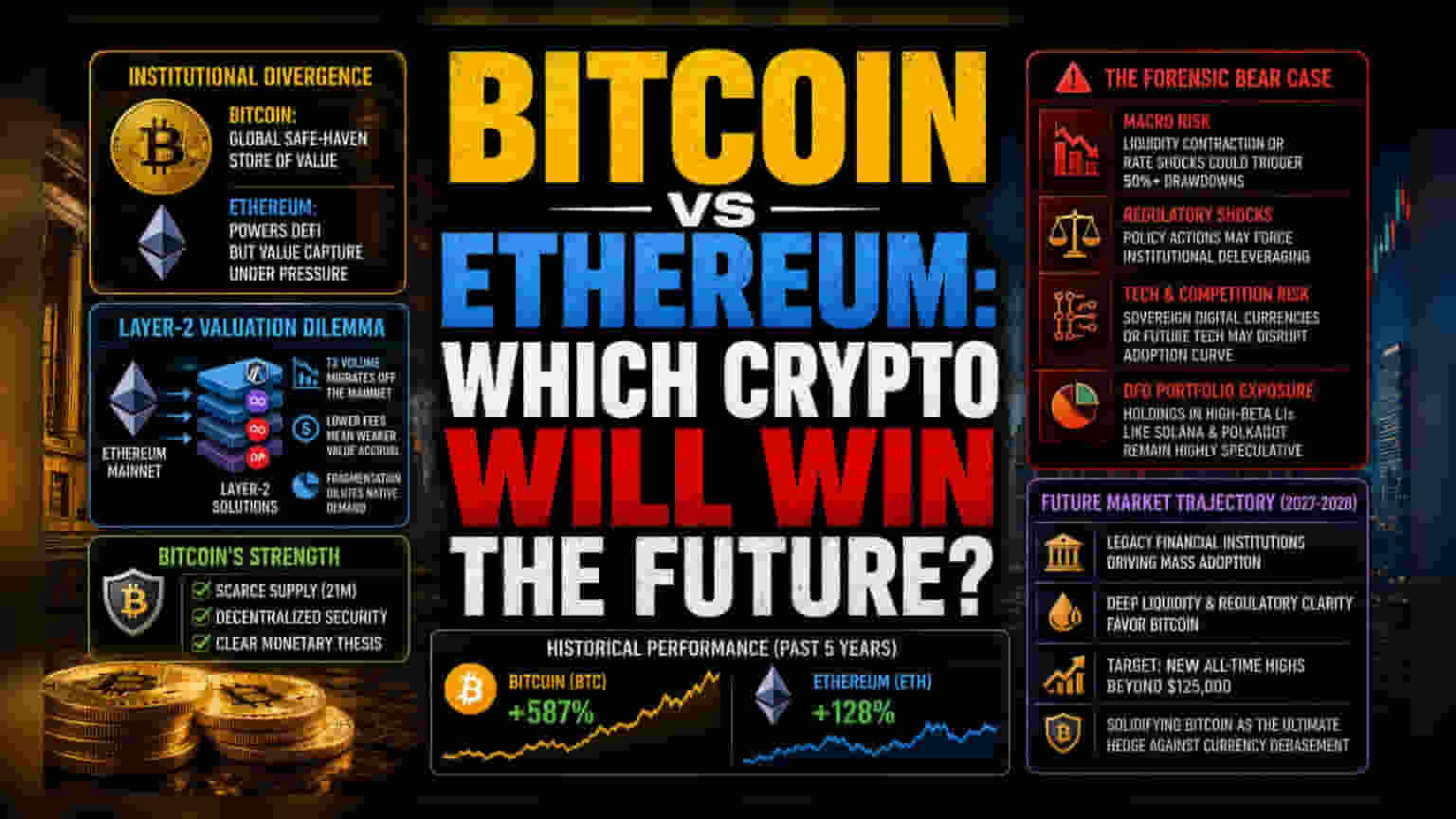


The Institutional Divergence
The ongoing debate regarding the hierarchy of digital assets has shifted from technological capability to structural value accrual. Institutional preference is increasingly concentrated on Bitcoin, driven by its perceived role as a global safe-haven asset rather than an application-layer utility. While Ethereum continues to dominate the decentralized finance ecosystem, market participants are questioning whether its native token can maintain scarcity in a landscape increasingly defined by modularity and secondary network expansion.
The Layer-2 Valuation Dilemma
Recent shifts in network architecture suggest that Ethereum’s internal value mechanism faces substantial headwinds. The proliferation of Layer-2 solutions has effectively decoupled transactional volume from the Ethereum mainnet, complicating the thesis for Ether as a singular value-capture asset. By outsourcing compute and fee generation to external layers, the primary network risks becoming a settlement hub with lower native fee pressure. This structural fragmentation stands in stark contrast to Bitcoin’s singular focus on security and monetary store-of-value, which provides a more predictable investment thesis for large-scale institutional allocators looking to bypass the complexity of smart-contract risks.
The Forensic Bear Case
Investors must weigh these bullish projections against significant macroeconomic and structural risks. Market history demonstrates that Bitcoin is highly sensitive to liquidity cycles and shifts in global monetary policy. A potential 50% retracement, as suggested by some market observers, would likely be triggered by a contraction in the broad money supply or regulatory shocks that force institutional deleveraging. Furthermore, the reliance on historical performance to forecast a $125,000 peak assumes a continuation of the current adoption curve, ignoring the possibility of future technological obsolescence or intense competition from sovereign-backed digital currencies. The firm DFG, despite its managed assets, also faces the inherent risk of its diversified portfolio, which includes exposure to volatile Layer-1 protocols like Solana and Polkadot that remain highly speculative compared to Bitcoin.
Future Market Trajectory
As the industry approaches the 2027-2028 timeframe, the focus will likely remain on whether Bitcoin can solidify its status as a liquid alternative to traditional equity markets and regional real estate. Institutional mandates generally favor assets with clear regulatory clarity and deep liquidity, both of which Bitcoin currently provides in greater abundance than its decentralized counterparts. Success in reaching new highs will depend less on speculative momentum and more on the sustained entry of legacy financial institutions into the asset class, solidifying Bitcoin's position as the primary hedge against currency debasement.