

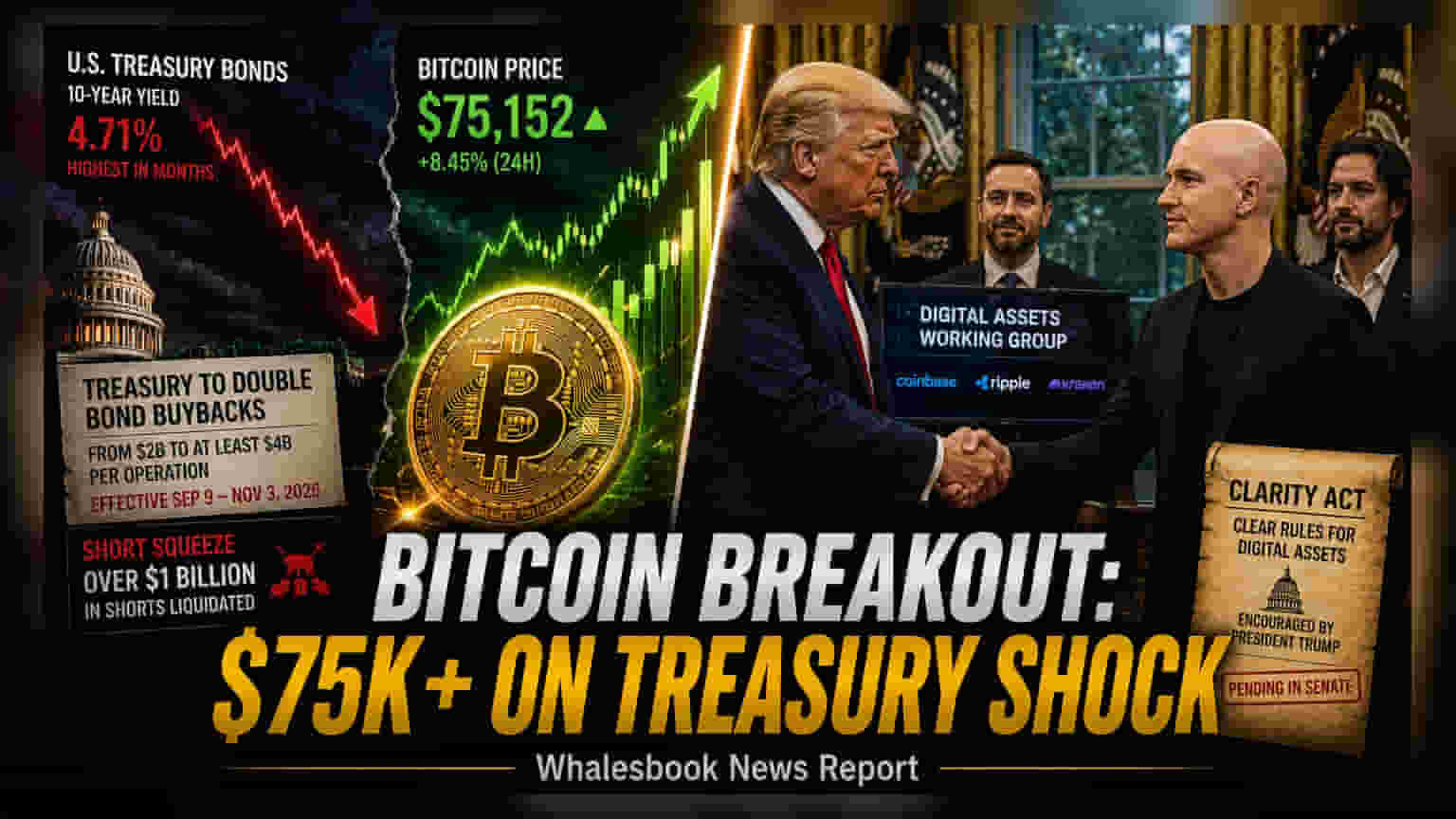
Bitcoin has climbed past $75,000, supported by the US Treasury’s decision to boost long-term bond buybacks. This move has triggered investor concerns about fiscal dominance and debt, while a massive wave of short-position liquidations has provided further fuel for the rally.
Bitcoin’s price jumped above the $75,000 mark on August 21, 2026, building on a strong weekly performance that has caught the attention of global financial markets. The latest rally follows the US Treasury's announcement that it will double its long-term bond buyback operations, increasing them from $2 billion to at least $4 billion per operation. This program is set to take effect on September 9 and run through early November 2026.
Investors are interpreting the Treasury’s move as a signal of 'fiscal dominance.' In simple terms, this happens when the government prioritizes financing its massive debt over other economic goals, like controlling inflation. When a government increases liquidity in the market to buy back its own debt, it can lead to fears of currency debasement. Many investors turn to assets like Bitcoin during such times, viewing them as a potential hedge against the risk that traditional money might lose value over the long term.
Beyond the macro-economic signals, the speed of the rally was amplified by a technical event known as a short squeeze. As Bitcoin’s price moved higher, traders who had bet against the currency were forced to close their positions to prevent further losses. Market data shows that over $1 billion in short positions were forcibly liquidated in the days following the Treasury’s announcement. This forced buying pressure creates a cycle that pushes the price up even faster in a short period.
Sentiment was also helped by recent political developments in Washington. President Donald Trump held a meeting at the White House with leaders from major cryptocurrency and technology firms, including executives from Coinbase and Ripple. During the discussion, the President encouraged Congress to advance the 'Clarity Act,' a proposed bill aimed at creating a clear regulatory framework for digital assets in the US. While this engagement has boosted market optimism, the bill remains stalled in the Senate, leaving the industry in a state of regulatory limbo for the time being.
Despite the excitement, market analysts point to several risks for investors to track. The rapid price increase has led to high volatility, and some experts suggest the rally is currently driven more by liquidity and technical factors rather than long-term demand. Additionally, the broader US economic environment remains uncertain, with long-term concerns about the national deficit continuing to loom over all risk-on assets. For now, investors are focused on whether this momentum can sustain itself or if it acts as a short-term relief rally in a still-maturing regulatory environment.