

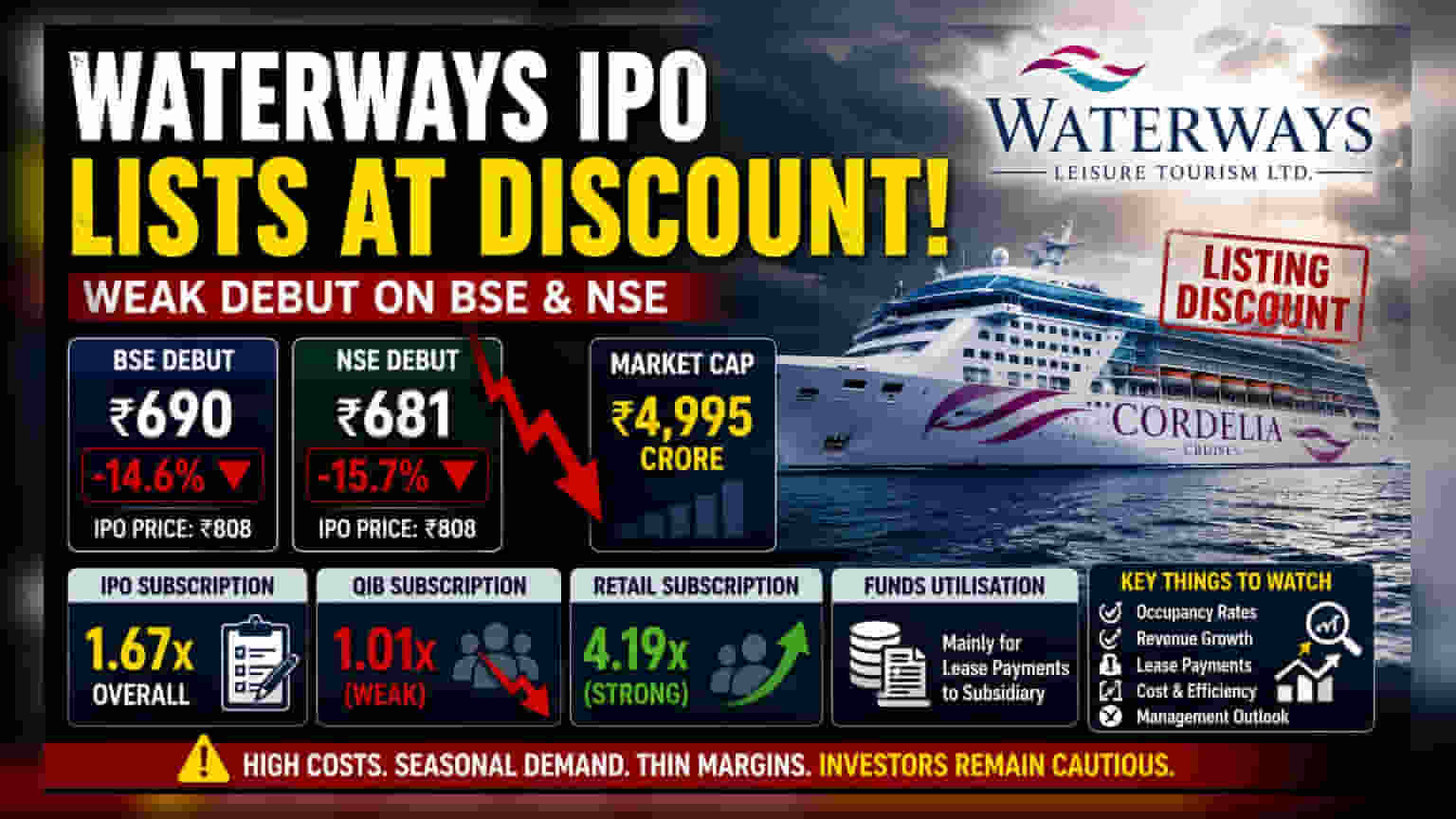
Waterways Leisure Tourism shares began trading on the BSE and NSE at a discount, opening around ₹681–₹690 against the issue price of ₹808. This weak market debut follows a moderate subscription response and signals investor caution regarding the company's valuation and the cruise sector's outlook.
What Happened
Waterways Leisure Tourism shares faced a challenging market entry today. The stock opened at a significant discount to its initial public offering (IPO) price of ₹808. On the Bombay Stock Exchange (BSE), the stock began trading at ₹690, while on the National Stock Exchange (NSE), it opened at ₹681. This represents a decline of approximately 14.6% to 15.7% from the issue price, depending on the exchange. With this opening, the company’s market capitalization stood at approximately ₹4,995 crore.
Why Investors Were Cautious
The weak listing follows a subscription trend that lacked broad-based enthusiasm. The ₹585 crore IPO was subscribed 1.67 times in total. While retail investors showed interest, with their portion oversubscribed 4.19 times, institutional investors (Qualified Institutional Buyers or QIBs) showed minimal participation, with their allocated portion subscribed at just 1.01 times. In the stock market, low institutional participation can often be interpreted as a sign of caution regarding valuation or business fundamentals.
The Business And Financial Picture
Waterways Leisure Tourism operates Cordelia Cruises, a domestic ocean cruise brand in India. The company’s financial structure relies heavily on capital-intensive operations, which are typical for the cruise and maritime leisure sector.
A key point for investors to consider is how the company utilizes its funds. According to the IPO prospectus, the net proceeds from this fresh issue are primarily earmarked for lease payments to its step-down subsidiary, Baycruise Shipping and Leasing (IFSC) Pvt Ltd. This indicates that a significant portion of the raised capital is being directed toward clearing or managing financial obligations related to ship leasing rather than direct expansion or new operational capacity. Investors often view capital allocation toward debt or lease management differently than capital aimed at immediate business growth.
Risks and Sector Context
The cruise industry is highly sensitive to seasonal demand and operational costs. Unlike more predictable sectors, the cruise business faces risks related to fuel prices, maintenance costs, and travel demand, which can fluctuate based on broader economic conditions. Furthermore, companies in this space often operate with thin margins. The market's cool response suggests that investors may be weighing the company's ability to maintain consistent profitability against these high fixed costs and lease obligations.
What Investors Should Track
Going forward, shareholders may want to watch how the company manages its lease obligations and improves operational efficiency. Key areas to monitor in the coming quarterly results include occupancy rates on their cruise ships, revenue growth trends, and the status of the lease payments to the subsidiary. The market will likely look for signs that the company can sustain its operations without needing frequent capital infusions. Management commentary regarding their strategy for managing seasonal demand and controlling operating expenses will be another important factor.