

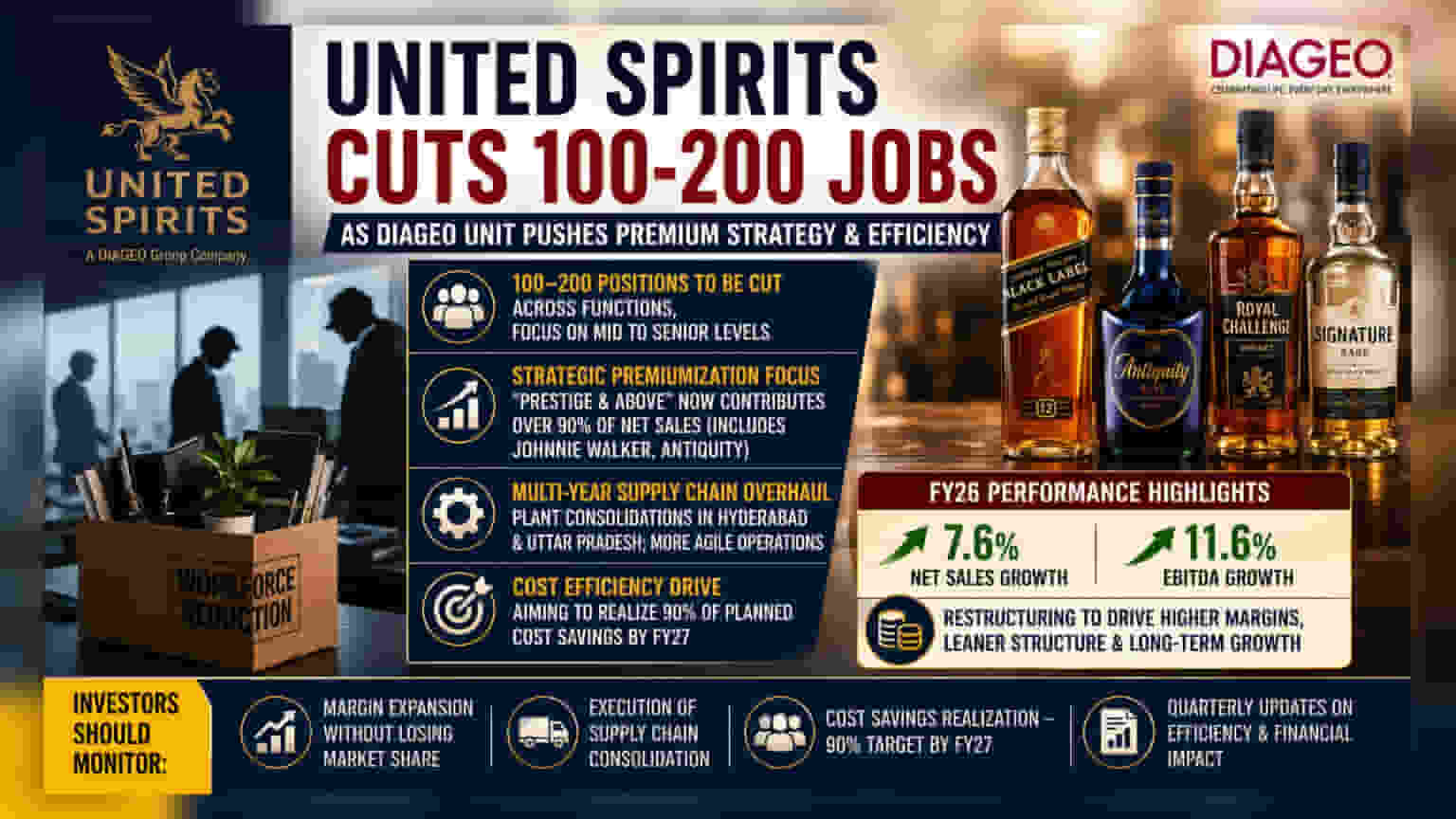
United Spirits is reducing its workforce by approximately 100 to 200 employees in India as part of a wider cost-saving plan from parent company Diageo. Despite this, the firm remains focused on its premiumization strategy, which helped drive strong sales growth in fiscal year 2026. Investors may monitor how these operational changes, alongside recent manufacturing consolidations, impact profit margins and business agility.
What Happened
United Spirits (USL), the Indian subsidiary of global liquor giant Diageo, is undergoing a workforce reduction involving approximately 100 to 200 positions. This restructuring is aligned with a broader global strategy by Diageo to streamline costs and enhance operational productivity. The reductions are expected to affect various functions across the organization, with a particular focus on mid- to senior-level roles. While the company maintains a total workforce of roughly 2,400 employees, these cuts are framed as a strategic effort to lean out the corporate structure rather than a response to financial distress.
The Shift Toward Premium Products
The job cuts are occurring alongside the company's long-term "premiumization" strategy. United Spirits has been actively pivoting its portfolio to prioritize higher-value spirits, a segment the company refers to as "Prestige and Above." This category, which includes well-known brands such as Johnnie Walker and Antiquity, now accounts for more than 90% of the company's net sales. By shifting resources and management focus toward these higher-margin products, the company aims to move away from low-margin, high-volume products, which typically requires a different organizational setup and headcount profile.
Linking Efficiency to Financial Growth
From a financial perspective, United Spirits reported positive results for fiscal year 2026, featuring a 7.6% increase in net sales and an 11.6% growth in EBITDA, or operating profit. These figures indicate that the current restructuring is proactive rather than reactive. The effort to cut costs is part of a larger, multi-year supply chain overhaul designed to optimize the company's manufacturing and distribution footprint. This initiative has already led to the consolidation or closure of several manufacturing sites, including units in Hyderabad and Uttar Pradesh, in an attempt to build a more agile production network.
Risks and Investor Monitorables
For investors, the crucial detail to track is whether these cost-cutting measures successfully expand profit margins without disrupting market share or distribution. The Indian spirits market is highly competitive, with established domestic players like Radico Khaitan and Allied Blenders & Distillers, as well as global competitors like Pernod Ricard, constantly vying for consumer preference.
Another layer of risk involves the execution of the supply chain consolidation. If closing manufacturing facilities or reducing headcount leads to distribution gaps or delays in production, it could create short-term operational hurdles. Management has previously suggested that 90% of the intended cost-saving benefits from this supply chain overhaul are expected to be realized by fiscal year 2027. Investors will likely look for confirmation in upcoming quarterly filings that these efficiency efforts are indeed translating into sustainable margin improvements.