 Whalesbook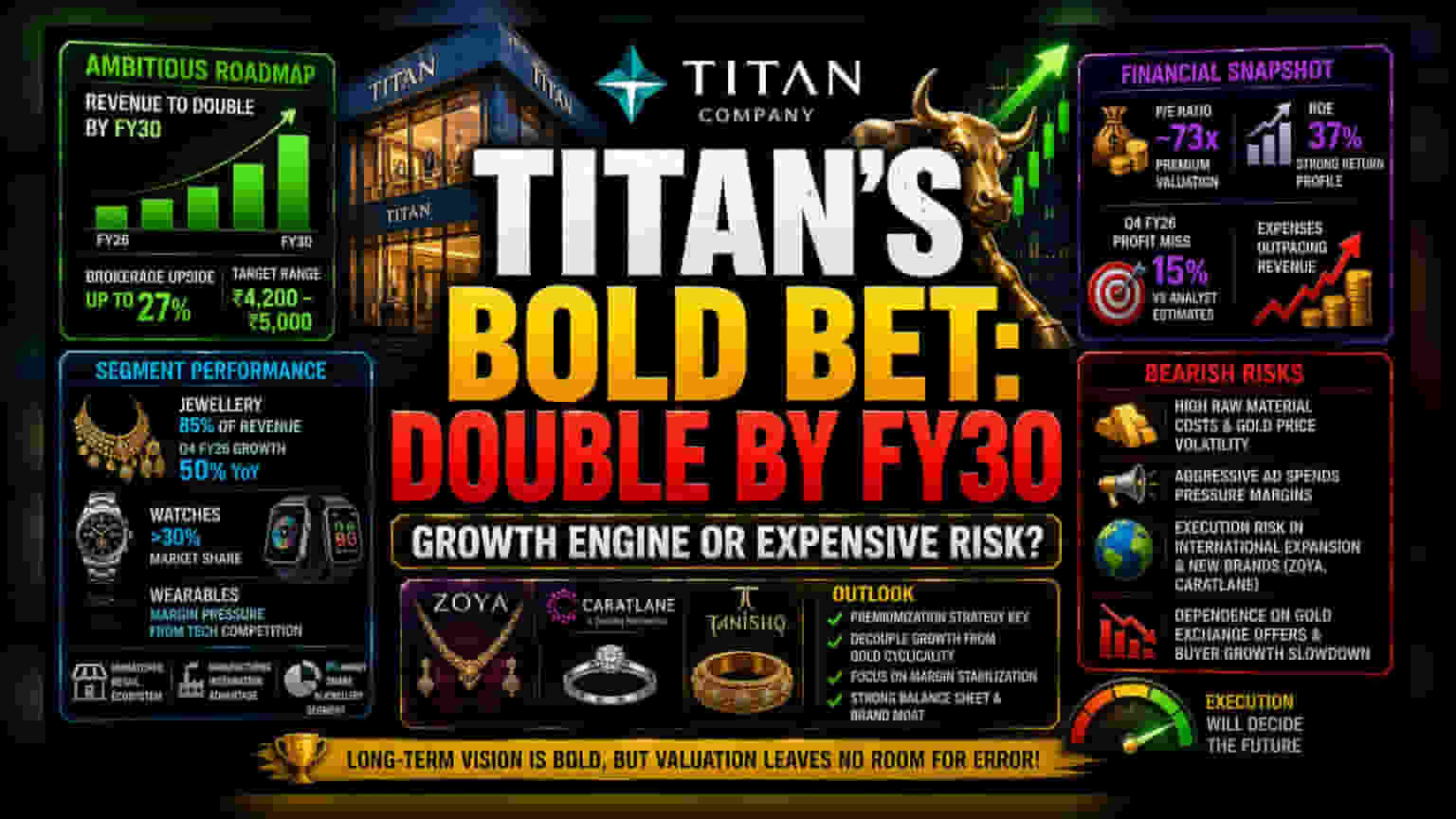


The Valuation Gap
Titan Company’s recent institutional analyst meet has set an ambitious tone, with the firm publicly committing to doubling its consolidated revenue by FY30. Market participants have largely reacted to this guidance with a renewed bullishness, leading to brokerage targets suggesting up to 27% upside from current levels. However, the enthusiasm masks a complex fundamental reality. Trading at a P/E of approximately 73x, the stock remains a premium-priced growth play that demands flawless execution. The divergence between long-term growth narratives and the immediate financial pressure of elevated raw material costs defines the current investment environment for this Tata group entity.
The Analytical Deep Dive
When contextualizing Titan’s current position, the contrast between segment performances is stark. The jewellery division, accounting for roughly 85% of revenue, continues to be a juggernaut, having recorded 50% year-on-year growth in the final quarter of FY26. Yet, this success is heavily indexed to consumer confidence in gold despite record prices. Unlike competitors such as Kalyan Jewellers or agile digital-first players like BlueStone, Titan leverages an unmatched retail ecosystem and deep manufacturing integration. However, the wearables and smartwatch segment presents a drag, with competitive pressure from tech giants squeezing margins and unit growth. While the company maintains an 8% market share in the broader jewellery space and over 30% in organized watches, the capital intensity required to scale further while maintaining a 37% return on equity is a mounting challenge.
The Forensic Bear Case
Investors should remain wary of the margin story. While top-line revenue growth appears robust, the company’s recent performance—specifically a 15% miss against analyst profit estimates in Q4 FY26—highlights structural vulnerability. Total expenses have outpaced revenue growth in recent periods, as higher raw material costs and aggressive advertising spending erode profitability. Furthermore, the company faces significant execution risk in its international expansion and the rapid scaling of newer brands like Zoya and CaratLane. Should the macro environment cool or gold price volatility persist, the premium valuation could face a sharp re-rating. Management’s past reliance on gold exchange programs to sustain volume must be weighed against the potential for slowing buyer growth if price points continue to climb.
The Future Outlook
Brokerage consensus generally remains constructive, with target prices fluctuating between ₹4,200 and ₹5,000 as the market weighs the FY30 roadmap against quarterly volatility. Future share price trajectory will likely hinge on the company’s ability to prove that its premiumization strategy can successfully decouple revenue growth from the cyclicality of precious metal prices. Institutional eyes will remain focused on the upcoming quarterly guidance for signs of margin stabilization.