

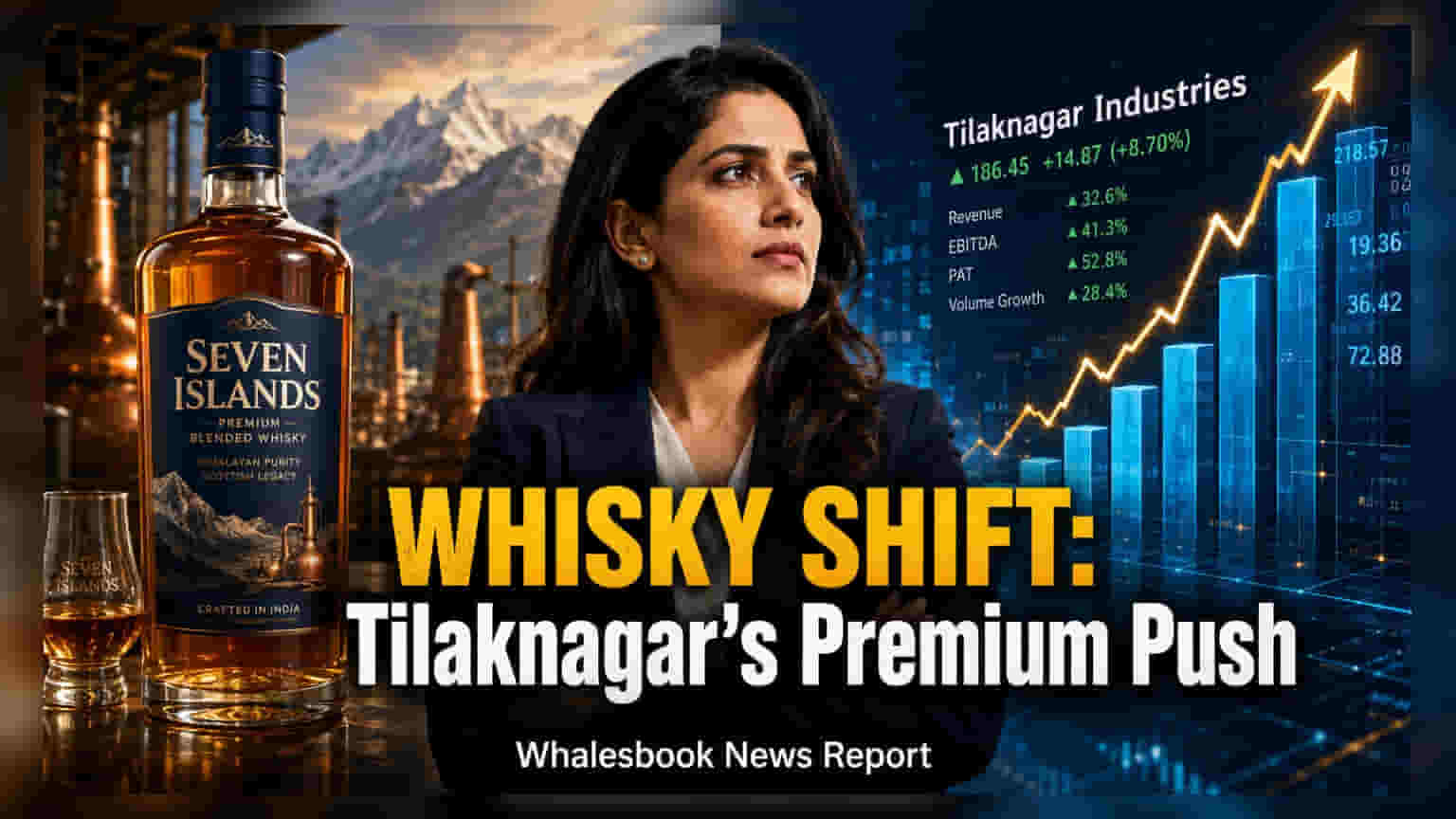
Tilaknagar Industries is moving beyond its traditional brandy base by launching Seven Islands, a pure malt whisky. This strategy targets younger consumers as the company reports a 68% annual revenue growth to ₹5,248 crore for FY26. Investors may track how this premium portfolio diversification impacts margins compared to its historical brandy-dominant business model.
Tilaknagar Industries is undergoing a significant business transformation, pivoting away from its historical reliance on brandy to capture higher-value segments in the Indian spirits market. The company recently launched Seven Islands, a pure malt whisky that blends spirits from Scotland and India. By choosing the pure malt category, the company aims to differentiate itself from the increasingly competitive and crowded Indian single malt market.
Strategic Shift in Product Mix
This move toward premium products is a calculated attempt to align with changing consumer habits in India. Management notes that younger consumers are increasingly moving toward higher-value spirits and cocktail-friendly formats. Historically, Tilaknagar Industries was heavily dependent on brandy, which previously accounted for approximately 90% of its business. Recent portfolio adjustments have reduced this dependence to about 30%, with whisky now serving as the company's primary revenue driver. The acquisition of the Imperial Blue brand has also been a key factor in strengthening the company's distribution network, which is essential for scaling these newer product lines.
Financial Performance and Growth
The company's financial results reflect this strategic transition. For the quarter ended March 2026, Tilaknagar Industries reported net revenue of ₹949 crore, marking a 134% increase compared to the same period in the previous year. For the full fiscal year 2026, the company recorded total revenue of ₹5,248 crore, representing a 68% growth rate. As the company expands into premium categories, the key monitorable for investors will be whether this shift sustains profit margins, as premium segments typically involve higher marketing and production costs compared to mass-market spirits.
Sector Context and Future Outlook
The broader Indian alcoholic beverages sector is undergoing a shift from volume-driven consumption to experience-driven premiumization. While the market remains vast, with annual consumption exceeding 200 million cases, competition is rising as both domestic players and international brands vie for market share. Additionally, the potential for a Free Trade Agreement between India and the UK remains an important factor for the industry, as it could influence the pricing and availability of imported Scotch, potentially impacting the competitive landscape for domestic premium whiskies. Moving forward, shareholders will likely monitor the reception of the Seven Islands brand and the company's ability to maintain its growth momentum while managing the costs associated with its ongoing expansion into the premium segment.