

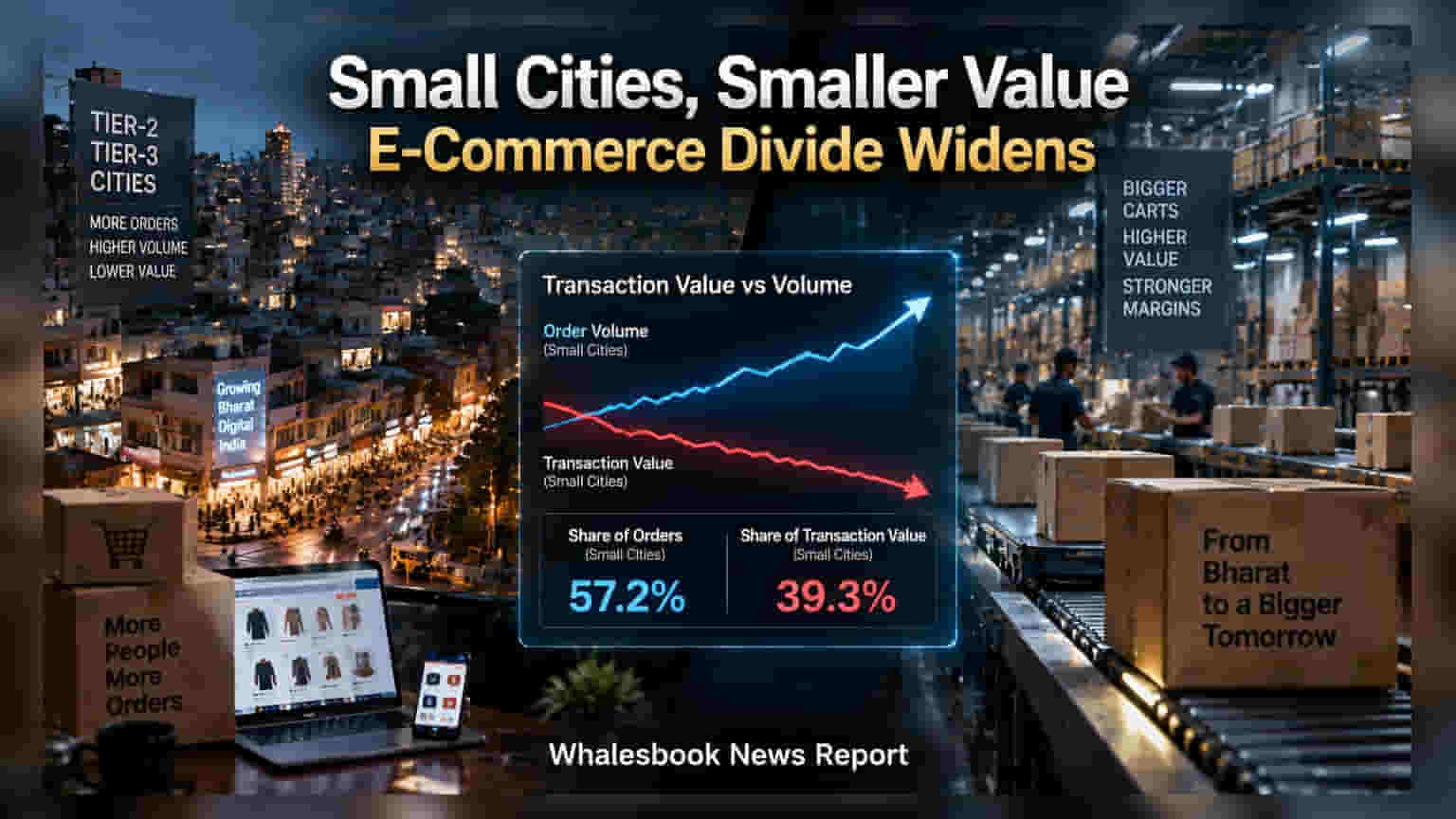
New data reveals that Tier-2 cities now drive over 57% of e-commerce orders, yet their average transaction value remains far below metro levels. This creates a profitability challenge for retailers, as higher logistics costs and lower spending per order could put pressure on profit margins across the sector.
The latest industry data covering over 200 million orders through July 2026 shows a widening divide in India’s e-commerce growth. While digital retail is expanding rapidly in smaller urban centers outside the top 96 cities, these regions contribute only 39.3% of the total transaction value despite accounting for 57.2% of all orders. This trend signals that growth in these areas is driven by the frequency of purchases rather than the size of the spending.
For retail investors, the most critical metric here is the average order value (AOV). The data shows a significant gap: the average transaction in smaller markets is ₹830, compared to ₹1,714 in major metropolitan areas. This discrepancy creates a profitability hurdle for e-commerce companies. Logistics and delivery costs are largely fixed, meaning a company pays roughly the same amount to deliver a small-value package as it does for a high-value one. When the order value is low, it leaves much less room to cover shipping and operational expenses, which can pull down profit margins.
The regional data highlights that a uniform national strategy may not work for all retail firms. Haryana, for example, reports a much higher AOV of ₹3,804, showing that some smaller markets can be highly profitable. In contrast, states like Bihar report an AOV of ₹609, which is significantly lower than the national average. Meanwhile, hubs like Gurugram demonstrate the massive potential of concentrated wealth, with an AOV of ₹6,693. This shows that retail companies need to be highly selective about where they expand their network.
Investors may want to watch how retail companies and logistics providers manage this balance between expanding their reach and maintaining profitability. A key monitorable will be whether companies can successfully upsell more products to increase the average order value in Tier-2 and Tier-3 markets. Furthermore, as the sector matures, the ability to streamline supply chains to reduce the cost of delivery will be just as important as growing the number of orders. Companies that prioritize high-value segments or efficient delivery models in smaller cities may be better positioned to protect their margins in the long run.