 Whalesbook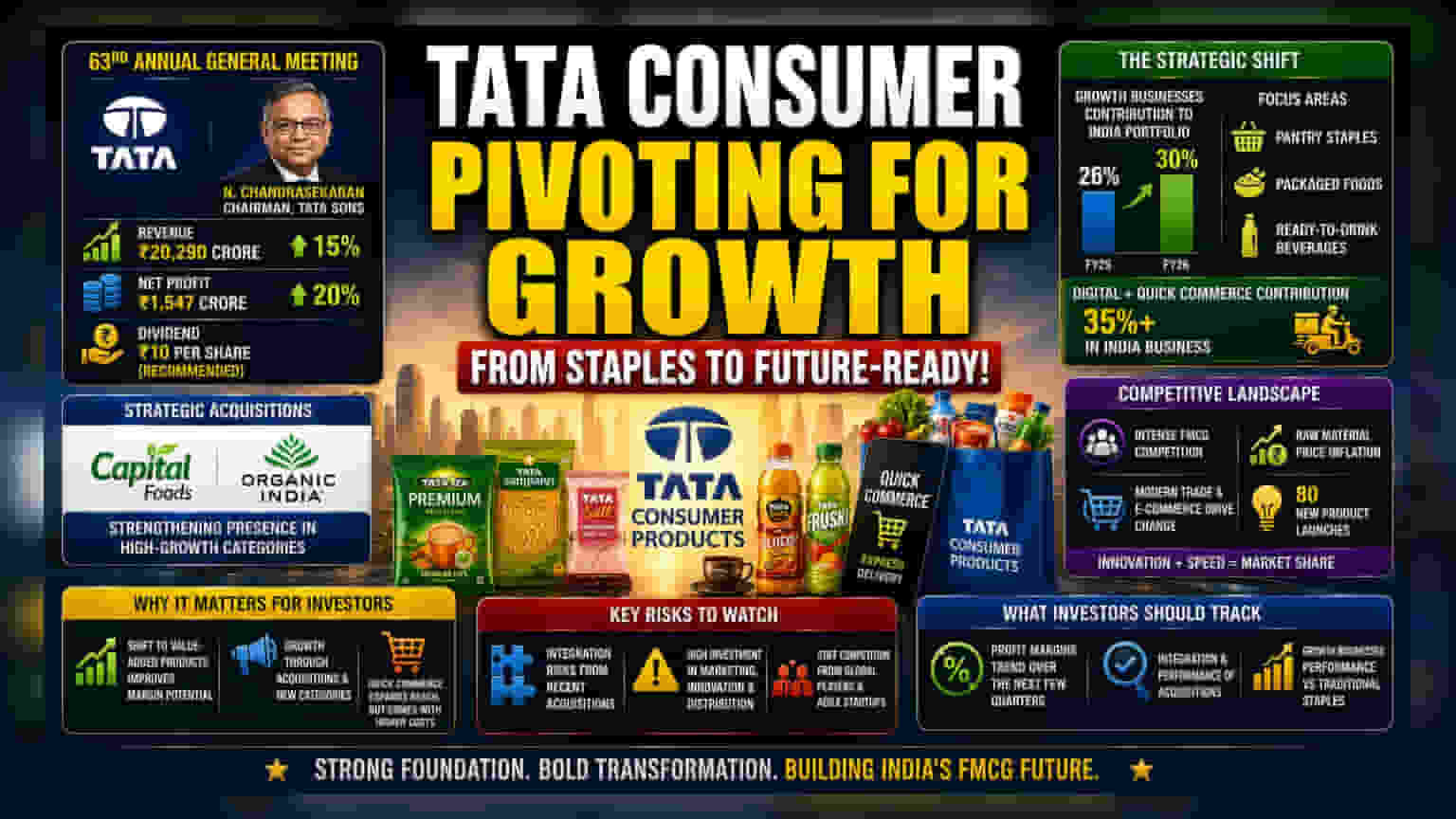


Tata Sons Chairman N. Chandrasekaran outlined Tata Consumer’s pivot from a tea-and-salt firm to a diversified FMCG giant. With revenue growing to ₹20,290 crore, the company is aggressively expanding through acquisitions like Capital Foods and Organic India. Investors are now watching whether this expansion into new categories and quick commerce can sustain profit margins amidst rising sector competition.
What Happened
At the company’s 63rd annual general meeting, Tata Sons Chairman N. Chandrasekaran highlighted India’s strong economic growth and outlined the future path for Tata Consumer Products. He described India as a major bright spot in the global economy and positioned Tata Consumer as a key player capable of capturing evolving consumption trends. The company reported a consolidated revenue growth of 15% to ₹20,290 crore for the year, alongside a 20% rise in net profit to ₹1,547 crore. The board has recommended a dividend of ₹10 per share.
The Strategic Shift
Tata Consumer is actively transitioning its identity. For decades, the company relied on traditional staples like tea, salt, and pulses. While these products continue to provide a stable foundation, the company is now channeling resources into higher-growth segments. This includes pantry staples, packaged foods, and ready-to-drink beverages. According to the company's filing, these 'growth businesses' now contribute 30% to the India portfolio, up from 26% just a year ago.
The strategy is heavily supported by recent acquisitions, including Capital Foods and Organic India. These moves are designed to increase the company's presence in high-demand categories where consumers are willing to spend more on branded, packaged products. The firm is also changing how it reaches customers, with digital channels and quick commerce platforms now accounting for over 35% of its business in India.
How Investors May Read This
For investors, the core development is the change in the product mix. Moving from commodity-driven items to value-added food products typically helps a company improve its profit margins over time. However, this transition requires heavy spending on marketing, innovation, and distribution.
The rise of quick commerce as a primary sales channel is also a significant shift. While this provides immediate access to customers, it often comes with higher distribution costs and intense competition, as many FMCG companies are competing for limited shelf space on delivery apps. Investors will likely look for signs that this distribution shift is adding to the bottom line rather than just increasing volume at the cost of margins.
Sector Context and Competition
The FMCG sector in India remains highly competitive. The shift toward modern trade and e-commerce has forced traditional players to rethink their supply chains. Tata Consumer’s move to double its new product launches to 80 indicates an aggressive effort to capture market share. However, the sector is also sensitive to raw material price inflation. Sustained profitability will depend on the company’s ability to pass on costs to consumers or manage input expenses through operational efficiency.
Risks and Concerns
One of the main challenges for Tata Consumer is the integration of its recent acquisitions. Bringing businesses like Capital Foods and Organic India into a single corporate structure involves significant execution risks. Differences in company culture, operational styles, and supply chain management can sometimes lead to temporary hurdles. Furthermore, as the company enters new categories, it faces stiff competition from both established multinational corporations and agile local startups. If the anticipated growth in these new categories does not materialize as planned, the heavy investment could pressure the company’s cash flow and return ratios.
What Investors Should Track
Investors may monitor a few key indicators in the coming quarters. First is the profit margin trend; if the cost of expanding into new categories rises faster than revenue, it could squeeze earnings. Second is the integration progress of recent acquisitions—shareholders will look for confirmation that these businesses are becoming accretive to earnings. Finally, the performance of the 'growth businesses' compared to traditional staples will be a critical measure of whether the company’s pivot to a diversified FMCG model is successfully gaining traction with consumers.