 Whalesbook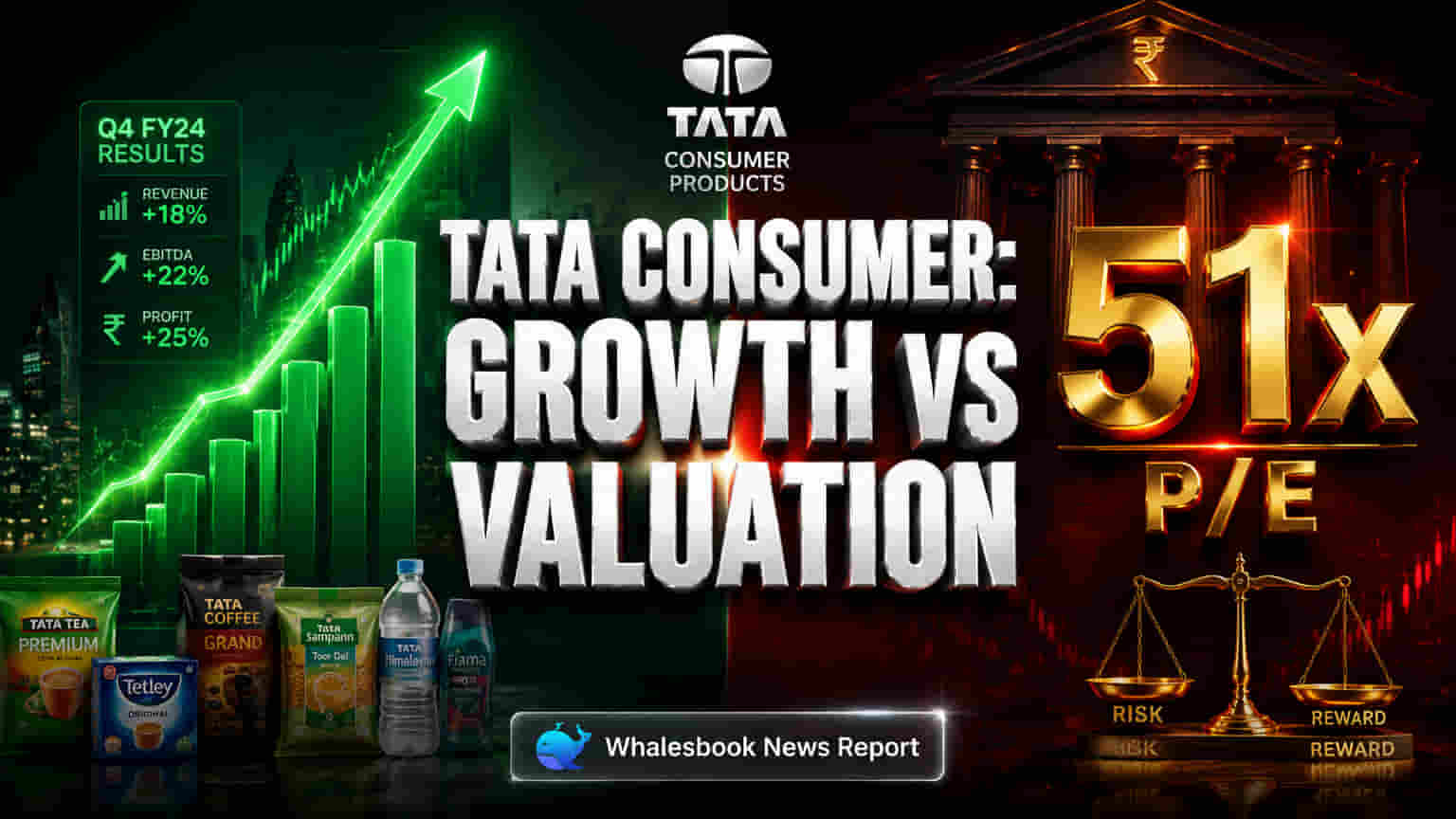


Strong Q4 Performance and Financials
Tata Consumer Products Ltd. (TCPL) wrapped up fiscal year 2026 with a robust fourth quarter. Revenue climbed about 18% year-on-year to ₹5,433 crore, while net profit surged over 21% to ₹419 crore. EBITDA also saw a strong 27% increase to ₹792 crore, as EBITDA margins expanded by approximately 100-120 basis points to around 14.6%. The company's India business was a key driver, achieving 16% volume growth thanks to strong sales in salt, ready-to-drink beverages, and the Tata Sampann food brand. TCPL announced a ₹10 per share dividend. For the full fiscal year FY26, consolidated revenue surpassed ₹20,000 crore, a 15% increase, with net profit climbing nearly 20% to ₹1,542 crore.
Diversification and Competition
TCPL is actively diversifying beyond its traditional beverage roots to become a broader FMCG player. Integrating Capital Foods and Organic India has expanded its reach into pantry staples, snacks, and health products, altering its competitive position. These "Growth" businesses now represent 33% of its Indian portfolio. The India Foods business itself grew 21% in Q4 FY26. However, TCPL faces intense competition across the FMCG sector. Hindustan Unilever (HUL) is a major rival in tea, while Nestle India challenges in coffee and instant foods. ITC and Adani Wilmar lead in staples through their vast rural networks. Additionally, new D2C brands and Reliance Consumer Products are adding pressure with competitive pricing and niche offerings.
High Valuation Faces Scrutiny
Despite its strong quarterly performance, TCPL's stock currently trades at a significant premium. In early May 2026, the stock's Price-to-Earnings (P/E) ratio was around 80 times its trailing twelve-month (TTM) earnings. This is substantially higher than the FMCG sector average of about 67 times. For comparison, HUL trades at a TTM P/E of roughly 33-55x, Britannia Industries around 55-58x, and Nestle India at about 80-83x. Analysts generally maintain an "Outperform" rating with an average 12-month price target near ₹1,290, indicating potential upside. However, the current high multiple offers limited room for missteps. The company projects a FY28 estimated P/E of 51x, which is still premium.
Challenges to Profit Margins and Valuation
Several factors could challenge the sustainability of TCPL's premium valuation and its profit margin outlook. Global supply chain disruptions and rising crude oil prices, partly due to geopolitical tensions, are increasing input costs for FMCG companies. A weaker Indian Rupee also raises import expenses. This inflationary environment may lead FMCG firms to increase prices by 3-4% in Q1 FY27, potentially squeezing margins. TCPL plans to increase its advertising spending from 6.5% to 7.5% of sales in FY27 to build its brands, which could affect short-term profitability. Integrating recent acquisitions also carries execution risks. While TCPL leads in tea and salt, it faces strong competition in instant noodles and has a smaller presence in biscuits and chocolates. The company's Return on Equity (ROE) of about 7-8% is lower than industry peers, indicating potential for better capital use.
Future Outlook and Strategy
Looking ahead, TCPL is positioning itself for continued growth. The company expects strong performance from its acquired businesses, Capital Foods and Organic India, driven by category expansion and new channels like food services and pharmacies. Management is confident about near-term margins, anticipating no significant pressure from current cost trends and guiding for a 50-75 basis point EBITDA margin increase in FY27. TCPL's innovation efforts remain strong, with 80 new product launches in FY26 contributing 4.5% to sales. Analysts generally maintain a "Buy" rating, with consensus price targets suggesting potential upside. The long-term strategy aims to transition TCPL from a beverage company to a broader FMCG player, with high-growth segments driving revenue, supported by its core strength in salt and coffee. NourishCo's growth and branding are also key to competing in beverages and achieving long-term market penetration.