 Whalesbook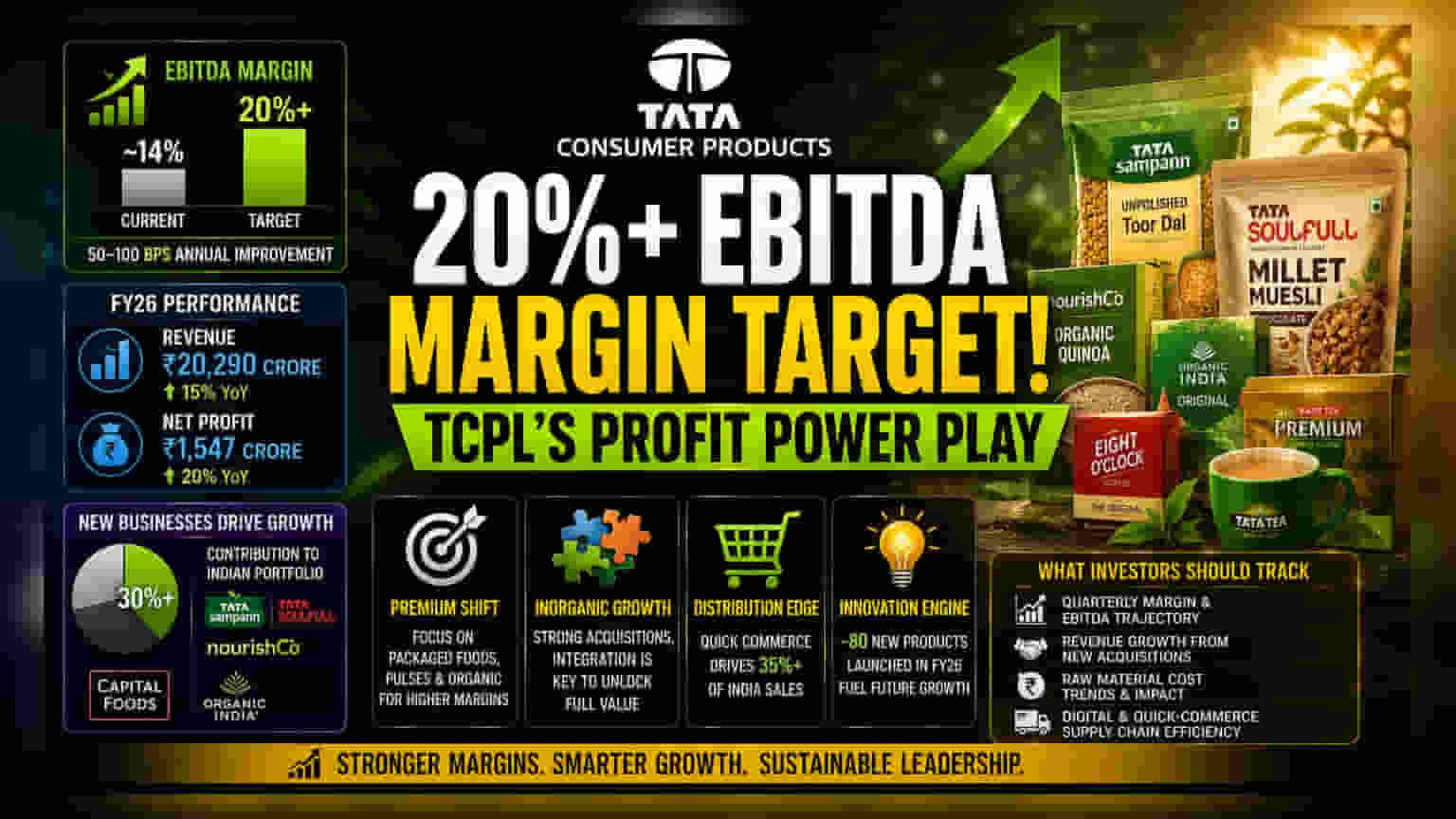


Tata Consumer Products (TCPL) has set a goal to lift its EBITDA margin above 20% from the current 14%. The company is shifting from a traditional tea-and-salt business to a broad FMCG player by integrating brands like Capital Foods and Organic India. While FY26 revenue rose 15% to Rs 20,290 crore, investors are closely monitoring how the company executes this growth while managing acquisition integration and intense competition in the packaged foods sector.
What Happened
Tata Consumer Products Ltd. (TCPL) has announced a long-term plan to significantly improve its operational profitability. The company is targeting an EBITDA margin—a key measure of profit from core business operations—of over 20%. This is a notable step up from its current level of approximately 14%. The management indicated that they expect an annual improvement of 50 to 100 basis points, depending on market conditions. For the fiscal year 2026, the company reported a 15% increase in total revenue, reaching Rs 20,290 crore, alongside a 20% growth in net profit to Rs 1,547 crore.
Why This Matters For Investors
For investors, a jump in margin targets suggests the company is moving toward higher-value, premium products rather than just relying on its traditional commodity-based business. By shifting its focus to packaged foods, pulses, and organic products, TCPL aims to increase the share of its Indian portfolio that comes from growth-oriented segments. Currently, newer businesses like Tata Sampann, Tata Soulfull, NourishCo, and recent acquisitions such as Capital Foods and Organic India contribute over 30% of the Indian portfolio. As these segments grow, they are expected to yield better margins than the company's legacy businesses.
The Growth and Integration Challenge
TCPL has been aggressive with inorganic growth, meaning it has acquired other companies to expand its footprint. While these acquisitions helped the company reach a revenue contribution of over Rs 1,300 crore from new businesses in FY26, they also bring execution risks. Integrating different corporate cultures, supply chains, and distribution networks is a complex task. Investors typically watch whether the company can maintain or improve the profit margins of these acquired entities. Any delay in full integration or unexpected costs could impact the company's ability to reach its 20% margin target.
Peer and Sector Context
The Indian FMCG sector is highly competitive. TCPL competes with established giants like Hindustan Unilever, ITC, and Nestle, as well as several smaller, regional players. In this environment, pricing power is limited by consumer sensitivity to price hikes. Furthermore, the FMCG industry often faces pressure from volatile raw material costs, such as tea, coffee, and packaging materials. Unlike some peers that have a single dominant product category, TCPL’s strategy is to broaden its presence. Success will depend on its ability to scale distribution, especially through quick commerce, which currently accounts for over 35% of its India sales.
What Could Go Wrong
Several factors could challenge the company's profitability goals. If raw material prices remain high or volatile, it could pressure profit margins despite the focus on premium products. Additionally, if demand for packaged foods slows down, or if the integration of acquisitions takes longer or costs more than anticipated, the expected margin expansion may be delayed. Investors should also note that as the company spends more on innovation—it launched about 80 new products in FY26—the cost of research and marketing could also rise, impacting short-term cash flow.
What Investors Should Track
Moving forward, the key monitorables include the company's quarterly margin trajectory and the pace of revenue growth from new acquisitions. Investors may track whether the company can successfully lower its operational costs while scaling its new product categories. Additionally, management commentary on raw material cost trends and the efficiency of the new digital and quick-commerce supply chain will be important to understand the sustainability of the targeted margin growth.