

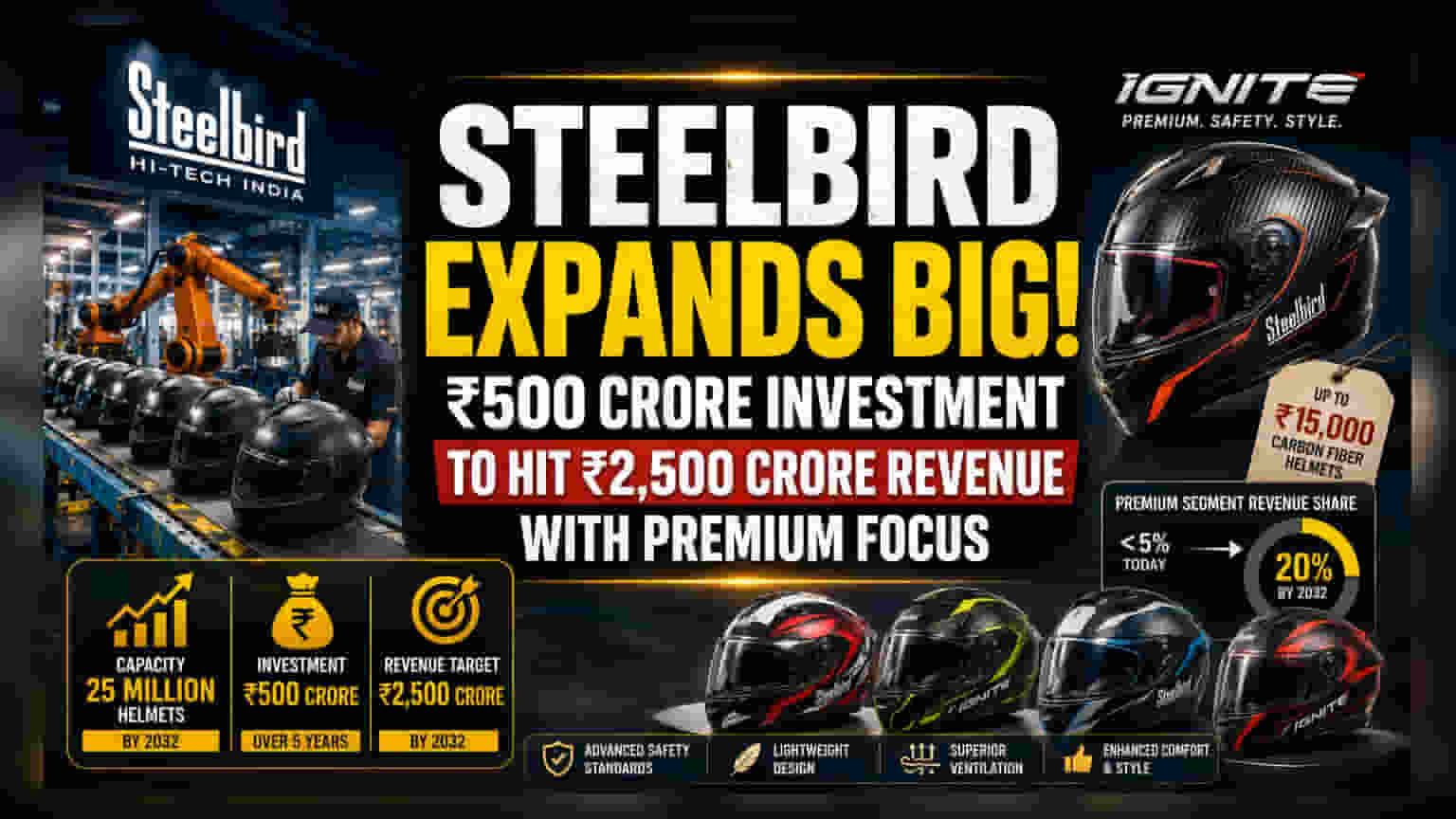
Steelbird Hi-Tech India has announced a ₹500 crore investment plan to double production capacity and shift its focus toward premium helmet segments. The company aims for the premium category to account for 20% of its revenue by 2032, up from less than 5% today. This move reflects the broader industry trend of rising demand for high-quality safety gear in India’s two-wheeler market.
What Happened
Steelbird Hi-Tech India, a major player in the Indian helmet manufacturing industry, has laid out an ambitious expansion plan to capture a larger share of the premium safety gear market. The company intends to invest ₹500 crore over the next five years to more than double its production capacity, aiming to reach 25 million helmets annually by 2032. This expansion is central to its goal of hitting a ₹2,500 crore revenue target within the same period.
The manufacturer, which reported a revenue of ₹869 crore in the last fiscal year, is currently scaling up its daily production to 60,000 units. A significant portion of this growth strategy revolves around a pivot to the premium segment, which the company expects to contribute 20% of its total revenue by 2032, compared to less than 5% today.
The Shift Toward Premium Products
For years, the Indian helmet market was dominated by mass-market, affordable products. However, as two-wheeler riders increasingly seek better safety, comfort, and aesthetics, manufacturers are pivoting toward higher-value products. Steelbird is betting on its 'Ignite' brand to lead this transition. By introducing advanced options like carbon fiber helmets, which can be priced as high as ₹15,000, the company is attempting to differentiate itself from traditional entry-level offerings.
This move toward premiumization is a strategic attempt to improve profit margins, which are often thinner in the mass-market helmet segment. By offering features such as advanced ventilation, lightweight materials, and enhanced safety ratings, Steelbird is trying to position itself as a lifestyle and safety brand rather than just a commodity seller.
Capacity and Financial Context
The company has already scaled its daily production to 60,000 helmets, supported by automation and capacity enhancements across its manufacturing facilities, which include sites in Himachal Pradesh and Noida. Having produced 9.85 million helmets in the recent fiscal year, the company is now setting a firm target of ₹1,000 crore revenue for the current fiscal year. Its long-term roadmap depends heavily on its ability to execute this production ramp-up while maintaining the quality standards required for premium products.
Industry and Competitive Reality
Steelbird competes in a crowded market alongside established players like Studds and Vega. The broader two-wheeler industry in India remains the primary driver of this demand. With two-wheeler sales growing, the necessity for BIS-certified and high-quality helmets has become a regulatory and consumer priority.
However, the strategy is not without challenges. While the premium segment is growing, the Indian helmet market remains highly price-sensitive. Achieving a 20% revenue share from premium products will require significant consumer education and the ability to convince riders that higher-priced helmets offer tangible safety and comfort benefits over cheaper alternatives. If the company cannot maintain its competitive edge against other brands also expanding their premium portfolios, it may face pressure on growth targets.
What To Monitor
For those tracking the sector, the key monitorable will be the actual market adoption of these premium models. Investors and industry observers will look for whether the company can successfully scale its 'Ignite' and premium series without sacrificing its volume leadership in the mass market. Additionally, monitoring the company's ability to maintain its retail network expansion—currently over 350 exclusive shops—will be vital to ensuring these premium products reach the intended customers.