

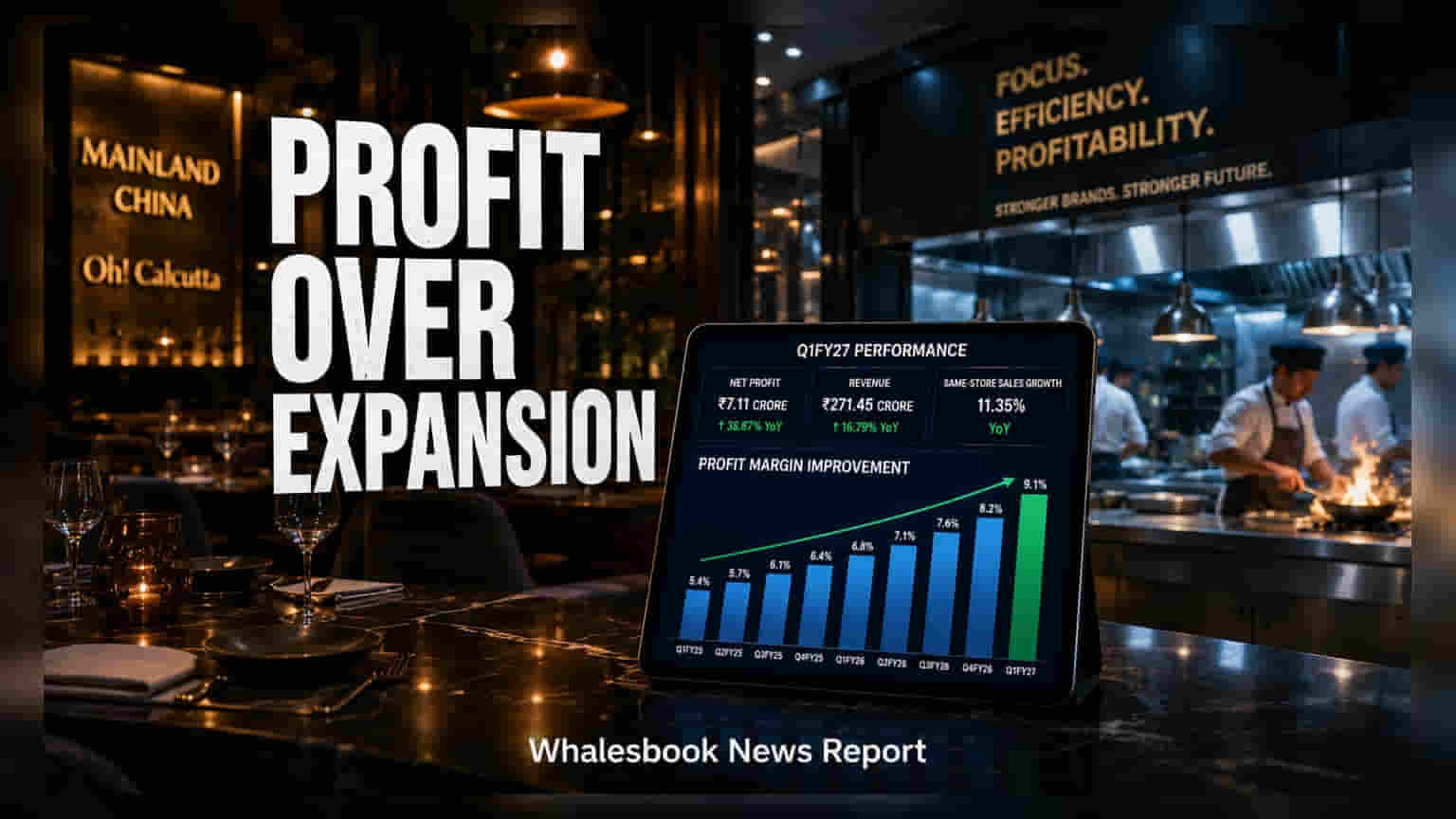
Speciality Restaurants is moving away from aggressive store rollouts to prioritize sustainable, profitable growth under new CEO Avik Chatterjee. This pivot follows a 38.87% increase in Q1FY27 net profit, as the company seeks to protect margins amidst rising operational costs and cautious consumer spending.
Speciality Restaurants is recalibrating its business approach under the leadership of new CEO Avik Chatterjee, who took charge in June 2026. The company, known for brands like Mainland China and Oh! Calcutta, is moving away from the industry-common strategy of rapid, volume-driven store expansion. Instead, management is focusing on consolidating its existing brand portfolio to ensure long-term bottom-line resilience and operational efficiency.
Prioritizing Margins in Q1FY27
The strategic shift toward profitability is already visible in the company's latest financial results. For the first quarter of the 2027 fiscal year, Speciality Restaurants reported a consolidated net profit of ₹7.11 crore, marking a 38.87% increase compared to the same period last year. Revenue also grew by 16.79% during the quarter. A key metric driving this performance was a same-store sales growth (SSSG)—a measure of sales generated by existing outlets over a period—of 11.35%. By focusing on enhancing the performance of established locations rather than adding new ones at an aggressive pace, the company aims to protect its unit economics in a challenging environment.
Navigating Sector Pressures
The restaurant sector is currently facing significant headwinds, including cooling discretionary spending and sustained inflationary pressure on food ingredients. While many quick-service and casual dining chains have historically pursued aggressive expansion to capture market share, the industry is now entering a phase of consolidation. Speciality Restaurants’ decision to prioritize its core brands and optimize operational overhead reflects a broader trend among listed players to focus on margin stability over mere footprint expansion.
Risks and Operational Challenges
While the shift to a profit-first model is intended to insulate the company, several operational risks remain. Inflationary pressure on food ingredients continues to be a primary concern for margins across the dining industry. Additionally, the company faces challenges regarding the availability of trained manpower, which can limit the speed of scaling operations. Rising rentals and increasing commission structures from third-party delivery aggregators also pose potential risks to profitability. Management is attempting to mitigate some of these pressures through strategies like a hybrid kitchen model to manage fuel cost volatility and by maintaining a disciplined approach to capital spending.
What Investors Should Track
Looking ahead, investors will be closely watching whether the company can maintain its margin performance in subsequent quarters. The board has also declared a final dividend of ₹1.00 per share, with a record date of September 4, 2026, which may be a point of interest for shareholders. Key monitorables for the coming months will include the company's ability to navigate raw material price volatility, manage delivery-related costs, and sustain its same-store sales growth without relying on a rapid increase in new store counts.