 Whalesbook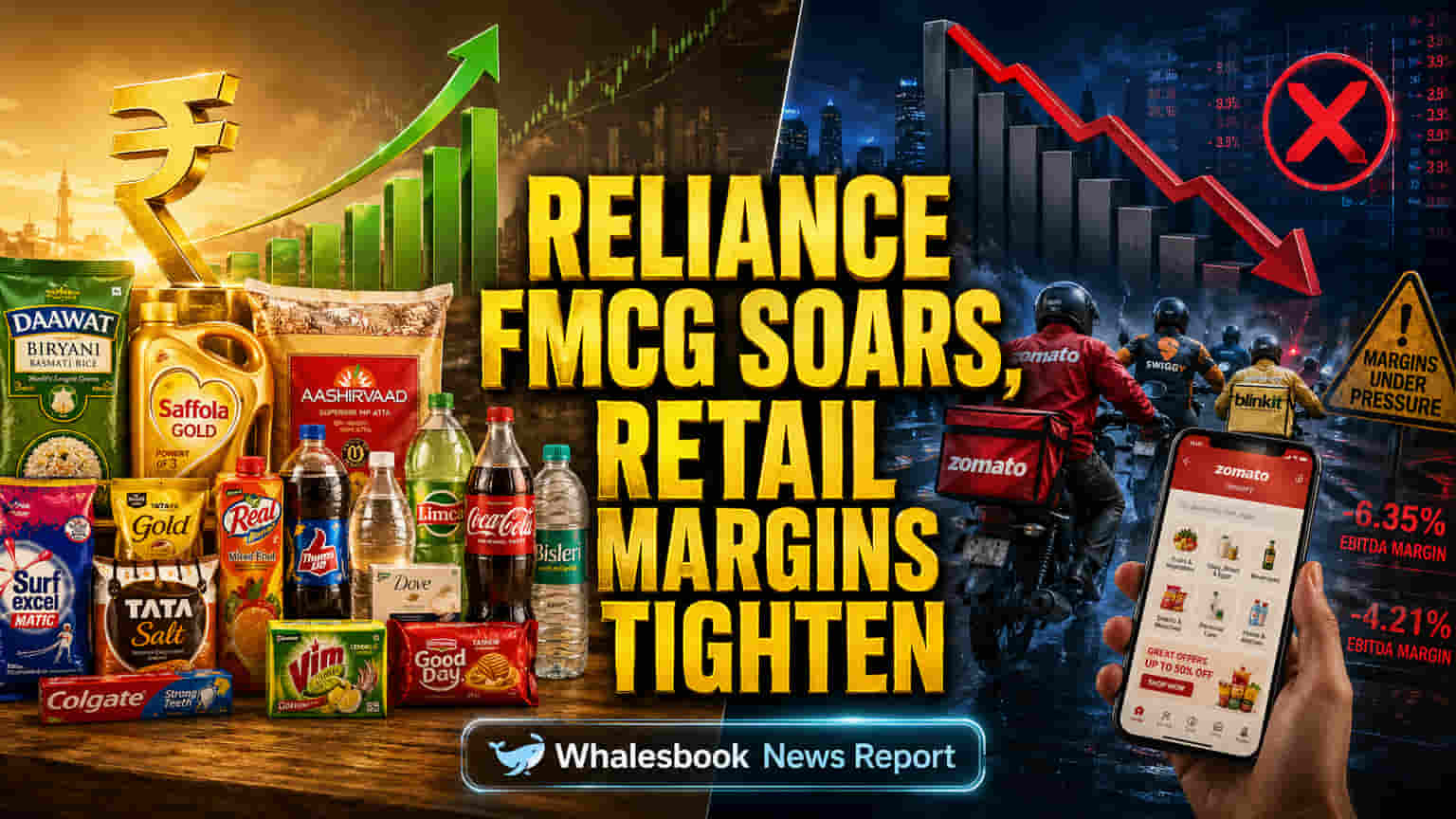


Reliance's FMCG Powerhouse and Retail Margin Squeeze
Reliance Consumer Products (RCPL) has quickly made daily essentials and staples its main revenue driver, bringing in ₹8,800 crore or 40% of gross revenue in fiscal year 2026. These products, along with beverages, anchor RCPL's ₹22,000 crore in overall FMCG sales for FY26, nearly doubling from the previous year. The flagship soft drink Campa led FMCG brand sales at ₹4,700 crore, becoming the nation's fourth-largest carbonated brand, followed by the staples brand Independence with ₹2,600 crore. RCPL is strategically expanding across categories from essential goods to packaged consumer items.
Reliance Industries Limited (RELIANCE.NS) is a giant with a market cap near ₹17.97 lakh crore. For FY26, it reported record consolidated revenue of ₹11.76 trillion and EBITDA of ₹2.08 trillion. Despite this scale, its consumer businesses face margin challenges. Reliance Retail Ventures' CFO, Dinesh Taluja, warned that retail margins are expected to stay under pressure due to faster quick commerce expansion. The company's Ebitda margin for the January-March quarter fell to 7.9% from 8.5% a year earlier. For the full FY26, the margin was 8.3%, down from 8.6%. This indicates a strategy balancing rapid market share growth in key channels with immediate profit.
FMCG Competition: Benchmarking Growth and Margins
The Indian FMCG sector is projected to grow 6-8% in FY26. RCPL's performance stands out, but it operates in a competitive landscape. Rivals like Hindustan Unilever Limited (HUL) reported FY24 turnover of ₹59,579 crore and a 23.8% EBITDA margin. ITC's FMCG-Others segment saw 3.7% growth in Q4 FY25, with segment EBITDA margins around 10%. These comparisons show different margin approaches among major FMCG companies.
Reliance Retail Ventures, rated 'Crisil AAA/Stable', reported 18% year-on-year revenue growth to ₹90,018 crore for the quarter ending September 30, 2024, with its EBITDA margins improving to 8.5%. This shows a positive trend in its overall retail operations, separate from quick commerce impacts. Rivals like Avenue Supermarts (DMart) trade at a P/E ratio around 101-105, reflecting investor confidence in their efficiency and growth. Tata Consumer Products, with a P/E of 75-80, also competes in food and beverages.
Margin Pressures from Quick Commerce Scale
Quick commerce, which often includes a mix of groceries, personal care, and household items, can boost sales for some. However, for Reliance, the aggressive expansion in this channel, with its associated logistics and delivery costs, is currently reducing overall retail Ebitda margins. This strategy differs from approaches like HUL's, which reinvests in brands and capabilities for volume growth, sometimes accepting short-term margin dips.
While RCPL's FMCG revenues are strong, the profitability of these high-volume staples and beverages warrants examination. The aggressive expansion strategy, particularly in quick commerce, poses a clear risk to overall profitability. Reliance Retail Ventures aims to grow its merchant partner base to over 4 million, incorporating acquisitions like Metro Cash and Carry India. However, the observed pressure on Ebitda margins suggests the costs of rapid customer acquisition and delivery infrastructure might outweigh immediate earnings gains. This mirrors an e-commerce trend of prioritizing market share over profit, increasing operational expenses and potentially thinning margins.
Reliance's broad retail expansion, while a strength, also intensifies competition. Rivals like Avenue Supermarts (DMart) focus on cost efficiency and value pricing, reflected in their higher P/E ratios. Reliance's current retail margin pressure could worsen if competitors gain efficiency or if input costs rise. Historically, Reliance's stock has shown volatility around earnings, with a 14% year-to-date decline in 2026, signaling investor scrutiny over how growth strategies affect profitability.
Outlook: Balancing Growth and Profitability
Reliance Industries shows a 'Strong Buy' technical sentiment. However, analyst ratings are mixed, averaging 'Hold' with neutral sentiment from 35 analysts recently. The company's future success depends on turning its vast FMCG and retail scale into consistent profits. Analysts will watch for guidance on margin recovery and the long-term effects of quick commerce and digital investments. While integrating its diverse consumer businesses points to a long-term vision, near-term execution is key to balancing aggressive growth with margin stability.