 Whalesbook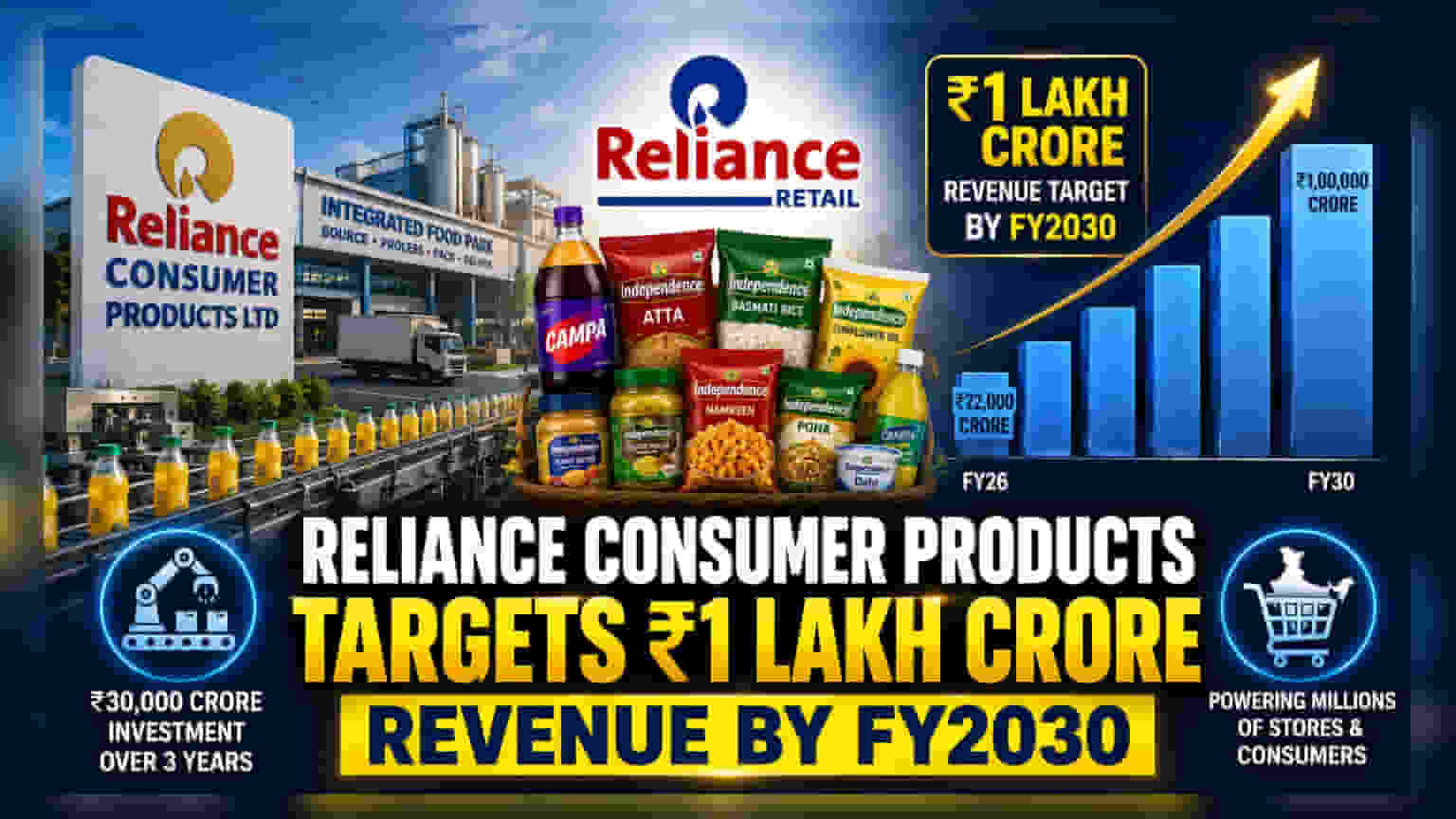
Reliance Consumer Products Ltd (RCPL) has announced an ambitious plan to reach ₹1 lakh crore in revenue by FY30, supported by a ₹30,000 crore investment over three years. With FY26 revenue hitting ₹22,000 crore, the company is betting on large-scale manufacturing, food parks, and widespread distribution to challenge established FMCG giants.
What Happened
Reliance Consumer Products Ltd (RCPL), a subsidiary of Reliance Retail, has set a major financial goal to achieve ₹1 lakh crore in annual revenue by fiscal year 2030. To reach this, the company is planning to invest ₹30,000 crore over the next three years. This money will be used to build large-scale, integrated food parks and expand its manufacturing capacity for various products, including staples, snacks, and beverages.
Scaling Up The FMCG Business
In fiscal year 2026, RCPL reported revenue of ₹22,000 crore, doubling its performance compared to the previous year. The company is now trying to move beyond being a distributor or retailer and into becoming a major product manufacturer. The strategy involves creating a network of manufacturing hubs equipped with automation and artificial intelligence to handle production at a massive scale. The parent company, Reliance Industries, aims to connect its retail strength with this new manufacturing capability to supply millions of stores and consumers across the country.
Why This Matters For Investors
For investors, this shift indicates a move toward vertical integration. By owning the manufacturing process, RCPL aims to control product quality, supply chain, and costs. The move into food parks—which will handle everything from sourcing to packaging—is designed to capture more value in the chain. However, moving from a retail model to a large-scale manufacturing model carries different types of risks. Manufacturing requires significant capital, skilled labor, and complex logistics, which are different from the challenges of operating retail stores.
Peer And Sector Context
RCPL is entering a highly competitive sector. The Indian FMCG market is dominated by long-standing giants like Hindustan Unilever, ITC, Nestlé, and Britannia. These companies have spent decades building deep distribution networks and strong brand loyalty. For RCPL to hit its ₹1 lakh crore target, it must gain significant market share from these entrenched players. Historically, the FMCG sector operates on thin margins, and companies must rely on high sales volumes to generate consistent profit. Reliance’s ability to use its retail network (Smart Bazaar and others) to push its own products gives it an edge, but sustaining this growth against established brands will be a key test.
Execution And Competition Risks
While the growth ambition is clear, there are real-world risks. Building large food parks involves significant execution challenges, including land acquisition, regulatory clearances, and the risk of cost overruns. Furthermore, the FMCG industry often experiences price wars. If the company relies too heavily on aggressive pricing to gain market share—similar to its strategy with Campa—it may face pressure on profit margins. Additionally, the company must ensure its new products maintain consistent demand. Unlike consumer electronics or garments, packaged food items are highly sensitive to regional tastes and pricing, making it harder to standardize products for the entire country.
What Investors Should Track
The most important factor to monitor will be the timeline of these food parks. Investors should watch for updates on how much of this new capacity is actually being used. Another key area is profit margin. As the company scales, it will be important to see if it can maintain healthy margins despite the high cost of expansion and aggressive marketing. Finally, tracking the performance of flagship brands like Campa and the Independence range will show if the company is successfully building brand loyalty or if growth is only coming from deep discounts.

