 Whalesbook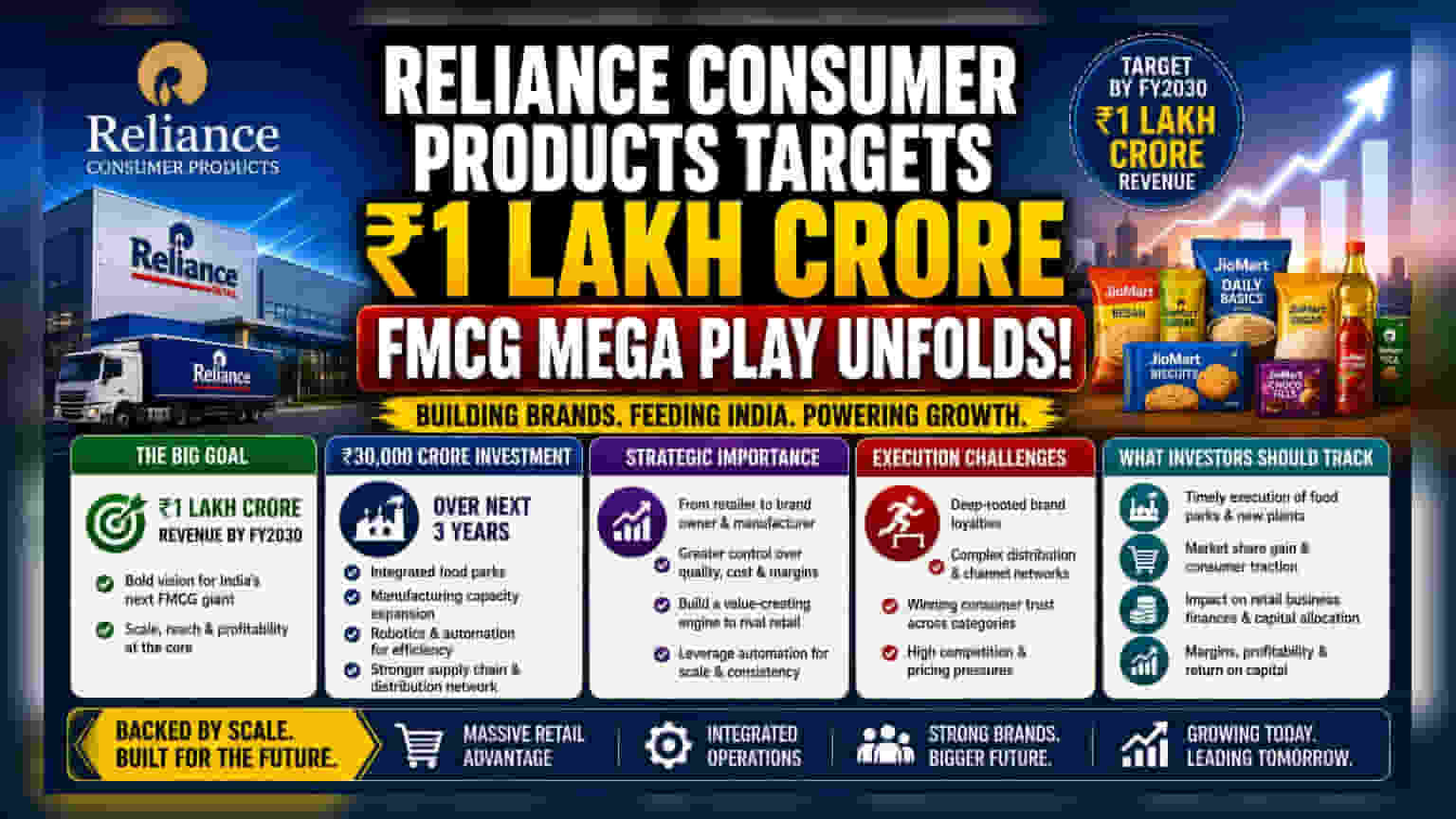
Reliance Consumer Products (RCPL) has announced a Rs 30,000 crore investment plan to hit Rs 1 lakh crore in revenue by 2030. The FMCG arm of Reliance Industries aims to challenge established players through massive infrastructure expansion and food parks. Investors should monitor how this capital-intensive move impacts margins and market share in the highly competitive Indian FMCG sector.
What Happened
Reliance Consumer Products Ltd. (RCPL), the fast-moving consumer goods (FMCG) arm of Reliance Retail, has outlined an ambitious growth plan at the 49th annual general meeting of Reliance Industries. The company is targeting Rs 1 lakh crore in revenue by the fiscal year 2030. To reach this goal, RCPL plans to invest Rs 30,000 crore over the next three years. This money will be used to build integrated food parks, expand manufacturing capacity, and broaden the distribution network for products ranging from staples to packaged foods.
Strategic Importance
For Reliance Industries, this move represents a significant shift from being a retailer of consumer goods to being a major producer and brand owner. By investing in its own manufacturing, the company aims to have better control over its supply chain, product quality, and profit margins. The plan includes the use of automation and robotics in its production facilities to maintain efficiency. The objective is to create a value-creating engine that can eventually rival the scale of the company’s retail business.
The Execution Challenge
The Indian FMCG market is notoriously difficult to penetrate due to deep-rooted brand loyalties and complex distribution networks. Established companies have spent decades building relationships with local retailers and distributors. While RCPL has the advantage of the massive existing distribution network of Reliance Retail, scaling a product-focused FMCG business is different from running a retail store. The company faces the challenge of convincing consumers to switch from trusted legacy brands to its new products. Achieving a high revenue target will require not just capital, but also strong consumer demand and successful product launches across categories like chocolates, biscuits, and staples.
Peer and Sector Context
The Indian FMCG sector is highly competitive, featuring established giants like Hindustan Unilever (HUL), ITC, Nestle India, Tata Consumer Products, and Britannia. These companies maintain strong market positions through decades of brand building and vast rural distribution networks. A new entrant, even one with significant capital, faces pressure to gain market share without engaging in aggressive price wars that could hurt profit margins. Investors often compare such growth strategies against incumbents, looking at metrics like operating margins and return on capital to see if the expansion is creating long-term value.
What Investors Should Track
Investors may monitor several key areas as this expansion unfolds. First, the pace of execution and whether the new food parks and manufacturing facilities become operational on time. Second, the ability of RCPL to gain shelf space and consumer traction in a crowded market. Third, the impact of this heavy capital spending on the overall financial health of the retail business. Finally, management commentary on profit margins will be important, as the FMCG business relies on high volumes and efficient cost management to remain profitable. The company’s success will depend on whether it can balance its aggressive growth targets with sustainable profitability.