 Whalesbook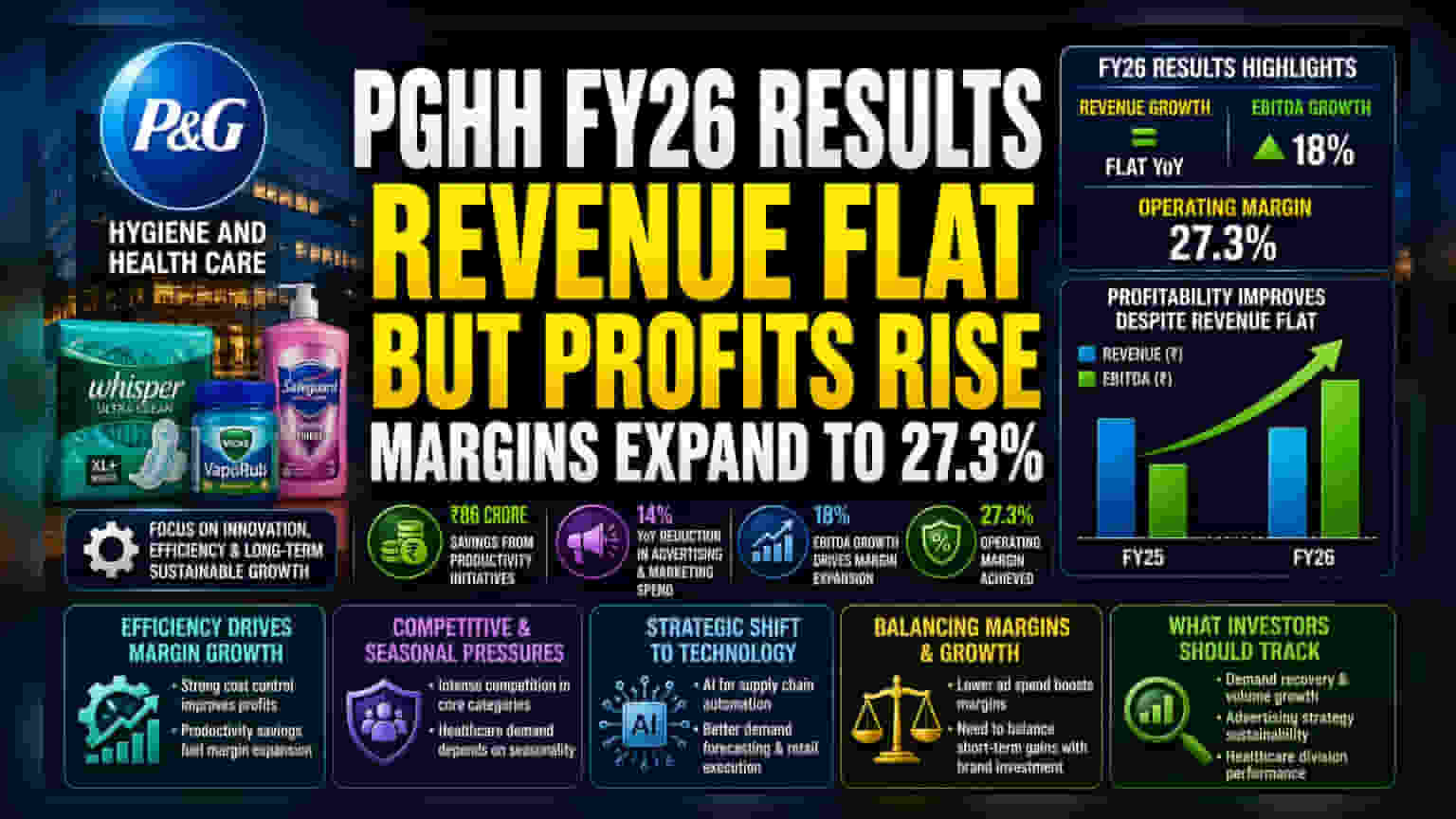


Procter & Gamble Hygiene and Health Care (PGHH) reported flat revenue for FY26 as category growth slowed and market competition intensified. However, the company successfully improved its operating profit by 18%, pushing margins to 27.3% through cost discipline and reduced advertising spending. Investors are now watching whether this focus on internal efficiency can be balanced with long-term brand investment and volume recovery.
What Happened
Procter & Gamble Hygiene and Health Care (PGHH) released its financial results for FY26, highlighting a period where revenue growth remained flat compared to the previous year. The company cited a combination of factors, including slower expansion in its core categories, intense competition, and broader trends of softer consumer demand. Despite the stagnant top-line revenue, the company’s operating profit, or EBITDA, grew by 18% during the year, leading to an expansion in operating margins to 27.3%.
Efficiency Gains and Cost Discipline
The improvement in profit margins was largely driven by internal productivity measures rather than higher sales. The company reported ₹86 crore in savings from productivity initiatives. A key driver of this margin expansion was a 14% year-on-year reduction in advertising and marketing spending. While this strategy successfully boosted short-term profitability, it highlights a trade-off often seen in fast-moving consumer goods companies: the need to balance immediate margins with the continuous investment required to maintain brand visibility and market share in a crowded industry.
The Competitive and Seasonal Landscape
PGHH operates in highly competitive segments. Its feminine care brand, Whisper, competes with both established players and newer market entrants. The healthcare division, home to the Vicks franchise, faces unique demand risks. Performance in this segment is historically sensitive to seasonal patterns, such as the onset of monsoons and the prevalence of respiratory illnesses. When these periods are milder than expected, demand for healthcare products can fluctuate, impacting the company’s ability to grow volume.
Strategic Shifts and Technology
To navigate the current environment, the company is shifting its focus toward digital and technological tools. PGHH is increasing its investment in artificial intelligence to improve supply chain automation, refine demand forecasting, and enhance how products are executed at the retail level. The goal is to move toward higher-value product offerings and ensure the company remains agile in a changing retail environment.
What Investors Should Track
Looking ahead, the market will monitor whether the company can sustain these profit margins without significantly impacting long-term growth. Key monitorables include the recovery of consumer demand, which would allow the company to return to volume-led growth rather than relying purely on cost cutting. Investors will also look for signs of whether the reduced advertising spend is a temporary measure or a long-term strategy, as sustained lower marketing investment could potentially affect market share against aggressive competitors. Additionally, the performance of the healthcare division in upcoming quarters will be a significant indicator of demand health, given its reliance on seasonal factors.