 Whalesbook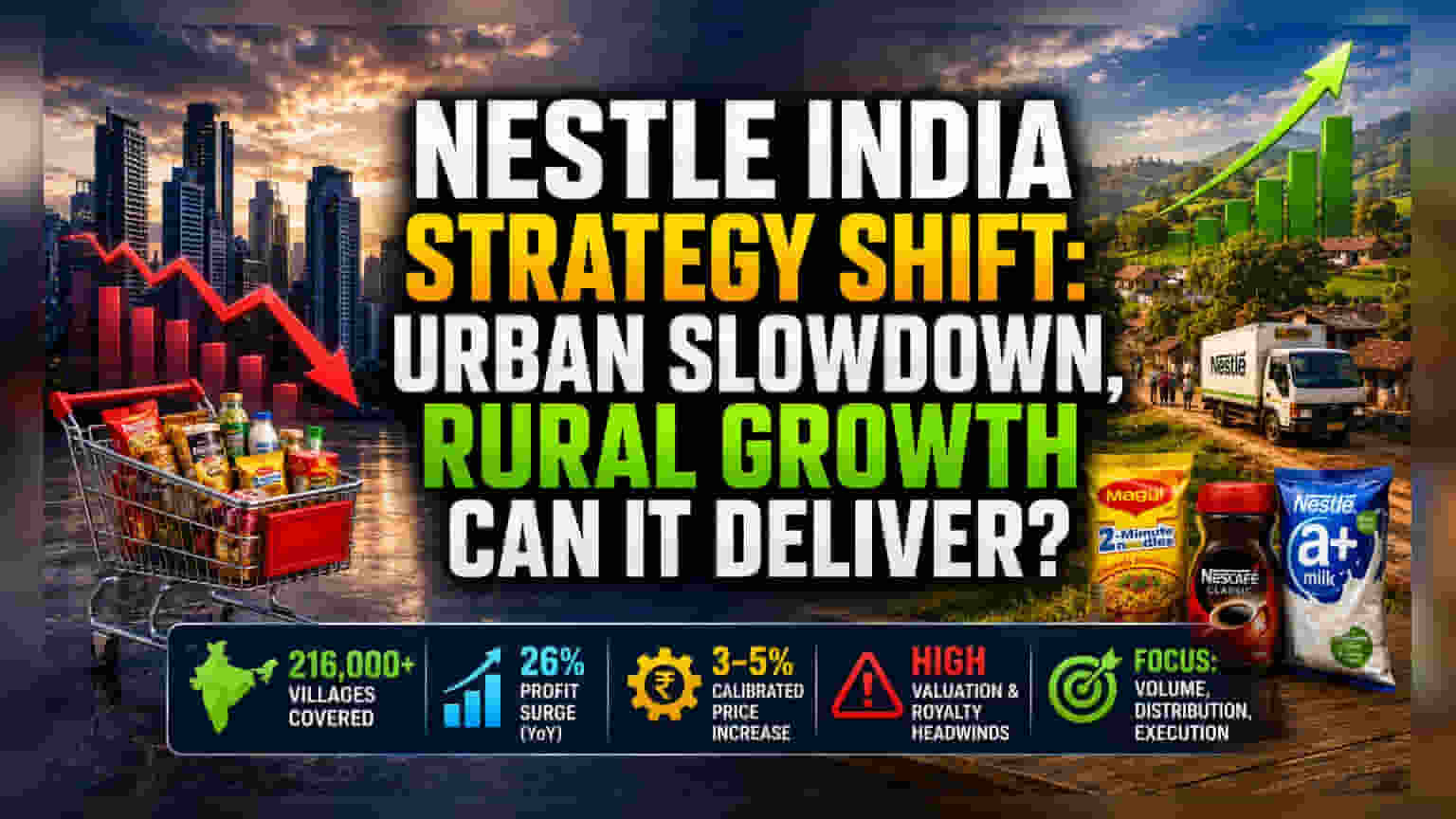


The Urban-Rural Divergence
Nestle India's recent strategic pivot arrives at a critical juncture for the Indian FMCG sector. While the company achieved a robust 26% year-on-year profit surge in the March quarter of FY26, current leadership, led by Chairman Manish Tiwary, has openly flagged a cooling effect among urban middle-class consumers. As real income growth continues to trail behind inflation, discretionary spending in tier-one cities is showing signs of hesitation. In contrast, the company’s structural push into India’s vast rural landscape—now spanning over 216,000 villages—is being positioned as the primary safeguard against urban consumption fatigue. This dual-track reality necessitates a highly localized approach to product formats and pricing, a shift that the firm is prioritizing to protect its market share.
Scaling Operations Amidst Margin Sensitivity
Operational efficiency remains a core pillar of the FY26 annual report, with the company successfully channeling savings from structural programs back into digital activation and capacity expansion. However, this commitment to volume-led growth is navigating a volatile commodity environment. Although pressures on cocoa and coffee have moderated, the company remains exposed to persistent inflation in edible oils and milk—key components of its cost structure. Analysts at ICICI Direct and other market observers note that the first half of fiscal 2027 may see continued margin pressure as the firm prioritizes volume maintenance over aggressive, growth-dampening price hikes. The company’s decision to limit price increases to a calibrated 3-5% reflects a broader industry preference for protecting consumer loyalty, even at the temporary expense of operating margins.
The Bear Case: Valuation and Royalty Headwinds
Despite a strong market position, institutional skepticism persists regarding the company's valuation. Trading at a price-to-earnings (P/E) ratio near 78x, the stock carries a significant premium relative to its historical median and broader FMCG peers. Further complicating the investor outlook is the ongoing tension surrounding royalty payments to its Swiss parent entity. With these payments exceeding ₹1,024 crore in FY26, and following a shareholder rejection of proposed royalty rate increases last year, the company faces potential friction regarding capital allocation. Furthermore, while the 'RUrban' initiative is ambitious, the company remains underpenetrated in rural markets compared to its direct competitors, necessitating sustained, high-cost investment that could weigh on free cash flow in the near term.
Outlook and Strategic Execution
The path forward centers on category-defining brands like Maggi and Nescafé as the engine for recurring volume growth. Management has clearly defined pricing as a last-resort measure, preferring to rely on productivity gains and distribution expansion to balance the impact of global supply chain disruptions. Investors are closely monitoring the upcoming half-year results in July 2026, which will serve as the first major indicator of whether this volume-led strategy can effectively counter the cooling trends in urban discretionary consumption.