 Whalesbook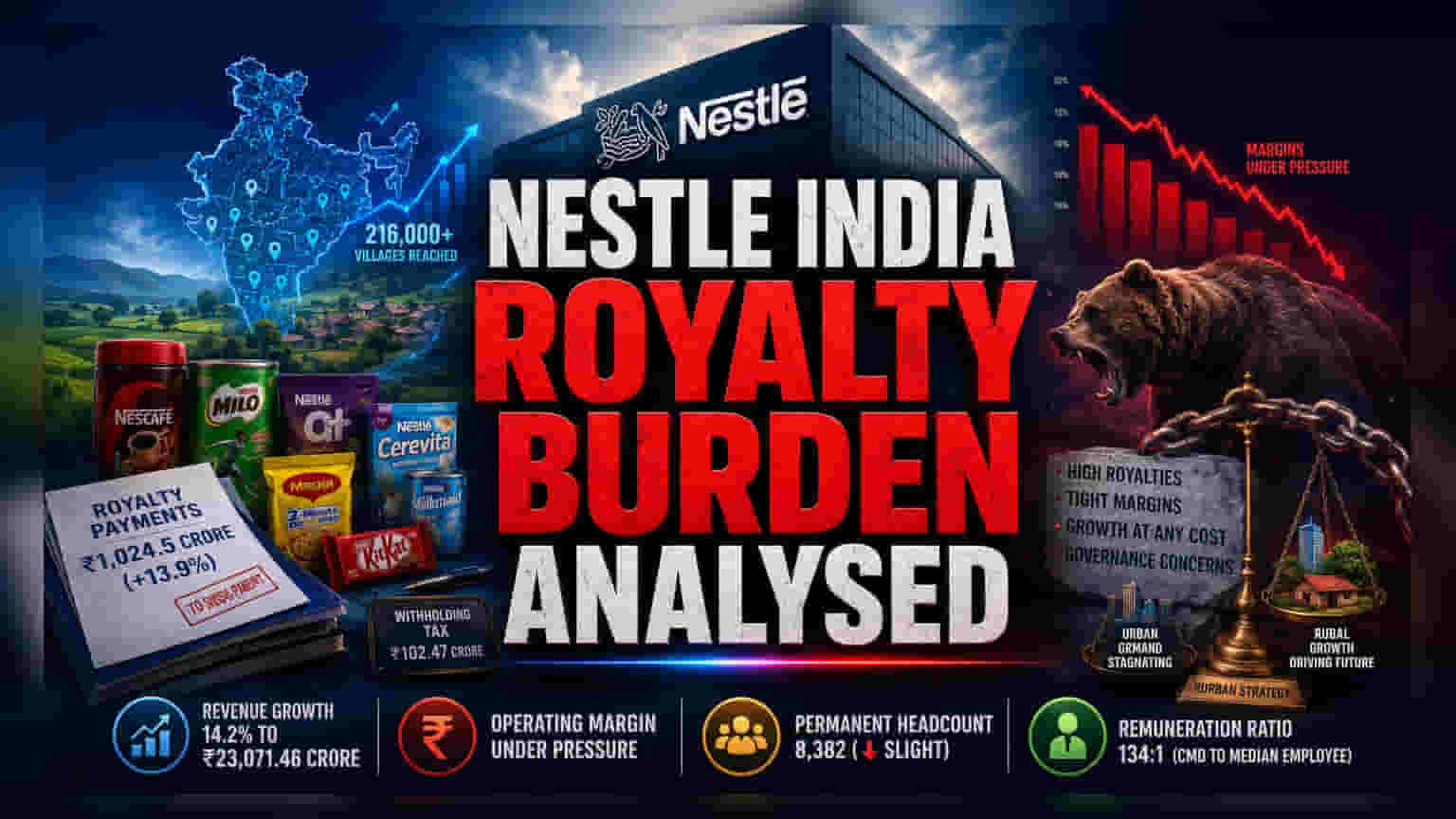


The Royalty Burden in Focus
Nestle India’s financial disclosures for the fiscal year ending March 2026 reveal a significant uptick in general licence fees paid to its Swiss parent, Société des Produits Nestlé S.A. These royalty payments climbed to ₹1,024.5 crore, a 13.9% increase from the previous year. Alongside this, the company remitted ₹102.47 crore in withholding tax, underscoring the substantial capital outflow required by its current General Licence Agreements. This payout structure remains a focal point for institutional investors who, in a significant display of shareholder activism last year, rejected a board-led proposal to incrementally raise royalty rates to 5.25% of net sales, effectively capping the rate at 4.5%.
The Volume-Margin Trade-off
While revenue grew by 14.2% to ₹23,071.46 crore, the broader financial narrative is defined by a tightening margin environment. Under the leadership of Chairman and Managing Director Manish Tiwary, who assumed the role in August 2025, the company has pivoted toward a volume-led 'RUrban' strategy. This initiative focuses on deep penetration into rural hinterlands, expanding the company’s presence to over 216,000 villages. However, this aggressive expansion, paired with persistent food inflation and increased advertising expenditure, has exerted notable downward pressure on operating margins. While the market values the company’s consistent 76x P/E multiple as a proxy for growth, operational efficiency is currently being sacrificed to defend market share in a fragmented consumption landscape.
The Forensic Bear Case
From a risk perspective, Nestle India’s reliance on parent-entity intellectual property creates a structural vulnerability. Unlike competitors with greater autonomy over product development, Nestle India remains tethered to the global group’s technology stack, limiting cost-flexibility during inflationary cycles. Furthermore, the company’s recent performance shows a trend of 'growth at any cost,' with profit margins frequently missing Street expectations due to commodity volatility and high operating expenses. The 134:1 remuneration ratio between the CMD and the median employee, coupled with a slight decline in permanent headcount to 8,382, adds a layer of social and governance friction that could complicate future capital allocation resolutions.
Future Outlook and Analyst Consensus
Looking forward, the company's reliance on tech-enabled distribution, specifically its NesMitra ecosystem, will be the primary engine for counteracting plateauing urban demand. Analysts maintain a cautious stance, noting that while the brand's moat remains wide, the reliance on rural growth to offset metro-centric stagnation is a high-stakes transition. Investors are closely monitoring the impact of potential commodity price easing in the coming quarters, which is required to stabilize margins without further compromising the firm’s aggressive brand-building investments.