

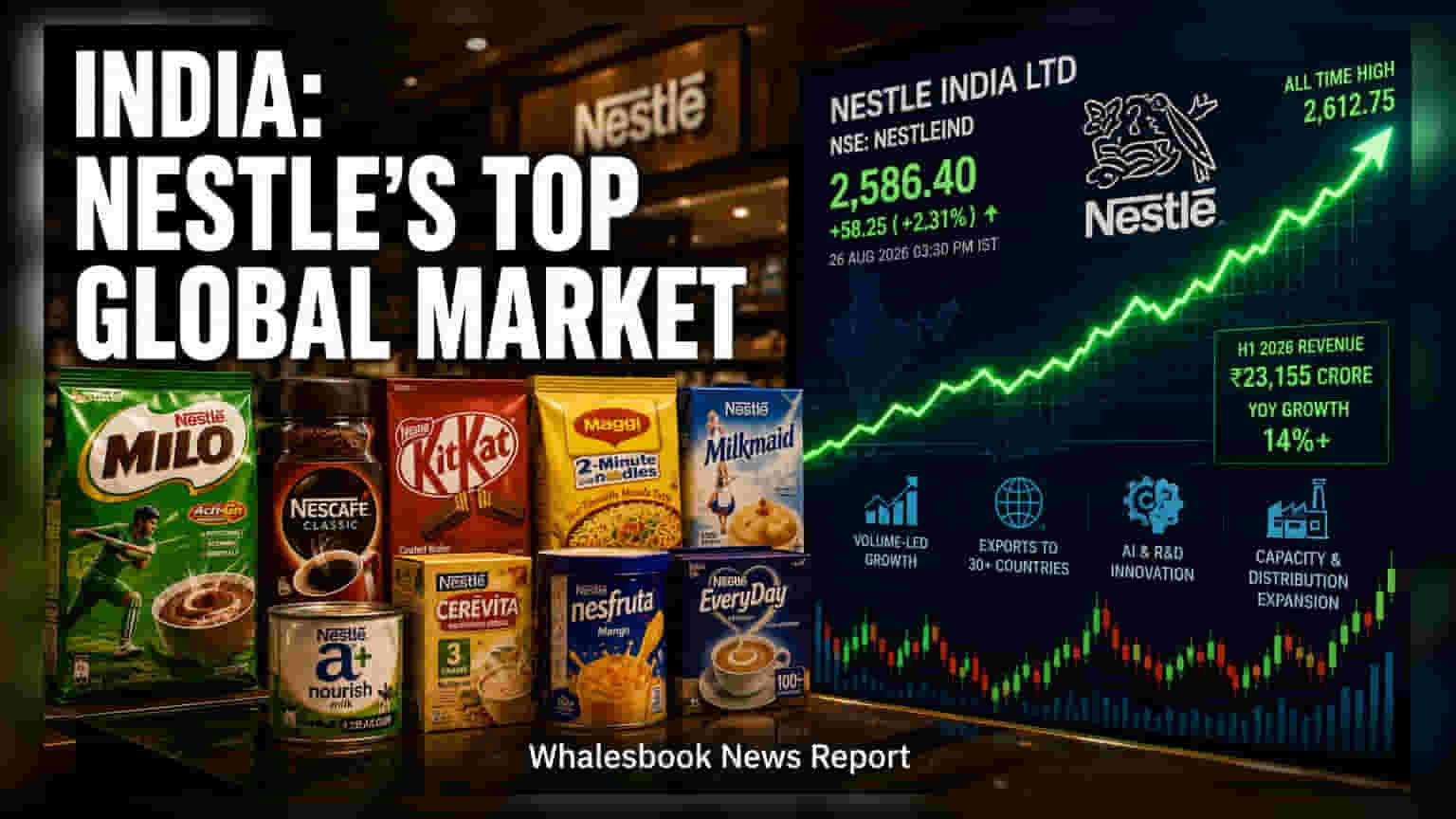
Nestle India has emerged as the company's fastest-growing market globally for the first half of 2026, with revenue exceeding Rs 23,155 crore. The company is prioritizing volume-led expansion to drive growth while navigating competitive pressures. Investors are watching how this strategy balances against recent regulatory demands and raw material cost fluctuations.
Nestle India has cemented its position as the company’s highest-performing market globally for the first half of 2026. Global CEO Philipp Navratil, during his recent visit to India, identified the country as a critical growth engine that is currently moving toward the company's top five global markets. For the fiscal year ending in 2026, the company reported revenue of approximately Rs 23,155 crore, reflecting a year-on-year growth rate of over 14%.
Focus on Volume-Led Growth
A key highlight of this performance is the company's strategy of 'real internal growth.' Instead of relying on inflation-driven price increases, Nestle is focusing on selling higher volumes of products across its mass and premium ranges. By targeting the rising middle class and increasing urbanization, the company aims to sustain long-term demand. This approach is supported by significant capital spending on manufacturing capacity and distribution networks, which the company views as necessary to capture the expansion of the Indian consumer market.
Beyond domestic consumption, Nestle is increasingly using India as a strategic base for its global operations. The local units are now acting as export hubs, shipping goods to more than 30 countries. Furthermore, the company is utilizing Indian R&D expertise to develop global product lines and incorporating artificial intelligence into its internal processes to improve efficiency. This shift suggests that India is being integrated as a core center for global capability rather than just a regional sales point.
Risks and Monitorables
While the growth trajectory appears strong, the company faces several operational and external challenges. Competition remains a significant pressure, requiring the company to continuously reinvest in its product mix and distribution. Additionally, fluctuations in the prices of raw materials, such as milk, grains, and packaging supplies, can directly impact profit margins. Investors also keep a close watch on regulatory developments, which can affect business operations.
For instance, the company recently disclosed in an August 26, 2026, regulatory filing that it received a Customs demand order of approximately Rs 2.46 crore, along with an equal amount in penalties. Such regulatory compliance issues and tax-related matters are standard monitorables for companies in the consumer goods space. Despite these pressures, Nestle India maintains a stable financial position, characterized by being nearly debt-free and having a consistent history of dividend payouts.
Looking ahead, the market will monitor whether the company can maintain its volume-led growth momentum without compromising on profitability. Key factors for shareholders will be the execution of planned capital projects, the stability of raw material costs, and the company's ability to resolve ongoing regulatory or litigation matters efficiently.