 Whalesbook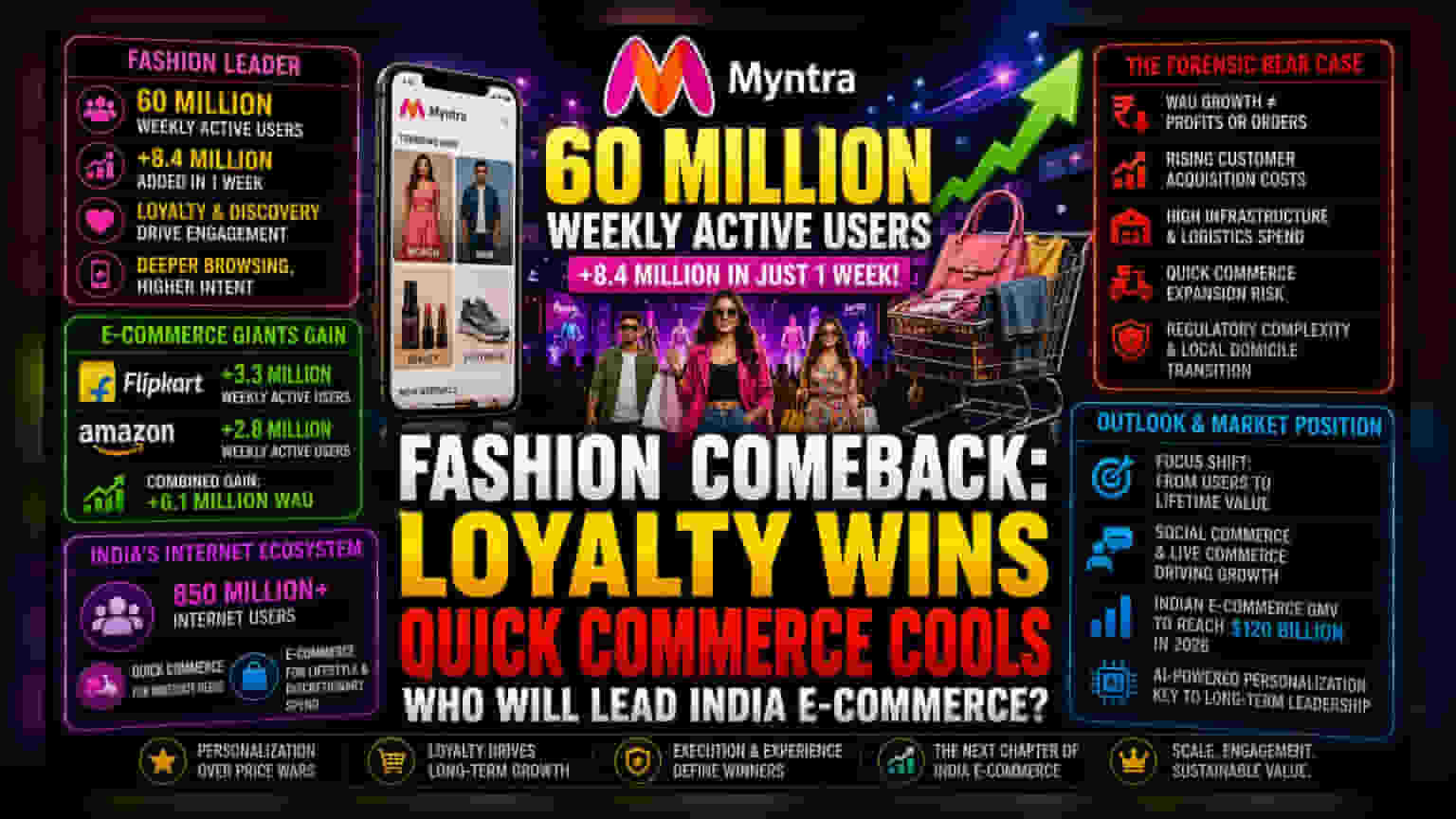


The Shift Toward Fashion-First Platforms
The digital retail environment is undergoing a notable recalibration as consumer preferences pivot back toward established fashion e-commerce platforms. Myntra’s ascent to 60 million weekly active users (WAU) signals that despite the hype surrounding quick-commerce, long-form e-commerce remains the primary engine for discretionary fashion and lifestyle spending. This surge, adding 8.4 million users in a single week, underscores a successful execution of loyalty-driven retention and deeper product discovery, contrasting sharply with the cooling engagement seen in high-velocity quick-delivery models.
Analytical Comparison of User Engagement
While Myntra capitalizes on a massive existing base, the competitive landscape shows clear fragmentation. Nykaa, which has long relied on the premium beauty segment, continues to struggle with sequential weekly user declines, suggesting that the convenience-first quick-commerce model may be cannibalizing interest in traditional beauty retail. Conversely, the broader e-commerce market led by Flipkart and Amazon continues to demonstrate resilience, with combined weekly user gains exceeding 6 million. This trend indicates that India’s 850 million internet users are bifurcating their behavior: using quick-commerce for immediate needs and returning to legacy marketplaces for varied, non-essential assortments.
The Forensic Bear Case: Scale vs. Profitability
Investors should remain cautious despite headline growth. A rise in WAU does not inherently map to increased order volumes or net profitability. As Myntra and its parent, the Walmart-backed Flipkart Group, continue to invest heavily in AI-driven personalization and logistics to defend their market share, the cost of acquisition is likely rising. Unlike lean-model competitors that operate with significantly lower overhead, the Flipkart ecosystem carries the weight of massive warehousing and infrastructure expenditures. Furthermore, the quick-commerce sector, though currently showing a slight dip, remains a structural threat; if platforms like Blinkit successfully expand their fashion and lifestyle inventory, the value proposition for dedicated fashion apps could be diluted. Furthermore, the regulatory environment for large marketplaces remains complex, as Flipkart continues its transition toward local domicile, adding layers of operational uncertainty.
Sectoral Outlook and Market Position
Looking ahead, the focus for Myntra and its peers is shifting from raw user acquisition to increasing per-user lifetime value. With the Indian e-commerce gross merchandise value (GMV) projected to reach $120 billion in 2026, companies are increasingly relying on cross-selling and social-commerce integrations—such as WhatsApp-led shopping and live-commerce events—to sustain growth. The current data suggests that the sector has moved past the initial 'discount-at-all-costs' phase, with winners defined by their ability to offer personalized, tech-enabled experiences rather than just massive inventory breadth.