

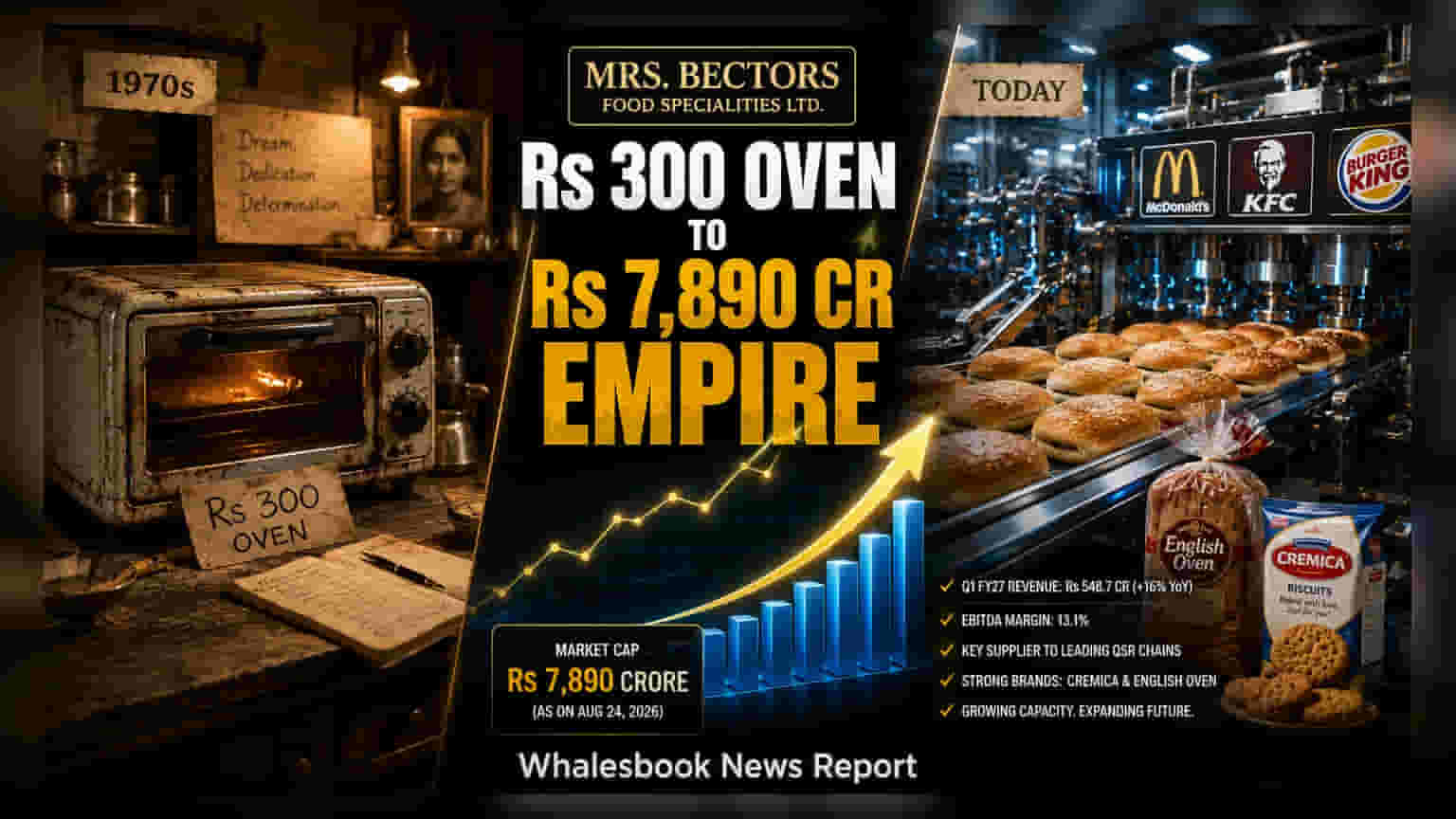
Mrs Bectors Food Specialities has grown from a home-based venture into a Rs 7,900 crore FMCG firm, supported by strong Q1 FY27 financial results. The company recently saw institutional interest from Abakkus and a leadership change, though competitive pressures and raw material costs remain key factors for investors to monitor.
The journey of Mrs Bectors Food Specialities is a notable story of growth in the Indian FMCG sector. Founded in the 1970s by Rajni Bector with a simple Rs 300 oven, the company has transformed into a publicly traded entity with a market capitalization of approximately Rs 7,900 crore as of August 24, 2026. Today, the business is a key supplier for major restaurant chains like McDonald’s, KFC, and Burger King, while maintaining a strong consumer footprint through its brands, Cremica and English Oven.
Financial Performance and Growth
The company’s recent operational performance suggests steady growth. In its Q1 FY27 financial results, Mrs Bectors reported consolidated revenue of Rs 548.7 crore, marking a 16% increase compared to the previous year. Profitability also showed improvement, with an EBITDA margin of 13.1%. This growth reflects the company’s ability to scale its production capacity and reach a wider market, moving beyond its traditional regional stronghold.
Institutional Interest and Leadership Changes
Recent developments have brought added attention to the company’s stock. In July 2026, Abakkus Investment Managers, led by Sunil Singhania, acquired a stake in the business, which generated positive sentiment among market participants. Following this, the company announced a key leadership change, appointing Anshul Rastogi as its new Chief Financial Officer effective August 7, 2026. For investors, these changes represent an evolution in the company’s corporate governance as it looks to manage its expanding operations.
Risks and Operational Challenges
While the company has shown consistent growth, investors should be aware of the challenges inherent in the FMCG sector. One primary risk is the volatility in raw material prices, such as wheat, sugar, and edible oils, which can directly impact profit margins if the company cannot pass these costs to customers. Additionally, the Indian bakery and biscuit market is highly competitive. The company must constantly innovate and maintain quality to protect its market share against both large established players and local competitors.
Another point of focus is the operational risk associated with capacity expansion. Scaling up production units requires precise execution to ensure that new plants are utilized effectively. If these projects face delays or do not achieve the expected output, it could put pressure on the company’s cash flow. Moving forward, shareholders may track how the new management team navigates these competitive pressures and whether the company can maintain its margin levels while scaling up its operations.