 Whalesbook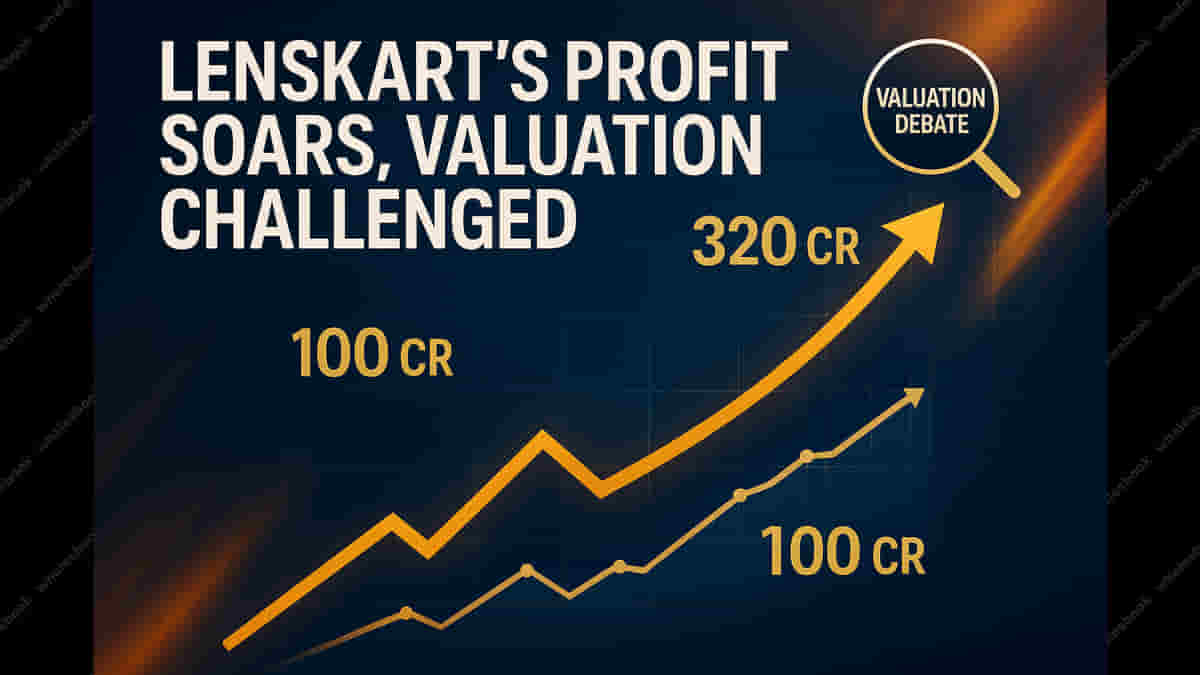
Lenskart Solutions Ltd. has announced robust financial results for the second quarter of fiscal year 2026, showcasing significant growth in both its bottom line and top line.
Financial Highlights
- The company's net profit surged by 19.6% year-on-year, reaching Rs 102 crore in Q2 FY26, up from Rs 85.5 crore in the same period last year.
- Revenue for the quarter saw a healthy increase of 20.8%, totalling Rs 2,096 crore compared to Rs 1,736 crore in the corresponding quarter of FY25.
- Earnings Before Interest, Taxes, Depreciation, and Amortisation (EBITDA) demonstrated substantial growth, increasing by nearly 45% to Rs 415 crore from Rs 287 crore.
- The EBITDA margin expanded significantly to 19.8%, a notable improvement from the 16.5% recorded in the comparable quarter of the previous fiscal year.
Segmental Performance
- Lenskart's revenue growth was broad-based, with both its Indian and international operations contributing positively.
- The Indian segment generated Rs 1,230 crore in revenue, an increase from Rs 1,088.7 crore in Q2 FY25.
- The international segment also showed strong performance, with revenue growing from Rs 658.36 crore in Q2 FY25 to Rs 879.64 crore in Q2 FY26.
IPO Context and Valuation Concerns
- These results follow Lenskart's recent public offering, which analysts have described as having a "tepid listing".
- The company was valued at approximately $8 billion (around Rs 70,000 crore) during its IPO process.
- Lenskart had priced its Initial Public Offering (IPO) in the range of Rs 382 to Rs 402 per share.
- This pricing implied a very high price-to-earnings (P/E) ratio of about 285 times its fiscal year 2025 profit of Rs 297 crore, which is considerably higher than global and domestic industry peers.
- Analysts, including those at Ambit Capital, have flagged this steep valuation as potentially "unwarranted".
- Ambit Capital noted that Lenskart's India business trades at an implied 55 times its estimated financial year 2028 EV/Ebitda, placing it 20-30% higher than comparable consumer peers like Trent and Nykaa's beauty and personal care segment.
- Concerns stem from the company's modest profitability and its substantial capital requirements.
Stock Price Movement
- On Friday, Lenskart's stock closed 0.67% higher at Rs 410.45 per share on the National Stock Exchange (NSE).
- This performance contrasted with a 0.05% decline in the broader Nifty Index on the same day.
- Lenskart's shares were listed on the exchanges on November 10th.
Impact
- The strong financial performance is a positive sign for Lenskart's operational health, potentially supporting its current valuation.
- However, the continued debate around its high valuation by analysts may create investor sentiment challenges and volatility for the stock moving forward.
- The company's ability to sustain growth and improve profitability will be key to justifying its market valuation.
Difficult Terms Explained
- Net Profit: The profit remaining after all expenses, including taxes and interest, have been deducted from total revenue.
- Revenue: The total income generated by a company from its primary business activities before deducting any expenses.
- EBITDA (Earnings Before Interest, Taxes, Depreciation, and Amortisation): A measure of a company's operating performance that excludes interest, taxes, depreciation, and amortisation expenses.
- EBITDA Margin: Calculated by dividing EBITDA by revenue, it indicates how much profit a company generates from its core operations as a percentage of its sales.
- IPO (Initial Public Offering): The process by which a private company offers its shares to the public for the first time, becoming a publicly traded entity.
- Valuation: The estimated economic worth of a company, often determined by market demand, financial performance, and future prospects.
- Price-to-Earnings (P/E) Ratio: A valuation ratio that compares a company's share price to its earnings per share (EPS). It indicates how much investors are willing to pay for each dollar of earnings.
- EV/EBITDA: Enterprise Value to EBITDA ratio. Enterprise Value includes market capitalization plus debt, minority interest, and preferred shares, minus cash and cash equivalents. It's a more comprehensive valuation metric than P/E.