 Whalesbook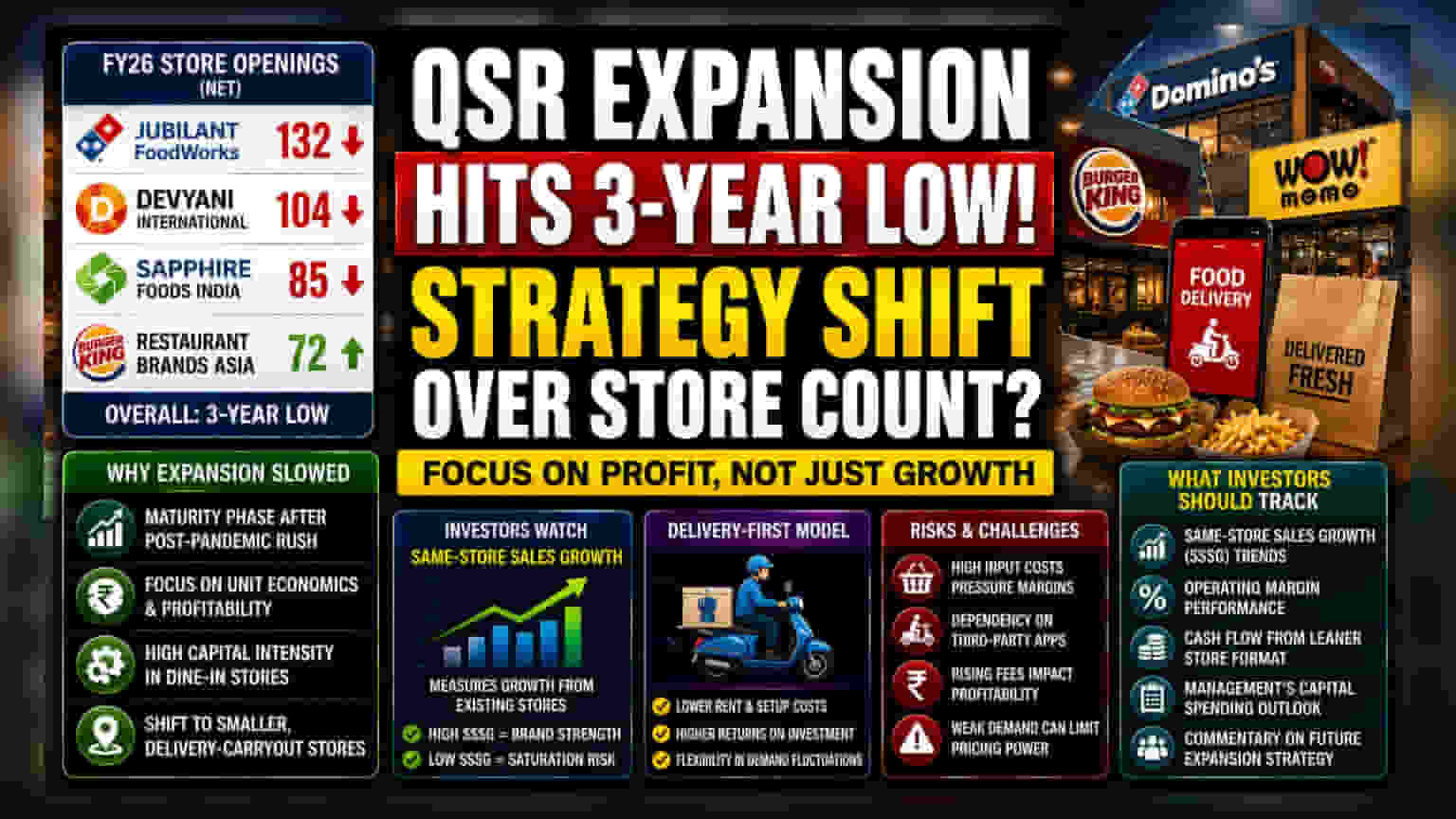


Major Indian QSR chains like Jubilant FoodWorks, Devyani International, and Sapphire Foods have slowed new store openings in FY26 to a three-year low. This strategic pivot marks a transition from aggressive physical growth to optimizing existing operations, improving same-store sales, and enhancing unit economics. Investors are shifting their focus from store count to sustainable profitability in a competitive, inflation-sensitive market.
What Happened
India’s major Quick Service Restaurant (QSR) chains have significantly slowed down their physical expansion pace, with net store openings hitting a three-year low in the fiscal year ending March 2026. This deceleration signals a cooling off period after the rapid, post-pandemic growth phase seen in FY22 and FY23. Data indicates that companies like Jubilant FoodWorks, which manages the Domino’s chain, along with Devyani International and Sapphire Foods, all added fewer new outlets compared to previous years. In contrast, Restaurant Brands Asia, the operator of Burger King in India, saw a slight uptick in expansion after a period of slower growth.
The Strategic Shift
The move to scale back is not necessarily a sign of business weakness, but rather a deliberate change in strategy. After aggressively opening new locations to capture market share immediately after the pandemic, these companies are now hitting a maturity phase. The primary objective has shifted toward improving 'unit economics'—a simple term for ensuring that each individual store is profitable and efficient. By reducing the number of new openings, companies are aiming to protect their profit margins and reduce the strain on capital that comes with setting up large dine-in restaurants.
Why Investors Are Watching Same-Store Sales
For investors, the most important metric is shifting from 'store count' to 'Same-Store Sales Growth' (SSSG). This figure measures the sales growth from restaurants that have been open for more than a year. When a company stops opening new stores at a rapid pace, the health of the business depends entirely on whether existing stores are selling more products to customers. High SSSG indicates strong brand loyalty and pricing power, while declining SSSG could signal that the brand is losing appeal or that the market is becoming saturated.
The Delivery-First Model
Another major reason for the slowdown is the changing consumer behavior toward online food delivery. Brands are finding that they do not need large, expensive dine-in spaces in prime locations to generate sales. Many companies are now favoring smaller 'delivery-carryout' stores, which require less space and lower investment. This model helps companies keep their rental and operational costs in check, allowing them to remain profitable even if customer spending on luxury or discretionary items fluctuates.
Risks and Challenges
While this focus on efficiency is generally viewed as a move toward stability, it does come with risks. The sector is still battling high input costs, such as the prices of raw materials like cheese, vegetables, and packaging. If these costs rise further and companies are unable to pass them on to customers due to weak demand, profit margins could come under pressure. Additionally, relying heavily on online delivery channels leaves these companies vulnerable to the fee structures and policies of third-party delivery apps. If delivery platforms change their pricing, it could directly impact the profitability of these QSR chains.
What Investors Should Track
Going forward, investors should look beyond just the number of stores a company opens. The key monitorable will be the company's operating margin performance and whether the shift to smaller, delivery-focused stores is effectively boosting cash flow. Updates on SSSG in quarterly filings will be essential to understand if the brands are retaining their customer base. Finally, management commentary regarding their capital spending plans will indicate whether they intend to restart aggressive expansion or continue prioritizing leaner, more profitable operations in the medium term.