 Whalesbook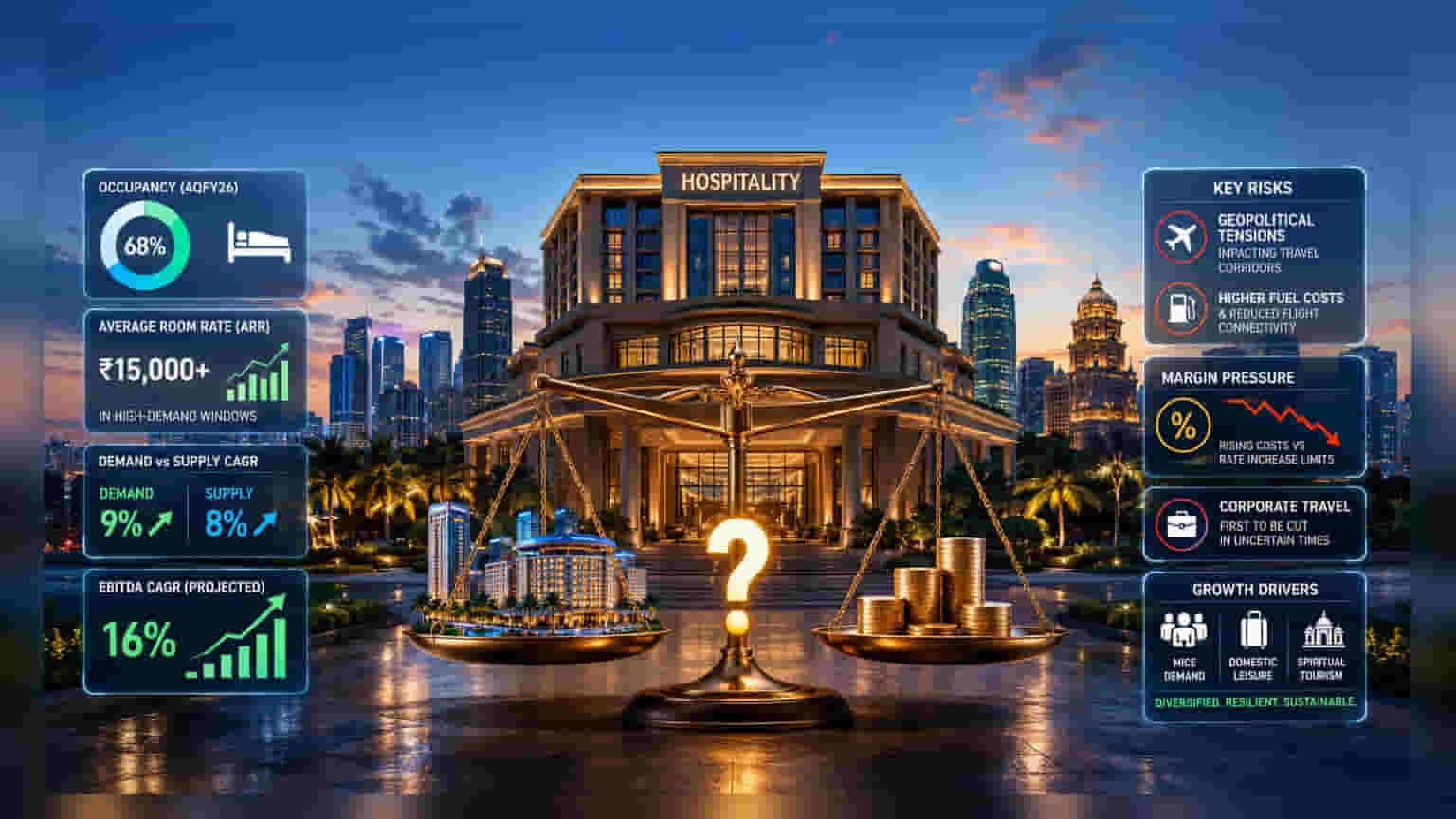


The Valuation Gap
The Indian hospitality sector is currently navigating a complex transition from high-growth post-pandemic recovery to a more tempered phase of stabilization. Market sentiment, recently cooled by geopolitical volatility, remains tied to the normalization of travel corridors. While the broader Nifty 50 has demonstrated resilience at all-time highs, individual hospitality players face a nuanced reality where top-line growth is increasingly sensitive to global risk factors rather than just domestic buoyancy. The projected 16% EBITDA CAGR relies heavily on the assumption that foreign tourist arrivals will revert to pre-conflict levels, providing a vital lift to existing premium occupancy rates.
The Analytical Deep Dive
When benchmarking against current market conditions, the sector exhibits a clear divergence in performance. While major metropolitan hubs like Mumbai and Delhi have maintained robust Average Room Rates (ARR)—occasionally exceeding ₹15,000 in specific high-demand windows—the recent 4QFY26 data indicates a softening in overall occupancy to approximately 68%. This performance reflects a broader regional trend where commercial activity, particularly in business hotel segments, has experienced a lull due to project delays and a cautious corporate travel stance. Unlike the rapid expansion observed in 2024, current supply growth is characterized by a disciplined approach, with new inventory additions remaining consistent at 13,000–15,000 keys annually. This structural supply-demand imbalance, where demand is forecasted to grow at a 9% CAGR against an 8% supply increase, remains the strongest fundamental pillar supporting long-term pricing power.
The Forensic Bear Case
Investors should remain cognizant of the fragility inherent in this recovery. The hospitality industry remains uniquely vulnerable to external shocks, as evidenced by the 15–20% decline in inbound traffic reported earlier this year. Risks are twofold: structural and geopolitical. Firstly, the reliance on Middle Eastern air corridors for transit remains a significant point of failure; any flare-up in regional tensions immediately translates to higher fuel costs and reduced flight connectivity, directly impacting visitor volume. Secondly, management teams are under increasing pressure to sustain margins that have risen substantially from pre-pandemic levels of 20% to the current 34–36% range. Should operational costs—driven by energy and staffing inflation—outpace the ability to increase rates, margin compression is a near certainty. Furthermore, historical data confirms that during periods of heightened uncertainty, corporate travel expenditure is the first line item to be curtailed, creating a volatile revenue floor for business-heavy hotel chains.
The Future Outlook
Forward-looking sentiment remains cautiously optimistic, predicated on the abatement of geopolitical noise. With large-scale events, MICE (Meetings, Incentives, Conferences, and Exhibitions) demand, and domestic leisure travel acting as the sector's primary shock absorbers, analysts maintain that the medium-term growth trajectory remains intact. Success in FY2027 will likely be defined by the industry's ability to diversify revenue streams away from transit-dependent international arrivals and toward resilient domestic and spiritual tourism circuits, which continue to show structural growth.