 Whalesbook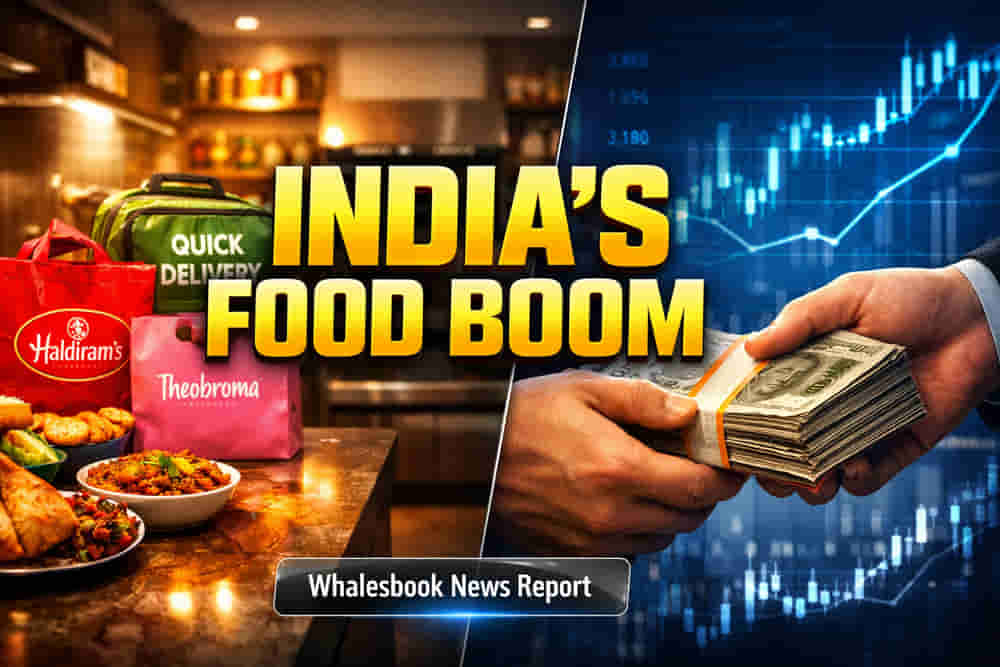
THE SEAMLESS LINK
The robust influx of private equity capital into India's food and beverage (F&B) sector is not merely a response to broad market growth but a strategic pivot toward leveraging new operational models and demographic shifts for accelerated consolidation and value creation. This investment wave underscores a fundamental recalibration of how value is unlocked in the Indian consumer space, moving beyond traditional distribution challenges to embrace tech-enabled scalability and the spending power of younger generations.
The Scalability Revolution: Tech and Demographics Redefine F&B PE
The Indian food and beverage sector is experiencing unprecedented investor interest, projected to grow substantially from $354.5 billion in 2024 to $535 billion by the end of fiscal year 2026. This expansion is critically underpinned by two transformative forces: the rapid scalability offered by quick commerce platforms and the distinct spending habits of millennials and Gen Z. Quick commerce has fundamentally dismantled historical distribution bottlenecks, enabling brands to launch, test, and scale operations in months rather than years, a proposition highly attractive to private equity seeking agile deployment. Concurrently, younger demographics, digitally native and ingredient-aware, are prioritizing convenience and trust, demonstrating a willingness to pay premium prices for curated products. This convergence creates fertile ground for PE firms looking to build category leaders capable of outperforming industry averages, with some investors aiming for growth rates 1.5 to 2 times the sector's norm.
Valuations and Deal Dynamics: A Midas Touch for Indian F&B
Recent transactions highlight the sector's hot market. Haldiram Snacks Food achieved a $10 billion valuation following minority stake investments from Temasek, International Holding Company (IHC), and Alpha Wave Global. In parallel, ChrysCapital secured an 85% controlling stake in the bakery chain Theobroma Foods, while Devyani International, a major quick-service restaurant (QSR) operator, acquired a majority stake in Biryani By Kilo's parent company. The broader Indian consumer sector saw M&A and PE deals reach a three-year high in early 2025, with F&B leading the surge in value. India's PE-VC investment market itself saw a rebound in 2024, totaling approximately $43 billion, with buyouts gaining prominence.
The Structural Shift: From Distribution Headaches to Digital Pipelines
The rise of platforms like Swiggy and Zomato (now Eternal) has normalized online food ordering and dining out, transforming them from occasional indulgences into mainstream habits. This shift directly addresses one of the traditional pain points for F&B businesses: reaching consumers efficiently. Quick commerce and food aggregators have created a digital pipeline, allowing brands to bypass extensive physical distribution networks and connect directly with a vast, digitally-savvy consumer base. This is particularly impactful for millennials and Gen Z, who are accustomed to immediate gratification and seamless online experiences. Their influence is substantial, currently driving $860 billion in consumer spending and projected to reach $1.4 trillion by 2030, representing nearly 43% of household consumption.
The Forensic Bear Case: Overvaluation and Execution Risks
Despite the robust deal activity, several factors warrant caution. While F&B brands command high valuations, publicly listed entities present a mixed financial picture. Devyani International, for instance, operates with a highly elevated P/E ratio, reported as -483.02 and -465.8x, indicating net losses and significant investor optimism priced into its shares. Its market capitalization stood at approximately ₹16,268.98 crore as of early 2026, with ₹372 crore in debt. This suggests a reliance on future growth to justify current valuations. Furthermore, overall PE investment in India showed a slowdown in late 2025, with Q3 2025 investment at $14.9 billion, potentially indicating a more cautious deployment environment. While investor interest remains strong due to India's macro factors, the preference for buyouts and control deals may suggest a move away from minority stakes in high-growth, less proven entities. The rapid pace of consolidation also brings execution risks, as integrating acquisitions and achieving projected synergies can prove challenging.
Future Outlook: Consolidation and Category Leadership
Looking ahead, investor capital is expected to increasingly favor branded, scalable platforms with predictable unit economics. The ongoing acceleration of consolidation suggests the F&B sector is solidifying its position as a core component of India's consumer private equity playbook. Investors will likely continue to seek category leaders capable of sustained, above-average growth, leveraging technology and demographic trends to drive profitability. While regional concepts will continue to fuel the deal pipeline, the focus remains on building dominant, scalable brands.