

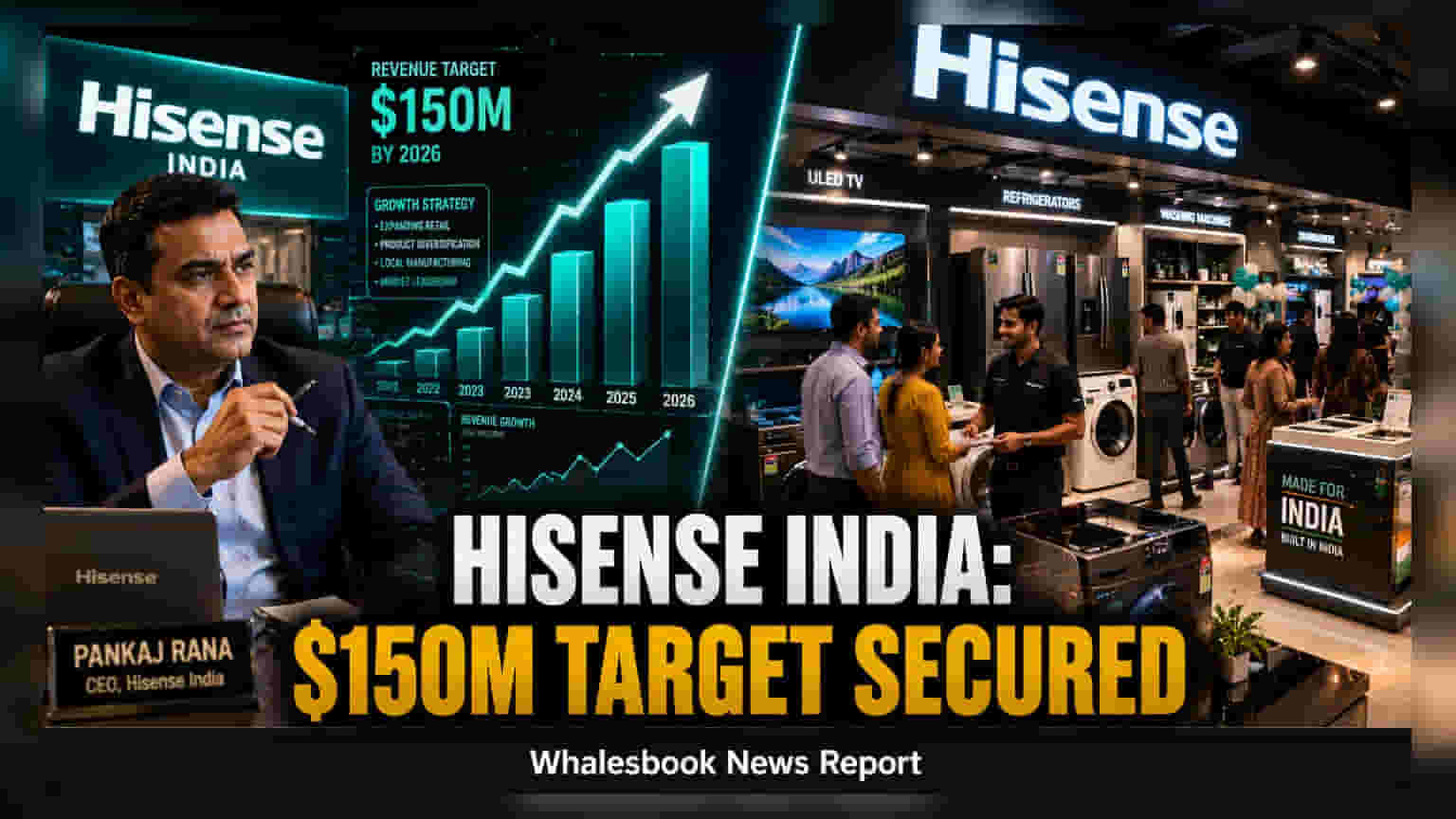
Hisense India aims to reach $150 million in annual revenue by 2026, driven by a push to expand its offline retail network to 15,000 outlets. The company is diversifying its portfolio beyond televisions into washing machines and refrigerators. Investors in the consumer durables sector should monitor the competitive landscape as the firm challenges established market leaders.
Hisense India has announced an ambitious growth strategy, targeting $150 million in annual revenue by 2026. As a subsidiary of the Chinese multinational Hisense Group, the company is shifting its focus significantly toward offline retail. While online sales have been a primary channel for many electronics brands, Hisense India now expects physical stores to drive 70% of its total sales within the next two years.
To support this target, the company plans to increase its retail presence from the current 4,000 outlets to 15,000. This expansion is designed to make products more accessible to a wider customer base and allows the brand to showcase its growing catalog in physical experience centers, such as the one recently opened in Gurugram.
Beyond its core television business, where it currently holds an estimated 3-3.5% market share, Hisense is actively diversifying. The company is scaling up its presence in the washing machine segment, with goals to become a top-five player, and is also expanding into refrigerators, dishwashers, and small home appliances. Its manufacturing facility in Sri City, Andhra Pradesh, plays a crucial role in this strategy by supporting local production, which helps in managing supply chains and potentially improving profit margins by reducing import dependence.
However, the Indian consumer durables sector is notoriously competitive. The market is dominated by well-entrenched global players like LG and Samsung, as well as several strong local brands. For Hisense, the challenge lies in winning brand loyalty and shelf space against these incumbents who have spent decades building their distribution networks and service infrastructure. Expanding from 4,000 to 15,000 stores is a significant logistical and financial undertaking, and the success of this strategy will depend on the company's ability to execute its retail expansion without compromising on profitability.
Additionally, the consumer electronics industry faces recurring risks, including fluctuations in raw material prices and foreign exchange volatility, which can impact margins. The company's performance will also depend on broader economic trends in India, specifically whether consumer demand for premium and mid-range home appliances remains steady. Because Hisense India operates as a private entity, it does not have publicly traded shares on Indian exchanges, meaning there is no direct stock market impact for investors. However, the company's performance serves as an important indicator of the intensity of competition and the changing trends in India's home appliance market. The key monitorable for the industry will be the company’s ability to gain market share in the washing machine and refrigerator categories while successfully scaling its physical retail network.