

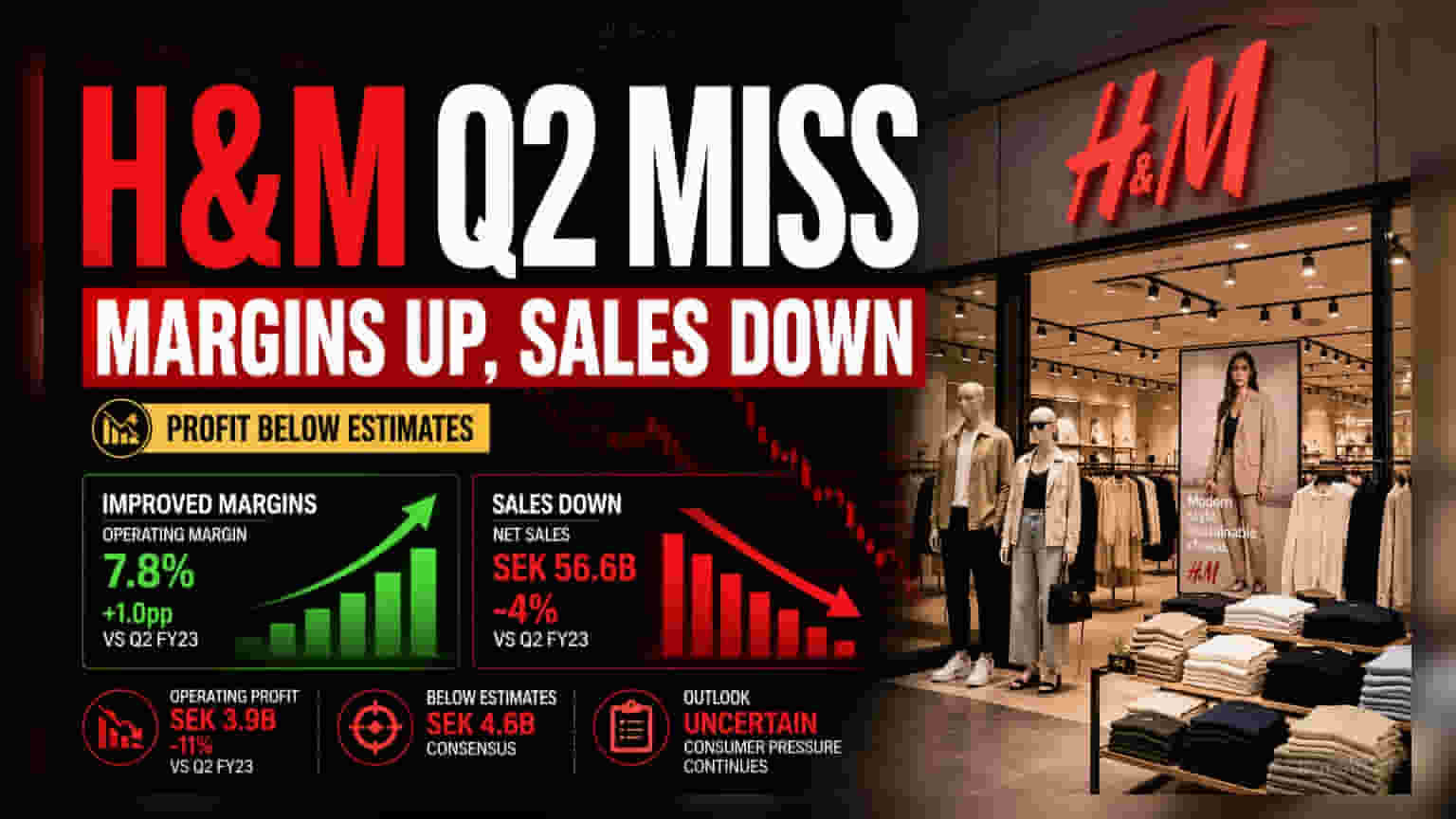
Swedish fashion retailer H&M reported a quarterly operating profit of 5.91 billion kronor, falling short of analyst targets as stricter inventory management limited sales. While profit margins improved to 12% due to operational efficiencies, the brand faces persistent demand challenges and intense competition from rivals.
What Happened
H&M Group’s second-quarter earnings report, covering the March-May period, showed a mixed performance. The company reported an operating profit of 5.91 billion kronor. This figure remained unchanged from the previous year and fell short of the 6.38 billion kronor that analysts had expected. While the retailer’s efforts to improve profitability through better inventory control and reduced store complexity yielded some results, these were offset by a decline in net sales, which fell to 54.8 billion kronor from 56.7 billion kronor a year ago. H&M noted that its tighter inventory management, while efficient, had in some cases limited its ability to fully meet customer demand.
The Efficiency Trade-Off
The core of the company’s current strategy, led by CEO Daniel Ervér, is to move toward a more profitable, sustainable model. When excluding one-time restructuring costs of 679 million kronor related to organizational changes, operating profit actually rose by 11% to 6.59 billion kronor. This boosted the operating margin to 12%, up from 10.4% in the same period last year. This suggests that while H&M is becoming more efficient at managing its costs and stock levels, it is struggling to find the right balance between cost control and sales growth. The company indicated that revenue in June is expected to remain on par with last year, signaling that consumer demand remains cautious.
Competition And Sector Pressure
H&M continues to navigate a fiercely competitive fast-fashion environment. The company is under constant pressure from major rivals like Inditex (the owner of Zara) and newer players like Shein, which utilize faster production cycles and aggressive supply chain strategies. As consumers increasingly prioritize value and speed, H&M is working to shorten lead times and refine its product offerings. However, the retail sector as a whole is grappling with cautious consumer spending and shifting preferences toward ultra-fast fashion and secondhand markets, which poses a continuous challenge to traditional apparel retailers.
Context For Indian Investors
While H&M is not listed on Indian stock exchanges, its performance offers valuable insights for Indian investors interested in the retail sector. H&M has a significant presence in India, with 64 stores and annual revenue exceeding ₹3,200 crore as of FY24. The brand competes directly in India with global giants like Zara (operated via a joint venture with the Tata Group) and Uniqlo, as well as several large domestic apparel chains. The global shift toward margin-focused retail, even at the cost of immediate revenue, is a trend seen across various global fashion brands operating in India. Indian investors monitoring the retail space often watch these global trends to gauge how local players—like Trent or Reliance Retail—might adjust their inventory, discounting, and expansion strategies to maintain market share.
What To Watch Next
The primary concern for investors remains whether H&M can pivot from this margin-focused phase back to consistent top-line growth. Key monitorables include the company’s ability to balance its leaner inventory approach with demand, the impact of its ongoing store optimization, and whether it can regain sales momentum in a challenging macroeconomic environment. Management's upcoming commentary on global demand trends and expansion plans in new markets will be crucial for understanding the sustainability of these margin improvements.